Fumimaro Konoe
| Name | Fumimaro Konoe |
| Title | Japanese politician (1891–1945) |
| Gender | Male |
| Birthday | 1891-10-12 |
| nationality | Japan |
| Source | https://www.wikidata.org/wiki/Q315594 |
| pptrace | View Family Tree |
| LastUpdate | 2025-11-17T06:47:34.775Z |
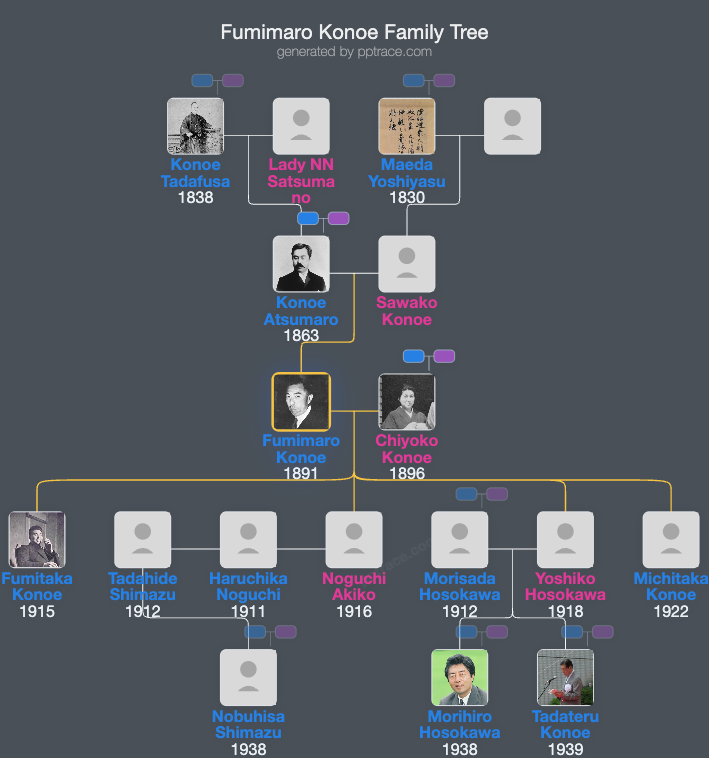
Family Tree
Tap  to expand more relatives
Introduction
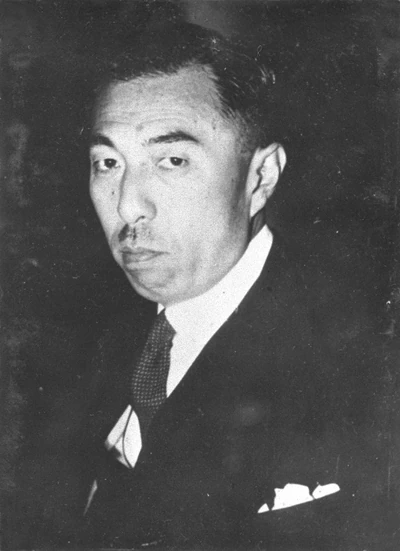
Fumimaro Konoe (近衞 文麿, Konoe Fumimaro) was born on October 12, 1891, in Tokyo, Japan, and died on December 16, 1945. He was a member of the prominent Konoe family, a branch of the Fujiwara aristocratic lineage. His family positioned him as the head of one of Japan’s most prestigious noble houses, originally established as part of the Five Regent Houses (go-sekke) following the division of the Fujiwara clan.
Konoe’s father, Atsumaro Konoe, was involved in political activism, including organizing the Anti-Russia Society in 1903. Fumimaro's mother died shortly after his birth; his father later married her younger sister. Upon his father's death in 1912, Konoe inherited his aristocratic title, kōshaku (prince), along with debt. His family was financially supported by the Sumitomo zaibatsu, which facilitated adjustments to his family's financial situation through the auctioning of heirlooms.
He attended Taimei Elementary School and Gakushuin, educational institutions for Japan’s nobility. He enrolled at the First Higher School, a university preparatory school, and later studied philosophy at Tokyo Imperial University. Subsequently, he transferred to the law department of Kyoto Imperial University, where he was influenced by the Marxist economist Hajime Kawakami and developed an interest in socialism.
During his university years, Konoe met Saionji Kinmochi, a genrō (elder statesman), whom he considered a mentor. After graduation, he briefly worked at the home ministry and was part of Japan's delegation at the Versailles Peace Conference in 1919. During this time, he published an essay criticizing Western hypocrisy regarding democracy and imperialism, notably opposing the League of Nations' racial equality clause.
In 1916, while still a student, Konoe took his father's seat in the House of Peers, the upper house of the Imperial Diet. He became involved in political factions including the kenkyukai, a conservative, militarist group led by Yamagata Aritomo. By supporting parties like the seiyukai, he aligned himself with the faction advocating for the preservation of noble privileges and stability.
Konoe was a member of the Japanese delegation at the Paris Peace Conference, where he proposed the Racial Equality Proposal for the League of Nations' Covenant. Although Japan's proposal was rejected, he viewed this as a significant setback. His diplomatic activities included observations on anti-Japanese sentiment in the United States and rivalries with China.
In his political career, Konoe served as president of the House of Peers from 1933 to 1937. His first term as Prime Minister began in June 1937, appointed on the recommendation of Saionji Kinmochi. His tenure coincided with the escalation of the Second Sino-Japanese War following the Marco Polo Bridge Incident in July 1937. During his premiership, he oversaw military campaigns and enacted the State General Mobilization Law in 1938, expanding government control over civilians. He resigned in January 1939 amid military setbacks in China.
Following his resignation, Konoe served as chairman of the Privy Council until he became Prime Minister again in July 1940. During this second term, he established the Imperial Rule Assistance Association, signed the Tripartite Pact with Germany and Italy, and oversaw military actions such as the invasion of French Indochina, recognition of Wang Jingwei's puppet government in Nanjing, and the signing of the Soviet–Japanese Neutrality Pact.
Despite diplomatic efforts to resolve tensions with the United States, the military’s rigid timetable and his own inflexibility contributed to the path toward war. Konoe resigned in October 1941, replaced by Hideki Tojo. He remained an advisor to Emperor Hirohito throughout World War II and played a significant role in the fall of the Tojo cabinet in 1944.
In the final months of the war, during the Allied occupation, Konoe briefly served as a minister in Prince Naruhiko Higashikuni's cabinet. He was suspected of war crimes, and on December 16, 1945, he committed suicide by ingesting cyanide before he could be arrested by authorities.