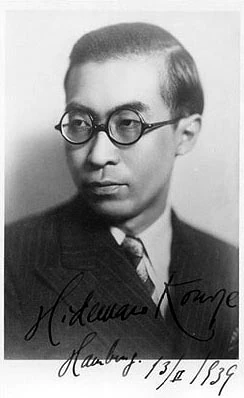
Hidemaro Konoye
| Name | Hidemaro Konoye |
| Title | Japanese composer and conductor |
| Gender | Male |
| Birthday | 1898-11-18 |
| nationality | Japan |
| Source | https://www.wikidata.org/wiki/Q1781834 |
| pptrace | View Family Tree |
| LastUpdate | 2025-11-17T06:47:45.863Z |
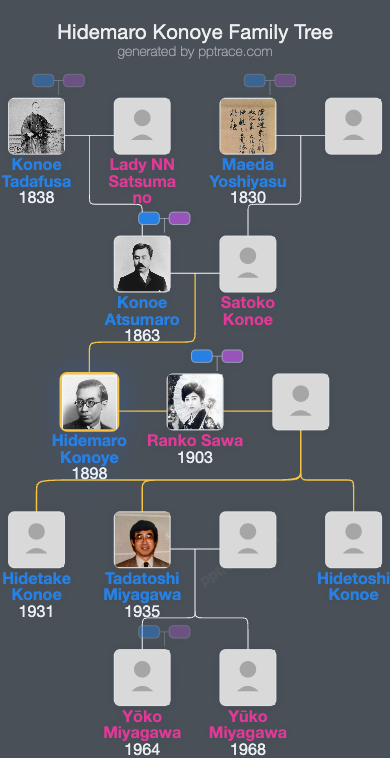
Family Tree
Tap  to expand more relatives
Introduction
Viscount Hidemaro Konoye (近衛 秀麿, Konoe Hidemaro) was born on November 18, 1898, in Kōjimachi, Tokyo, and died on June 2, 1973. He was a Japanese conductor and composer of classical music. Konoye was the younger son of Duke Konoe Atsumaro, a member of one of the Five Regent Houses of the Fujiwara clan, an aristocratic family historically responsible for providing gagaku musicians to the Imperial Household.
Despite his family's traditional association with music, Konoye pursued a career in music rather than politics, which was the preferred path of his family. His interest was supported by his older brother, Fumimaro Konoe, who was a prominent politician and served as Prime Minister of Japan before World War II.
Konoye attended the Gakushuin Peers School, where he developed close friendships with peers such as Takashi Inukai. During his early years, he visited the Tokyo Music School frequently and received private instruction from the composer Kosaku Yamada. After graduating from Gakushuin, he enrolled at Tokyo Imperial University to study literature but withdrew due to loss of interest.
At the age of 25, Konoye traveled to Europe to study music. He studied in Paris under Vincent d'Indy and in Berlin under Franz Schreker. He also trained in conducting with Erich Kleiber and Karl Muck. In 1924, he conducted with the Berlin Philharmonic. After a year and a half in Europe, he returned to Japan in September 1924 with orchestral scores and music materials he acquired there, transported on three ships.
In 1925, Konoye co-founded the Japan Symphonic Association and became its conductor in 1926. He later established the New Symphony Orchestra of Tokyo, which is known today as the NHK Symphony Orchestra. Over ten years, he contributed significantly to the development of the orchestra, elevating its reputation to be competitive with European orchestras.
Konoye is notable for making the first electrical recording of an entire Mahler symphony—the Fourth Symphony—in May 1930, with a small alteration (a cut in the third movement). He also conducted various guest appearances internationally, leading approximately 90 orchestras, including the orchestra of La Scala in Milan and the NBC Symphony Orchestra in the United States. His international connections included friendships with notable conductors such as Erich Kleiber, Leopold Stokowski, Wilhelm Furtwängler, and Richard Strauss.
During the 1930s, he visited Germany and conducted the Berlin Philharmonic Orchestra. Plans for an American tour with the NBC Symphony Orchestra, under the supervision of Leopold Stokowski, were halted by the outbreak of World War II. In 1964, he performed Mozart's Clarinet Concerto with Benny Goodman.
As a conductor, Konoye introduced many Japanese audiences to Western compositions through premieres of works by Richard Strauss, Paul Hindemith, Wolfgang Amadeus Mozart, Kurt Weill, Maurice Ravel, Darius Milhaud, and others. Notable Japanese premieres he conducted include Strauss's Serenade for Winds (1926), Hindemith's Overture to Neues vom Tage (1927), Mozart's Sinfonia Concertante for Four Winds (1927), Kurt Weill's Kleine Dreigroschenmusik (1929), Ravel's Ma mère l'Oye (1929), Strauss's Oboe Concerto (1962), and Milhaud's Oboe Concerto (1970).
As a composer and arranger, Konoye produced original works such as the "Kronungs-Kantate" (1928), "Etenraku" for orchestra (1931, an arrangement of a gagaku piece), the Japanese national anthem "Kimigayo" for orchestra, and "Chin Chin Chidori" for voice and piano. He was also involved in orchestrating existing music, including Mussorgsky’s "Pictures at an Exhibition" and Schubert’s String Quintet.
One of his significant recordings is the 1930 electrical recording of Mahler's Symphony No. 4, featuring soprano Sakaye Kitasaya and the New Symphony Orchestra of Tokyo.
Konoye’s career reflects a dedicated engagement with both Japanese and Western classical music, as well as efforts to introduce and develop orchestral music in Japan during the early to mid-20th century.