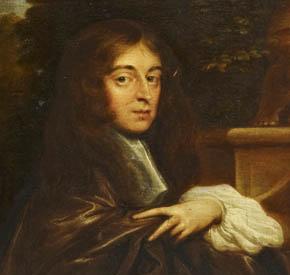
Henry Hyde, 2nd Earl Of Clarendon
| Name | Henry Hyde, 2nd Earl Of Clarendon |
| Title | English noble |
| Gender | Male |
| Birthday | 1638-06-02 |
| nationality | Kingdom of England |
| Source | https://www.wikidata.org/wiki/Q3784948 |
| pptrace | View Family Tree |
| LastUpdate | 2025-11-12T01:14:51.164Z |
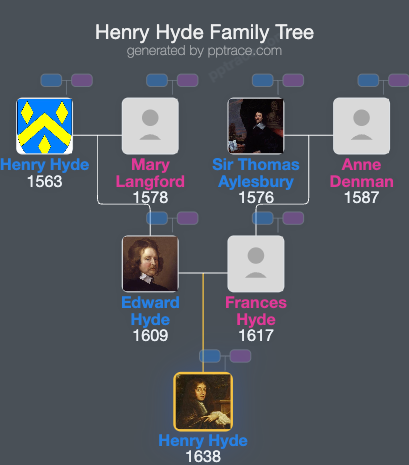
Family Tree
Tap  to expand more relatives
Introduction
Henry Hyde, 2nd Earl of Clarendon, PC (2 June 1638 – 31 October 1709), was an English aristocrat and politician who held various offices during the late 17th and early 18th centuries. He was the eldest son of Edward Hyde, 1st Earl of Clarendon, and Frances Aylesbury. Clarendon was a brother of Anne Hyde, the first wife of King James II of England, making him the maternal uncle of Queen Mary II and Queen Anne.
He was partly raised in Antwerp and Breda by his mother. Before 1660, Clarendon served as a copyist, decipherer, and confidential secretary to his father in correspondence with royalists. Following the family's return to England in 1660, he married Theodosia Capell, daughter of Arthur Capell, 1st Baron Capell of Hadham, and Elizabeth Morrison. Theodosia died in 1661; in 1670, Clarendon married Flower Backhouse, daughter of William Backhouse and Anne Richards. Flower Backhouse was previously married to William Bishop and Sir William Backhouse, and she owned Swallowfield Park in Berkshire, which Clarendon rebuilt.
Clarendon was styled Lord Cornbury from 1661 and served as Member of Parliament for Wiltshire until 1674. In 1662, he was appointed private secretary to Queen Catherine of Braganza, and in July 1665, became her lord chamberlain. He was involved in legal disputes over the Queen's allowances and was an opponent of court factions, criticizing figures such as Buckingham and Arlington. He succeeded to the earldom of Clarendon upon his father's death in 1674. By 1680, he was appointed a privy councillor, influenced by his brother-in-law James, Duke of York. He also held positions including keeper of Denmark House and treasurer and receiver-general of Queen James II's revenues.
In the early 1680s, Clarendon was associated with early concerns about the religious inclinations of court figures and was considered sympathetic to Catholic interests. In 1685, King James II appointed him Lord Privy Seal, and shortly thereafter, he became Lord-Lieutenant of Ireland. His tenure in Ireland began in January 1686, where he encountered tensions related to the Irish military and political landscape, involving figures such as Richard Talbot, Earl of Tyrconnell. Clarendon expressed concerns over Catholic influence and attempted to advocate for the inclusion of Catholics in Irish governance, though his influence waned during Tyrconnell’s resurgence in Ireland. He was recalled to England in early 1687 and subsequently withdrew from public office.
Following his loss of office, Clarendon engaged in private life, undertaking various business ventures and legal actions related to his estates. In 1688, he received a pension from James II. During the Glorious Revolution, Clarendon aligned with William of Orange, supporting William and agreeing to support his invasion plans. He was involved in the political debates surrounding James II’s flight and the subsequent settlement, though he refused to take oaths to William and Mary.
Clarendon was implicated in Jacobite plots against William III, resulting in his imprisonment in the Tower of London in 1690. He was released in 1691 and thereafter lived in relative tranquility until his death. His later years involved litigation over family estates, notably the sale of Cornbury House, and an interest in historical writings. He did not receive favor at Queen Anne’s court due to his perceived Jacobite sympathies but continued to be granted a pension.
Henry Hyde died on 31 October 1709. His Diary covering 1687–1690, along with his correspondence and letters of his brother Rochester, was published in 1828. He authored "History and Antiquities of the Cathedral Church at Winchester," which was continued by Samuel Gale and published in 1715.