Charles De Fitz-James, 4th Duke Of Fitz-James
| Name | Charles De Fitz-James, 4th Duke Of Fitz-James |
| Title | Marshal of France |
| Gender | Male |
| Birthday | 1712-11-04 |
| nationality | France |
| Source | https://www.wikidata.org/wiki/Q2960573 |
| pptrace | View Family Tree |
| LastUpdate | 2025-11-12T01:14:32.295Z |
Family Tree
Tap  to expand more relatives
Introduction
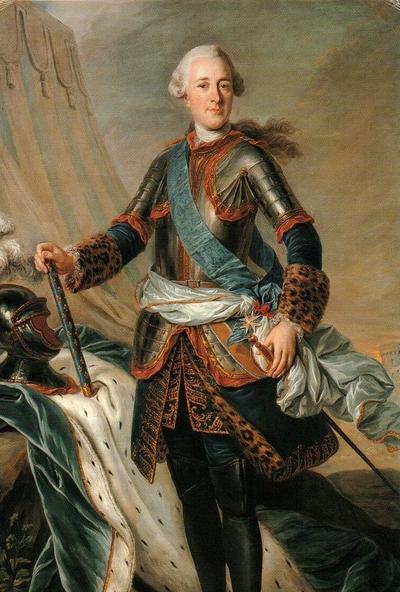
Charles, duc de Fitz-James (4 November 1712 – 22 March 1787) was a French general and the 4th Duke of Fitz-James. He was born in Saint-Germain-en-Laye and died at his hôtel particulier in Paris. He was a descendant of the British House of Stuart.
Early Life
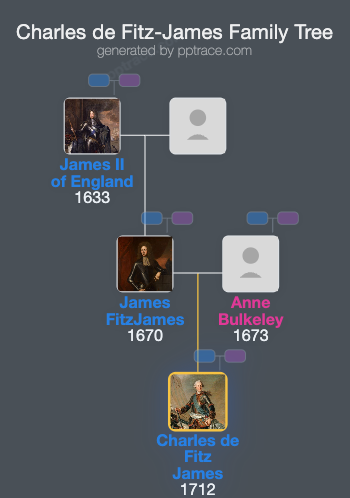
Charles was the son of James FitzJames, 1st Duke of Berwick, who was an illegitimate son of James II of England. From birth, he was known as the "count of Fitz-James". His elder brother was Henri de Fitz-James, who was dismissed from service, and his younger brother François de Fitz-James, who pursued holy orders. At the age of 17, on 28 December 1729, Charles was appointed governor and lieutenant-general of Limousin.
Military Career
In 1730, Fitz-James joined the musketeers. On 31 March 1732, he received a commission to command a company in the Montreval cavalry regiment. By 1733, he was in command of an Irish cavalry regiment, which was subsequently renamed the Fitz-James regiment in his honor.
In 1733, hostilities resumed in Europe following the death of Augustus, king of Poland. A French army under his father invaded Germany. Fitz-James saw his first active service during the sieges of Kehl (1733) and Philippsbourg (1734). He was present at his father’s death, being nearby when his father was killed by a cannonball. After inheriting the dukedom and becoming a peer of France, Fitz-James continued serving on the Rhine under Marshal de Coigny until the Treaty of Vienna in 1738.
War of the Austrian Succession
The death of Charles VI in 1740 precipitated another European conflict. France supported the claims of the elector of Bavaria to the imperial throne. In 1741, Fitz-James served in a French army that crossed the Rhine at Fort-Louis and in another crossing at the Meuse. He participated in numerous battles and sieges, including the Siege of Prague (Siege of Belle-Isle), the sieges of Oudenaarde and Dendermonde, and the Siege of Namur in 1746.
He was promoted to lieutenant general on 10 May 1748, shortly after hostilities ended, and became a peer of France. He was invested as a knight of the orders of the King on 2 February 1756.
Seven Years' War
At the onset of the Seven Years' War, Fitz-James commanded several army corps in Germany. His engagements included the Battle of Hastenbeck (1757), the Battle of Krefeld (1758), and the Battle of Lutterberg (1758). During the Battle of Minden on 1 August 1759, he commanded the entire French cavalry, which attempted an unsuccessful charge.
Later, he was returned to France in November 1760 and, on 16 September 1761, took command of the Languedoc province.
Later Life
Fitz-James became involved in a conflict over taxation with the Parlement of Toulouse in 1763, which resulted in violence and his resignation from his position. He lived in disgrace until 1766 when he was appointed commander of Béarn, Navarre, and Guyenne. In 1771, he assumed command of Brittany. He was made Marshal of France in 1775 and subsequently retired from military service.
Family
In 1741, Fitz-James married Victoire Goyon (1722–1777), granddaughter of French Field Marshal Charles-Auguste de Goyon. They fathered seven children, among whom was Jacques Charles, who became the 5th Duke of Fitz-James (1743–1805) and a French Maréchal de camp. His daughter includes Laure Auguste de Fitz-James.
References
This biographical account draws from sources including the "Dictionnaire universel d’histoire et de géographie" (1878), Louis-Gabriel Michaud's "Biographie universelle ancienne et moderne" (1843–1865), and Michel Popoff's "Armorial de l'Ordre du Saint-Esprit" (1996).
External Links
Additional information can be retrieved from the database "Base" (French), accessed on 1 July 2018.