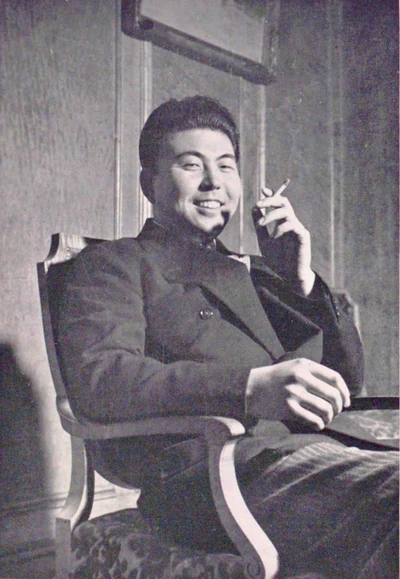
Fumitaka Konoe
| Name | Fumitaka Konoe |
| Title | (1915-1956) |
| Gender | Male |
| Birthday | 1915-04-03 |
| nationality | Q188712 |
| Source | https://www.wikidata.org/wiki/Q6899853 |
| pptrace | View Family Tree |
| LastUpdate | 2025-11-17T06:47:37.976Z |
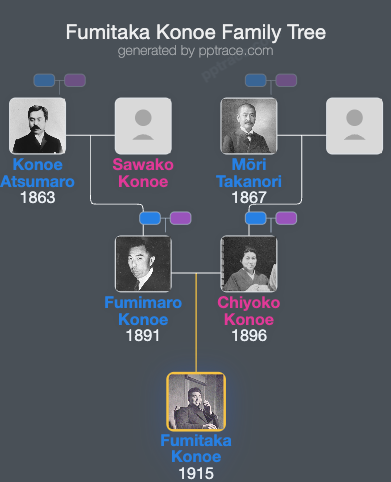
Family Tree
Tap  to expand more relatives
Introduction
Fumitaka Konoe (近衛 文隆, Konoe Fumitaka), born on April 3, 1915, in Kyoto, was the eldest son of Fumimaro Konoe, who served as Prime Minister of Japan. He was a descendant of Emperor Go-Yōzei, belonging to the Konoe family, one of the five kuge (noble) houses, with the lineage originating from the Fujiwara clan.
Konoe completed his early education at Gakushūin Junior High School before being sent to the United States for diplomatic studies. He graduated from Lawrenceville School and attended Princeton University. During his stay in America, he participated as an amateur golfer and managed a golf club.
He returned to Japan in 1938 and became his father's executive secretary. In 1939, he took a position as a lecturer at Toa Doubunin University (The Tung Wen College) in Shanghai and served as a student director. During this period, he engaged in diplomatic activities, attempting to negotiate directly with Chiang Kai-shek to prevent conflict between the Kuomintang government and the Imperial Japanese Army. He established associations with Chinese officials, efforts which led to his recall to Japan following concerns over espionage and secret negotiations. It is believed that his contacts with Chinese officials and a Chinese spy posed risks to Japanese national security during this tense period.
Upon his return, Konoe founded the youth political organization Shonen Doshi-kai (青年同志会) advocating for direct negotiations to avoid war in China. His activities were viewed critically by military authorities, and in February 1940, he was drafted into the Imperial Japanese Army. Owing to his family background, he received a rapid promotion to First Lieutenant and was assigned to an artillery regiment based in Manchukuo.
In 1944, he married Masako Otani, a niece of Empress Teimei, in Harbin. During World War II, he served as a first lieutenant in the Imperial Japanese Army.
Following Japan's surrender in August 1945, Konoe was detained by Soviet forces. On August 19, 1945, he was arrested by a Soviet GRU Smersh unit and taken as a prisoner to the Soviet Union. Over the next ten years, he was moved through fifteen different detention camps in Siberia. Throughout his imprisonment, he refused to use his rank as an officer as protection from labor and mistreatment.
Efforts by the Japanese government, including a formal plea by Prime Minister Ichirō Hatoyama in 1955, to secure his release were unsuccessful. The Soviet Union declined release requests, and he was reportedly killed in 1956 at NKVD special camp No. 48 in Ivanovo Oblast, Cherntsy village. The presumed cause of death was cerebral hemorrhage due to arteriosclerosis and acute nephritis, though there are alternative theories suggesting poisoning by Soviet secret services.
His remains were repatriated to Japan in 1958, thanks to his wife Masako. In 1991, in accordance with Soviet laws on political repression, he was officially posthumously acquitted of wrongdoing. The Russian Federation's Military Police High Public Prosecutor reconfirmed this ruling in 1992, and a formal certificate was issued in 1997.
At his death in 1956, he had no legitimate children. His wife Masako adopted Moriteru Hosokawa, the step-grandson of Fumimaro Konoe, who later became the head of the family.