Prince William Frederick, Duke Of Gloucester And Edinburgh
| Name | Prince William Frederick, Duke Of Gloucester And Edinburgh |
| Title | British prince, nephew and son-in-law of George III; (1776-1834) |
| Gender | Male |
| Birthday | 1776-01-15 |
| nationality | United Kingdom of Great Britain and Ireland |
| Source | https://www.wikidata.org/wiki/Q701723 |
| pptrace | View Family Tree |
| LastUpdate | 2025-11-12T01:16:54.964Z |
Family Tree
Tap  to expand more relatives
Introduction
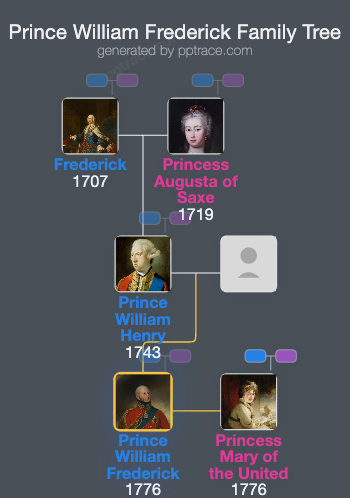
Prince William Frederick, Duke of Gloucester and Edinburgh, was born on 15 January 1776 at Palazzo Teodoli in Rome. He was a great-grandson of King George II of Great Britain and a nephew and son-in-law of King George III. His father was Prince William Henry, Duke of Gloucester and Edinburgh, the third son of Frederick, Prince of Wales. His mother was Maria Walpole, the illegitimate daughter of Edward Walpole and granddaughter of Robert Walpole. Due to his descent, he was granted the title of Prince of Great Britain with the style His Highness, not His Royal Highness, at birth.
He was baptized at Teodoli Palace on 12 February 1776. His godparents included Ernest II, Duke of Saxe-Gotha-Altenburg; Duchess Charlotte; and Christian Frederick Charles Alexander, Margrave of Brandenburg-Ansbach. During his time in Stockholm in 1802–1803, William attracted attention for his interest and rumored affair with Aurora Wilhelmina Koskull; Queen Charlotte of Sweden recalled his remark that he would marry her if she were her daughter.
William attended Trinity College, Cambridge, starting in 1787 and received his Master of Arts degree in 1790. His London residence was located at 31 Upper Grosvenor Street, Mayfair. Following his father's death on 25 August 1805, he inherited titles including Duke of Gloucester and Edinburgh and Earl of Connaught. From 1811 until his death, he served as Chancellor of the University of Cambridge. In 1812, some Swedish nobility offered him the throne of Sweden; however, the British government declined this proposal, and the throne was eventually assumed by Jean-Baptiste Bernadotte, who became King Charles XIV John.
In his military career, William was commissioned as a captain in the 1st Regiment of Foot Guards upon the outbreak of war with France in 1793, with his rank of lieutenant-colonel backdated to 1789. He was promoted to colonel in 1794 and participated in the Flanders campaign. Promoted to major-general in 1795, he commanded a brigade during the Helder Expedition in 1799 and was mentioned in despatches. He achieved the rank of lieutenant-general in 1799, full general in 1808, and field marshal in 1816. His colonelcies included the 115th Regiment of Foot (Prince William’s), the 6th Regiment of Foot, and the 3rd Regiment of Foot Guards.
William's personal life includes a clandestine marriage to Ann Maguire in 1811, conducted at the house of Ann Hamilton in London. This union was reportedly maintained until William’s death in 1834 but was potentially invalid under the Royal Marriages Act. No official marriage certificate has been found.
On 22 July 1816, William married his first cousin Princess Mary, the fourth daughter of King George III. The marriage took place at St. James's Palace, London. Following this, he was granted the style of His Royal Highness by Order in Council. The Duke and Duchess lived at Bagshot Park in Surrey. They did not have children, as they married both at age 40 during a period when the future of Princess Charlotte of Wales was a concern for succession planning.
William engaged in various activities beyond his military service and court duties. He chaired the inaugural meeting of the United University Club in London in 1822 and supported causes such as the abolition of slavery. Notably, he expressed strong opposition to the slave trade in a speech to the House of Lords in 1807.
He was associated with prominent abolitionist figures such as John Opie and Amelia Opie, with whom he maintained social connections in the 1790s. Historically, he was known for his marked social decorum and exclusive demeanor, and he earned nicknames such as "Silly Billy" and "Slice of Gloucester." In 1810, he was involved in Theodore Hook's Berners Street hoax, which involved misleading multiple visitors to a house in Westminster.
Due to the circumstances of his birth, William was excluded from membership in the House of Hanover and was not listed in the family genealogies or invited to certain family events in Germany. He died on 30 November 1834 at Bagshot Park and was buried at St. George's Chapel, Windsor. Several areas in London, including Connaught Place, Connaught Street, and Connaught Square, are named after his subsidiary title, Earl of Connaught.
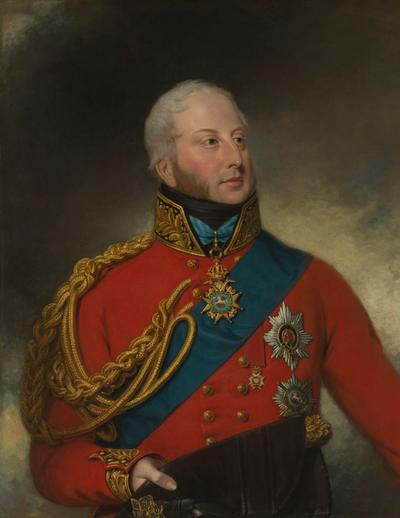
He was a recipient of several honors, including being appointed Knight of the Garter in 1794, Knight Grand Cross of the Order of the Bath in 1815, and Knight Grand Cross of the Royal Guelphic Order in 1815. His coat of arms was a differenced version of the royal arms, featuring a label argent with specific symbols.
William Frederick's ancestry traces back to the British royal family and German noble lines, emphasizing his position within the interconnected European aristocracy.