Henry Pelham-Clinton
| Name | Henry Pelham-Clinton |
| Title | British noble; (1720-1794) |
| Gender | Male |
| Birthday | 1720-04-16 |
| nationality | Great Britain |
| Source | https://www.wikidata.org/wiki/Q4121443 |
| pptrace | View Family Tree |
| LastUpdate | 2025-11-26T23:21:18.705Z |
Family Tree
Tap  to expand more relatives
Introduction
Henry Fiennes Pelham-Clinton, 2nd Duke of Newcastle-under-Lyne, KG, PC, was born on 16 April 1720 in London. He was the second son of the 7th Earl of Lincoln. Following the death of his father in 1728 and his older brother, the 8th Earl of Lincoln, in 1730, he became the 9th Earl of Lincoln as a minor. His guardian was his uncle, the 1st Duke of Newcastle-upon-Tyne, who was childless and considered Lord Lincoln his heir.
As a minor, Lord Lincoln received multiple sinecure positions, including a lifetime appointment as Controller of Customs at the port of London, which provided him with a substantial income. On 16 October 1744, he married his cousin Catherine Pelham, the daughter of his uncle Henry Pelham, who served as Prime Minister at the time. An agreement made at this time designated Lord Lincoln as the heir to both his uncles, Henry Pelham and the Duke of Newcastle-upon-Tyne. Through these familial connections, Lord Lincoln also gained a court position as a gentleman of the King's Bedchamber.
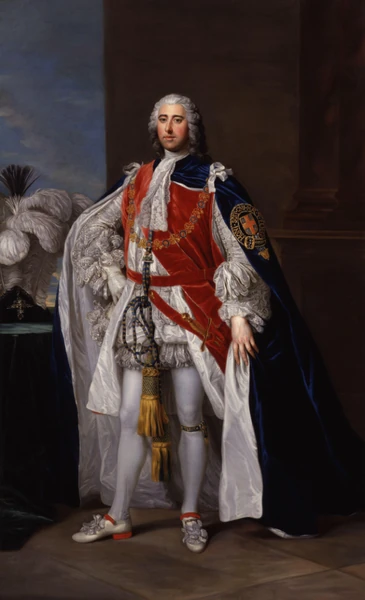
In 1752, Lord Lincoln was appointed a Knight of the Garter. In 1756, his uncle, who was then the Duke of Newcastle-upon-Tyne, successfully petitioned King George II to be created Duke of Newcastle-under-Lyne with a special remainder to Lord Lincoln. When the duke died in 1768, Lord Lincoln inherited the dukedom, becoming the 2nd Duke of Newcastle-under-Lyne.
During his tenure as duke, he largely refrained from active political involvement, although he exercised influence through control of parliamentary seats. He supported the military career of his relative Sir Henry Clinton, notably lobbying for Clinton's appointment as commander-in-chief of British forces in America during the American Revolution. His son, Thomas Pelham-Clinton, served as aide-de-camp to Sir Henry Clinton.
In 1768, he was appointed to the Privy Council. In December 1783, he supported William Pitt the Younger’s ministry by commanding his controlled MPs to back Pitt, aiding in Pitt’s parliamentary support to form a government. The duke died on 22 February 1794 in Westminster at the age of 73.
The duke is known for establishing Clumber Park in Nottinghamshire, starting in 1768 on an estate inherited from his uncle. He transformed approximately 4,000 acres of heathland into a landscaped park featuring a large artificial lake. The main mansion built there was demolished in 1938, but the estate is now managed by the National Trust and accessible to the public. Clumber Park is also associated with the Clumber Spaniel, a dog breed named after the estate.
He served as a Bailiff on the board of the Bedford Level Corporation from 1742 to 1764, overseeing fenland reclamation efforts. His papers are archived at the University of Nottingham’s Manuscripts and Special Collections. The town of Lincoln, New Hampshire, is named after him.
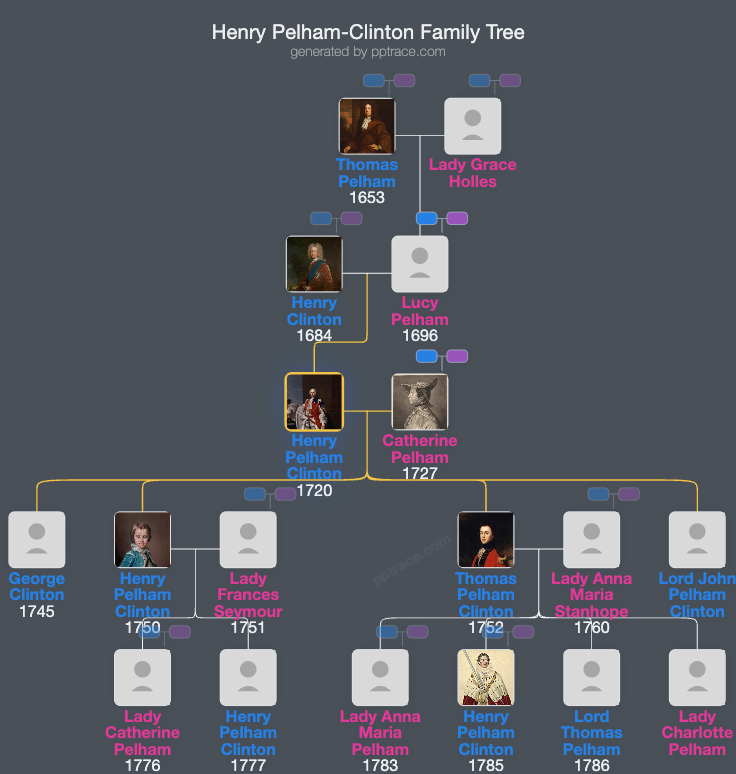
Regarding his family, before his wife's death at age 33, he fathered four sons: George Pelham-Clinton, Lord Clinton (1745–1752); Henry Fiennes Pelham-Clinton, Earl of Lincoln (1750–1778), who married Lady Frances Seymour-Conway; Thomas Pelham-Clinton, 3rd Duke of Newcastle-under-Lyne (1752–1795), who married Lady Anna Maria Stanhope; and Lord John Pelham-Clinton, who died in 1781 and was said to have been a lover of Horace Walpole.