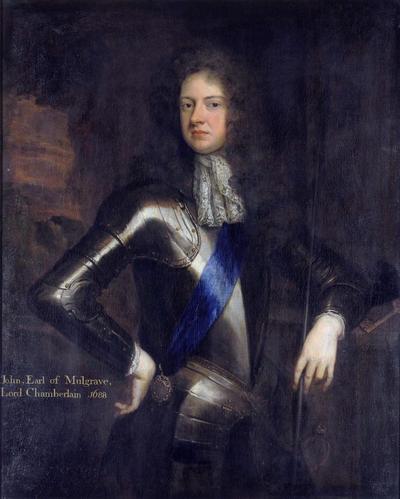
John Sheffield, 1st Duke Of Buckingham And Normanby
| Name | John Sheffield, 1st Duke Of Buckingham And Normanby |
| Title | English poet and politician (1648–1721) |
| Gender | Male |
| Birthday | 1648-04-07 |
| nationality | Great Britain |
| Source | https://www.wikidata.org/wiki/Q2736244 |
| pptrace | View Family Tree |
| LastUpdate | 2025-11-12T01:14:38.804Z |
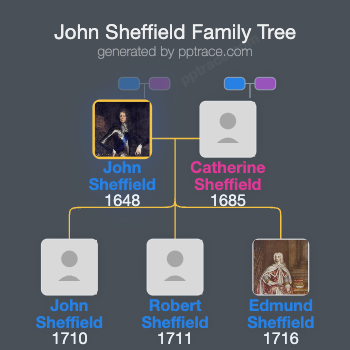
Family Tree
Tap  to expand more relatives
Introduction
John Sheffield, 1st Duke of Buckingham and Normanby, was born on September 8, 1647, and died on February 24, 1721. He was a British military officer, writer, and Tory politician during the late 17th and early 18th centuries.
He was the only son of Edmund Sheffield, 2nd Earl of Mulgrave. In 1658, he inherited his father's titles, becoming the 3rd Earl of Mulgrave and the 5th Baron Sheffield.
At the age of eighteen, Sheffield joined the naval fleet to serve in the Second Anglo-Dutch War. He participated in the Battle of Sole Bay in 1672 and was given command of a ship the following year. He also held the rank of colonel of infantry and served under Henri de La Tour d'Auvergne, Viscount of Turenne. In 1674, he was made a Knight of the Garter.
In 1680, Sheffield was tasked with leading an expedition to relieve the Garrison of Tangier, then under siege by Moulay Ismail ibn Sharif. There are accounts suggesting he was deliberately supplied with a defective ship, though the motives remain unclear. At court, he supported the Duke of York and played a role in the disgrace of the Duke of Monmouth.
In 1682, Sheffield was dismissed from court, possibly due to his courtship of Princess Anne, who was 17 at the time. Nevertheless, following King James II's accession, he joined the Privy Council and was appointed Lord Chamberlain. He married Catherine Sedley, the daughter of the king's mistress.
Sheffield supported James II's policies and stayed in London during his flight into exile. He also protected the Spanish ambassador from mob violence. Despite this, he accepted the Glorious Revolution and was created Marquess of Normanby in 1694. In 1696, he opposed supporting William III against Jacobite efforts and was dismissed from the privy council.
With the ascension of Queen Anne, he was appointed Lord Privy Seal and Lord Lieutenant of the North Riding of Yorkshire. In 1703, he was elevated to the title of Duke of Buckingham and Normanby. During the Whig dominance from 1705 to 1710, he was removed from his office but was made Lord Steward in 1710 and Lord President of the Council in 1711. He did not retain this position after Queen Anne's death.
He died in 1721 at his residence in St. James's Park, which stands on what is now Buckingham Palace. His son, Edmund Sheffield, succeeded him, but upon his son's death in 1735, the titles became extinct.
As a writer, Sheffield authored "An Account of the Revolution," along with essays and numerous poems. His poetic works include "An Essay upon Poetry" and "An Essay upon Satyr," the latter of which was circulated in manuscript and was often attributed to John Dryden. He also adapted Shakespeare's "Julius Caesar," splitting it into two plays with added choruses, some of which were written by Alexander Pope.
Sheffield was a patron of Dryden and a friend of Pope, the latter of whom held a favorable opinion of Sheffield's "Essay upon Poetry." His works were published posthumously and involved in copyright disputes, notably when Edmund Curll published a pirated edition in 1721. The authorized edition overseen by Pope appeared in 1723.
His familial alliances include three marriages: first to Ursula Stawell in 1685; second to Catherine Greville in 1698; and third to Lady Catherine Darnley in 1705, with whom he had three sons, one of whom, Edmund, succeeded him as the 2nd Duke of Buckingham. Sheffield also fathered an illegitimate son, Charles, with Frances Stewart, and possibly others.