Ranko Sawa
| Name | Ranko Sawa |
| Title | Japanese actress |
| Gender | Female |
| Birthday | 1903-07-25 |
| nationality | Q188712 |
| Source | https://www.wikidata.org/wiki/Q11566004 |
| pptrace | View Family Tree |
| LastUpdate | 2025-11-17T06:47:51.233Z |
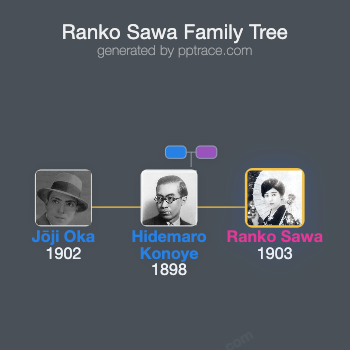
Family Tree
Tap  to expand more relatives
Introduction
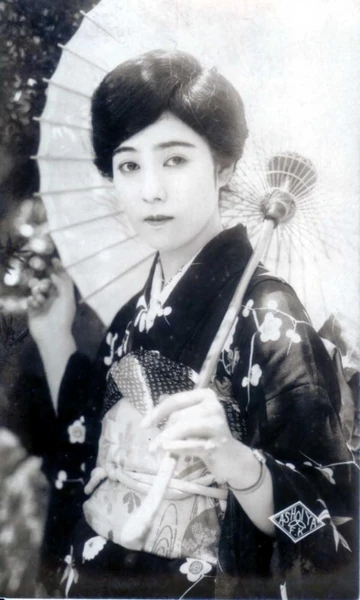
Saw Ranko (born July 25, 1903 – January 11, 2003) was a Japanese actress. Her birth name was Saw Shizuko, and her legal name at the time of marriage with Shiro Matsumoto was Matsumoto Shizuko. Her name at the time of death was listed as Saw Shidzuko. She was also known by her former stage names Izumi Ranko, Izumi Ranko, and Sawa Ranko.
She was born in Higashi Rokubancho (now Higashi Rokubancho, Miyagino Ward), Sendai City, Miyagi Prefecture. Her father was the Chinese classics scholar Kōjirō Sawa. Regarding her birth name, it is recorded in the 1933 edition of the All Matsutake Actors Directory as "Sawa Shizuko," and reports at the time of her death indicated her real name was "Sawa Shidzuko." She was raised in Chiba City, where her family’s ancestral home was located, and later graduated from the former Soga Elementary School (now Chiba City Soga Elementary School). In April 1916 (Taisho 5), she moved to Tokyo and enrolled in the former Tokyo Home Economics Girls’ School (now Toyoshima Okagakuen High School). However, she dropped out in May 1919 (Taisho 8) and entered the Takarazuka Music and Opera School (now Takarazuka Music School), established in January of the same year. She was a 9th-term student of the Takarazuka Revue, alongside classmates such as Yoshiko Katsura, Ashiko Kameda, Sumiko Tatsumi, and Miyako Nara.
Her stage name is said to be derived from the 27th poem of the Ogura Hyakunin Isshu, "Mikanohara Wakitte Nagaruru Izumi ga wa Itsumi Kitto Kato Koi Shikaruram." In March 1920 (Taisho 9), she made her debut on stage in the 25th performance of the Takara Zuka Girls' Revue, "Poisonous Flower Garden," performing as a maiden. In the summer performance "Nevui-Rai Fu," in July of the same year, she played the role of the goddess of peace and also served as the lead actress.
In July 1921 (Taisho 10), she appeared in the first act of the summer performance, but left the Takara Zuka Girls' Revue later that year due to romantic issues with composer Shiro Matsumoto. After leaving the troupe, she married Matsumoto at the age of 18.
She returned to Tokyo and in March 1923 (Taisho 12) joined Shochiku Kamata Studio, shortly transferring to Nikkatsu Koenji Studio. In June, she appeared in director Osamu Wakayama’s "Basking in Fire," but the studio was devastated by the Great Kanto Earthquake. On May 25 of the same year, she transferred to the Imperial Kinema Geinō and adopted the stage name "Sawa Ranko." Her starring role in "Koi Muko Jigoku," released on June 26, was a huge hit. Her lead role in "Kago no Tori," released on August 14, was also very successful.
On February 9, 1927 (Showa 2), she left Imperial Kinema after her last film, "Basha Tora," directed by Eiichi Matsumoto, and took a hiatus. On May 15 of the same year, she rejoined Nikkatsu and was affiliated with the Kyoto Nikkatsu Daishogun Studio. Her comeback film "Ukiyo Kuruma," released on July 1, marked her first appearance after returning. While at this studio, she developed a romantic relationship with Susumu Minobe (later renamed Joji Oka or Jōji Oka), which led to her being forced to leave the company in November 1929.
Records indicate that she and Susumu Minobe were married, but details vary across sources. The 1933 edition of the All Matsutake Actors Directory and the "Entertainment Personages Dictionary: Meiji, Taisho, Showa periods" suggest they were married, while the "Complete Japanese Film Actors: Male Actors Edition" states that their marriage was essentially informal.