Hidetake Konoe
| Name | Hidetake Konoe |
| Title | Japanese composer and conductor (1931-2003) |
| Gender | Male |
| Birthday | 1931-02-04 |
| nationality | Japan |
| Source | https://www.wikidata.org/wiki/Q13572007 |
| pptrace | View Family Tree |
| LastUpdate | 2025-11-16T10:34:56.762Z |
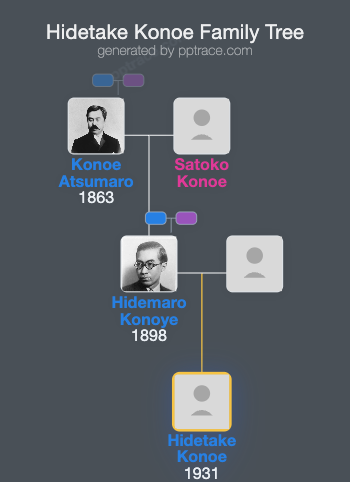
Family Tree
Tap  to expand more relatives
Introduction
Hidetake Konoé (February 4, 1931 – March 31, 2003) was a Japanese composer and conductor. He was born in Kobe City, Hyogo Prefecture, and his father was the composer Hidemaro Konoé. The original character form of his name at birth was "近󠄁衞 秀健󠄁", and his mother was Fumiko Tsuboi. He was acknowledged by his father on October 20, 1935.
He was born as the second son (illegitimate child) of Hidemaro Konoé, and later became an adopted son of Baron Tadmaro Mizugawa. However, on February 25, 1939, he left the Mizugawa family register and was adopted by Noboru Tokiwa, the third son of Tokiwa Iwa Yao, also known as Tokiwa Tadayoshi (a member of the noble Tokiwa family). Ultimately, he returned to the Konoé family.
His educational background includes enrollment in Gakushuin Elementary School in 1936, but due to wartime evacuations, he attended several schools. After the war, he returned to Tokyo and re-enrolled in Gakushuin Junior High School.
In 1947, he joined the Toho Symphony Orchestra (now Tokyo Symphony Orchestra), serving as a percussionist and arranger for the orchestra. In 1959, he studied abroad at the Mannheim City Music Academy in West Germany, majoring in composition and conducting. In 1962, he further studied at the Gizi Music Academy in Italy, focusing on conducting, composing, and film music.
After returning to Japan, he became a director of the Konoé Music Research Institute in 1965 and served as its chairman from 1967 to 1972. He was also active in imperial family-related events and worked as a technical instructor for the Imperial Household Agency’s Court Music Department. He taught at Dokkyo University and Takasaki Art Junior College and continued to serve as the permanent conductor of the Dokkyo University Orchestra until late in his life.
On June 9, 1993, he conducted the Imperial Court music ensemble for the marriage ceremony of Crown Prince Naruhito and Masako Owada.
He passed away on March 31, 2003, due to acute aortic dissection at the age of 72.
His family includes his eldest son, Hitori (born February 24, 1962), a bassoonist and chairman of the Konoé Music Research Institute; his eldest grandson Gōdai (born 1997), a violist living in Amsterdam who placed third in the viola division at the Munich International Music Competition; his eldest daughter Mayu (born 1997), a violist; his daughter Fumiko (born 1963), a translator working for NHK International; and his second son, Daisuke (born January 21, 1967), a lawyer.
He has relatives such as his younger brother, the composer Tadatoshi Mizugawa; his nieces, violinist Yoko Mizugawa and cellist Yuko Mizugawa. The Konoé family is descended from Fujiwara no Tadamichi and was one of the five regent houses (Gosekke).
In terms of genealogy, he is a thirteen-generation male-line descendant of Emperor Go-Yōzei, with the Konoé family being a male-line descendant of Emperor Go-Yōzei’s fourth prince, Prince Naoe Shinjū.
His major works include orchestral pieces such as "Fantasy Concertino for Trumpet and Orchestra" (premiered in 1980), choral work "Kengen Sanshi" (premiered in 1981), march for orchestra (premiered in 1981), theme and variations (premiered in 1985), "Comet Fantasy" which was first performed at the Sydney Opera House (1985), the "Australian Overture" (1985), "Saluting the President" (1985), suite "Shunjo no Michi" (The Path of Order) (1986), among others.