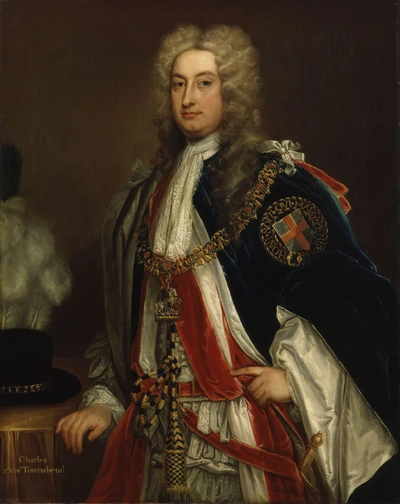
Charles Townshend, 2nd Viscount Townshend
| Name | Charles Townshend, 2nd Viscount Townshend |
| Title | British Whig statesman (1674-1738) |
| Gender | Male |
| Birthday | 1674-04-18 |
| nationality | Great Britain |
| Source | https://www.wikidata.org/wiki/Q336529 |
| pptrace | View Family Tree |
| LastUpdate | 2025-11-26T23:21:27.682Z |
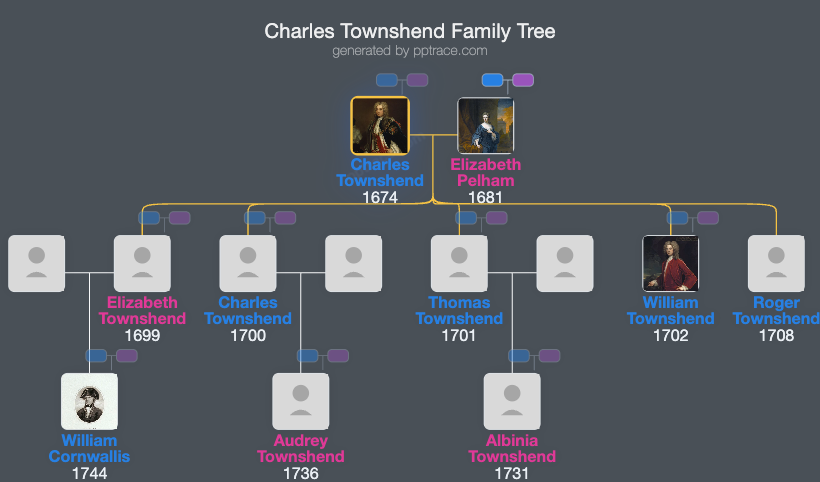
Family Tree
Tap  to expand more relatives
Introduction
Charles Townshend, 2nd Viscount Townshend, was born on 18 April 1674 at Raynham Hall, Norfolk. He was the eldest son of Sir Horatio Townshend, 3rd Baronet, who was created Baron Townshend in 1661 and Viscount Townshend in 1682. The Townshend family is of Old Norfolk descent, tracing their lineage back to Sir Roger Townshend (d. 1493), who served as legal advisor to the Paston family and was a justice of the common pleas. His descendant, Sir Roger Townshend (c. 1543–1590), was the father of Sir John Townshend (1564–1603), a soldier, and grandfather of Sir Roger Townshend (1588–1637), who was created a baronet in 1617.
Townshend was educated at Eton College and King's College, Cambridge. He succeeded to his peerages in December 1687. Initially, he held Tory sympathies, but over time he adopted Whig political views.
In his early political career, Townshend was appointed Captain of the Yeomen of the Guard in November 1708 and was summoned to the Privy Council in 1707. From 1709 to 1711, he served as ambassador extraordinary and plenipotentiary to the Dutch Republic, participating in negotiations leading up to the Treaty of Utrecht. He was elected a Fellow of the Royal Society in April 1706.
Following his return to England, Townshend became a vocal critic of the Tory ministry and gained favor with King George I. In September 1714, he was appointed Secretary of State for the Northern Department. During his tenure, he promoted peaceful foreign policies after the suppression of the Jacobite rising of 1715 and opposed British involvement in the Great Northern War. Instead, he favored defensive alliances with Austria and France.
His political career was marked by shifting alliances and internal conflicts within the Whig party. In October 1716, he was dismissed from office and briefly served as Lord Lieutenant of Ireland until April 1717. The subsequent years saw a split within the Whig party, with Townshend and Robert Walpole initially allied but later experiencing disagreements. By June 1720, he became Lord President of the Council and, following the death of James Stanhope, was reinstated as Secretary of State for the Northern Department in 1721, serving until 1730.
During his second term, Townshend's diplomatic efforts improved Anglo-Dutch relations. He helped dismiss rival political figures like Lord Carteret and managed foreign policy complexities, including tensions with Austria and conflicts in European diplomacy. Despite disapproval from some contemporaries, King George II retained him in office, although Walpole's influence increased over time, leading to ideological and political disagreements. A final rupture with Walpole occurred in 1730, after which Townshend retired from public service.
In his later years, he focused on agricultural pursuits at Raynham Hall. He was a proponent of the Norfolk four-course crop rotation system and championed the cultivation of turnips as fodder, earning him the nickname "Turnip Townshend." His advocacy contributed to agricultural advancements associated with the British Agricultural Revolution.
Townshend died at Raynham Hall on 21 June 1738.
He was married twice. His first marriage was to the Hon. Elizabeth Pelham (1681–1711), daughter of Thomas Pelham, 1st Baron Pelham of Laughton. They had several children, including Elizabeth Townshend, who married Charles Cornwallis, 1st Earl Cornwallis; Charles Townshend, 3rd Viscount Townshend; Thomas Townshend; William Townshend; and Roger Townshend.
His second marriage was to Dorothy Walpole (1686–1726), sister of Sir Robert Walpole. They had children including George Townshend; Augustus Townshend; Horatio Townshend; Edward Townshend, Dean of Norwich; Richard Townshend; Dorothy Townshend; and Mary Townshend.
Charles Townshend’s contributions to British political and agricultural history are notable, with his involvement in foreign policy during the early 18th century and his role in advancing agricultural practices.