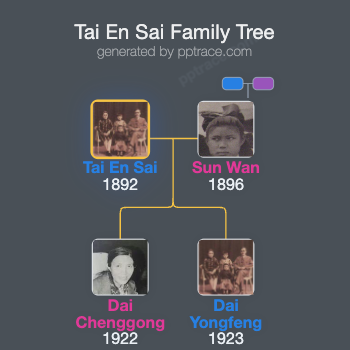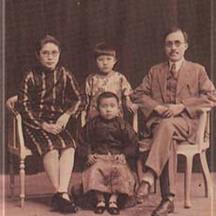
Tai En Sai
| Name | Tai En Sai |
| Title | Chinese politician |
| Gender | Male |
| Birthday | 1892-05-06 |
| nationality | Qing dynasty |
| Source | https://www.wikidata.org/wiki/Q11075299 |
| pptrace | View Family Tree |
| LastUpdate | 2025-01-16T23:43:38.956Z |
Family Tree
Tap  to expand more relatives
YouTube
Introduction
Dainsai (1892–1955), courtesy name Shangde, was a native of Changle County, Guangdong Province (now Wuhua County, Meizhou City), born in Hong Kong. In his early years, he studied at the Yucai Book Society in Hong Kong and graduated in 1913 from St. John’s University in Shanghai. That same year, he went on to further his studies at the Tsinghua Preparatory School for studying in the United States in Beijing. In 1914, Dainsai entered Columbia University in the United States to study International Law, earning his Ph.D. in 1937. His doctoral thesis was titled "The Impact of Unequal Treaties," published by the university.
After returning to China upon graduation, Dainsai served as the Secretary of the Foreign Affairs Department and as the Leader of the Political Group for the Guangdong Military Government. In 1921, he was appointed as the head of the Wuzhou Municipal Hall, making him the leader of the second municipal government established in China after Guangzhou. During the same period, he married Sun Wan, the second daughter of Sun Yat-sen, in Macau. In October 1923, he concurrently served as the supervisor of customs at Wuzhou and as the Guangxi negotiator, holding positions related to the Chinese navy and land forces. In 1925, during Sun Yat-sen’s terminal illness in Beijing, Dainsai participated as one of the witnesses to Sun’s will and was involved in guarding Sun’s body and other related ceremonies. He also wrote an elegiac couplet.
During Sun Yat-sen’s Northern Expedition, Dainsai actively engaged in military and administrative affairs. In 1921, as Sun Yat-sen led the Northern Expedition from Guangzhou, Dainsai, as the head of Wuzhou Municipal Hall, promoted the construction of archways in the city—drawing on Guangzhou’s experience—to foster urban development in Wuzhou. He also served as the Supervisor of River Management in Guangdong in 1928, and as acting principal of Zhongshan Memorial Middle School (now Zhongshan Memorial Middle School) from 1938 to 1946.
During the Second Sino-Japanese War, Dainsai became the principal of Zhongshan Memorial Middle School in 1938 and remained in that position until 1946. After the founding of the People's Republic of China in 1949, he moved to Macau to continue his work in education and administration. After losing his son, Dai Yongfeng, in 1952—who died due to mental shock causing a cerebral hemorrhage—Dainsai suffered a stroke and became paralyzed. He died in Macau on January 16, 1955, at the age of 63. His original body was buried in the Baima Lane Cemetery in Macau and was later re-interred in the Dai family tomb located at No. 34, Middle Road, Wuyan Cemetery, in Happy Valley, Hong Kong.
Dainsai’s family included his wife Sun Wan and children Dai Yongfeng and Dai Chenggong. He maintained close relations with members of the Sun family, including Sun Kex and Sun Yat-sen, and was considered an important relative of Sun Yat-sen.