Lyndon B. Johnson
| Name | Lyndon B. Johnson |
| Title | president of the United States from 1963 to 1969 |
| Gender | Male |
| Birthday | 1908-08-27 |
| nationality | United States of America |
| Source | https://www.wikidata.org/wiki/Q9640 |
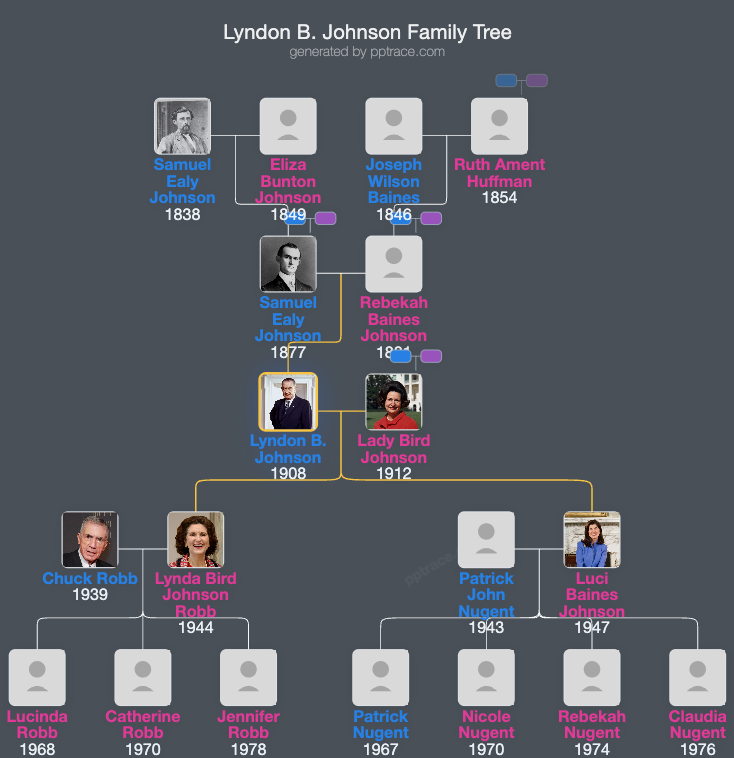
| pptrace | View Family Tree |
| LastUpdate | 2025-11-17T06:45:20.520Z |
Family Tree
Tap  to expand more relatives
Introduction
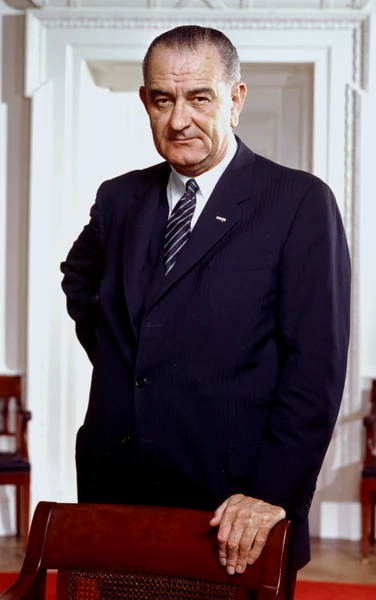
Lyndon Baines Johnson (August 27, 1908 – January 22, 1973), commonly known as LBJ, was an American politician who served as the 36th president of the United States from 1963 to 1969. He assumed the presidency following the assassination of President John F. Kennedy. Prior to his presidency, Johnson served as vice president during Kennedy’s administration from 1961 to 1963.
Born in Stonewall, Texas, Johnson was the eldest of five children to Samuel Ealy Johnson Jr. and Rebekah Baines. His family was of modest means, and he was born on a small farm near the Pedernales River. Johnson was the youngest in his class at Johnson City High School, graduating in 1924 at age 15. He enrolled briefly at Southwest Texas State Teachers College (SWTSTC) in 1924 but left to work in California before returning to Texas. He later re-enrolled at SWTSTC, where he earned a Bachelor of Science degree in history in 1930 and a certification as a high school teacher.
Johnson’s early career included teaching Mexican-American children at the segregated Welhausen School in Cotulla, Texas, and teaching public speaking at Sam Houston High School in Houston, Texas. He was influenced by his upbringing in rural Texas and gained experience in public speaking, debate, and campus politics during his college years.
Johnson’s entry into politics was facilitated by his appointment as legislative secretary to Congressman Richard M. Kleberg in 1931, following a recommendation from his father. During the New Deal era, he supported President Franklin D. Roosevelt and became active in political circles. In 1935, he was appointed as Texas state administrator of the National Youth Administration (NYA), where he coordinated public works projects across Texas.
In 1937, Johnson was elected to the United States House of Representatives from Texas's 10th congressional district in a special election, succeeding James P. Buchanan. He served in the House from April 10, 1937, until January 3, 1949. During his tenure, he was a member of the House Naval Affairs Committee and contributed to military infrastructure projects, including establishing naval air training bases in Texas.
In 1948, Johnson was elected to the United States Senate after a controversial primary victory. He assumed office as a senator on January 3, 1949, and continued to serve until he became vice president in 1961. He held leadership roles in the Senate, including Senate majority whip (1951), Senate Democratic leader (1953), and Senate majority leader (1954).
In 1960, Johnson sought the Democratic presidential nomination but was ultimately unsuccessful, losing to John F. Kennedy. Despite this, Kennedy chose Johnson as his vice-presidential running mate, and they secured victory in the general election. As vice president, Johnson was a close adviser to Kennedy.
Johnson’s presidency was marked by extensive legislative achievements under his "Great Society" programs, including civil rights legislation such as the Civil Rights Act of 1964, the Voting Rights Act of 1965, and the Civil Rights Act of 1968. He aimed to reduce poverty through initiatives like the War on Poverty and signed the Social Security Amendments of 1965, which created Medicare and Medicaid. He prioritized space exploration, making the Apollo program a national goal, and enacted significant educational reforms, including the Higher Education Act of 1965 and the Immigration and Nationality Act of 1965.
His foreign policy focused on containing communism, notably through involvement in the Vietnam War, which became increasingly unpopular and contributed to his decision not to seek re-election in 1968. Johnson initially announced candidacy for a second term but withdrew after poor primary results and rising domestic unrest.
After leaving office, Johnson retired to his ranch in Texas, maintaining a low public profile until his death on January 22, 1973. His presidency is subject to academic debate, with recognition for domestic policy achievements contrasted with criticism of the Vietnam War escalation.