Samuel Ealy Johnson
| Name | Samuel Ealy Johnson |
| Title | American politician (1877-1937) |
| Gender | Male |
| Birthday | 1877-10-11 |
| nationality | United States of America |
| Source | https://www.wikidata.org/wiki/Q655601 |
| pptrace | View Family Tree |
| LastUpdate | 2025-11-17T06:45:23.368Z |
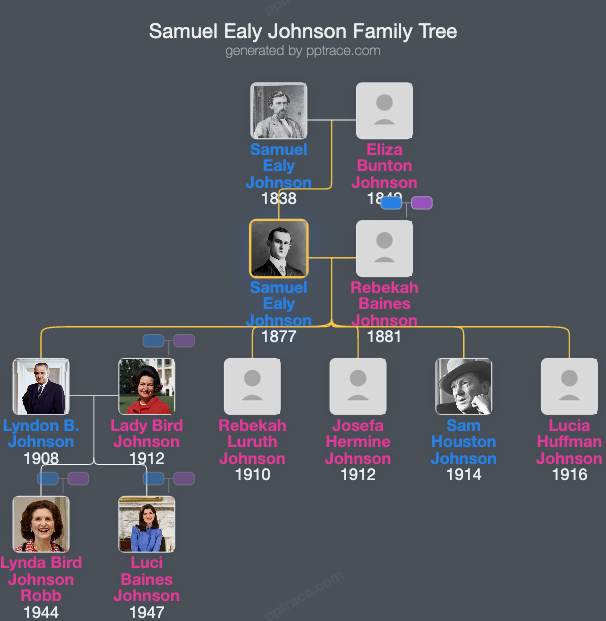
Family Tree
Tap  to expand more relatives
Introduction
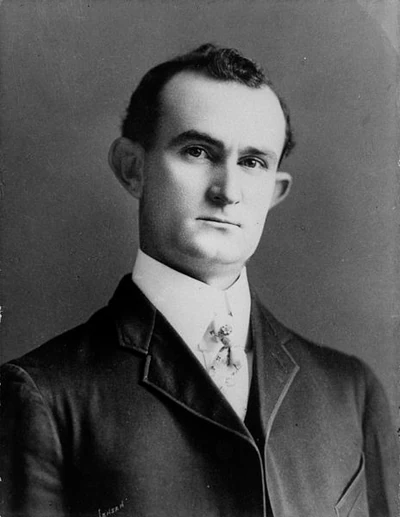
Samuel Ealy Johnson Jr. (October 11, 1877 – October 23, 1937) was an American politician, businessman, and farmer. He served six terms as a Democratic member of the Texas House of Representatives during the 29th, 30th, 35th, 37th, and 38th Legislatures. Johnson resided in the Texas Hill Country and encountered challenges related to agriculture and cattle trading. He was the father of Lyndon B. Johnson, the 36th President of the United States. His father was Samuel Ealy Johnson Sr.
Early life
Samuel Johnson was born in Buda, Texas, in 1877, to Eliza Jane (née Bunton) and Samuel Ealy Johnson Sr. He was the fifth child in his family. At age ten, his family moved from Buda to the Pedernales River area. On his family's farm near Pedernales, Johnson developed early competitiveness. During his teenage years, he aspired to pursue more than farming and began attending a local school. However, the public schools at the time required tuition, which his family found difficult to afford.
To supplement his income, Johnson purchased a barber's chair and tools upon the retirement of a barber in Johnson City, financing the purchase with a loan. He practiced barbering on friends and neighbors, earning enough money from evening haircuts to pay his school tuition. Health problems forced him to leave high school; his parents sent him to live on his uncle Lucius Bunton's ranch in Presidio County for several months. After returning home, Johnson aspired to become a teacher. Since no accredited high schools or colleges were available locally, he learned that passing a state examination could qualify him for a teaching certificate without completing high school. He studied with thirteen textbooks at his grandfather’s home and passed the exam in 1896.
Johnson taught in one-room schoolhouses throughout the Texas Hill Country for three years. He considered pursuing a law degree but lacked the financial resources, returning to work on his family farm once his father aged. After a period of good rainfall, he earned enough to hire farmhands and began trading in cotton futures in Fredericksburg. He became a well-liked figure in the Johnson City area.
Personal life
Johnson married Rebekah Baines, daughter of Joseph Wilson Baines, on August 20, 1907. Their marriage produced six children, including Lyndon B. Johnson, born on August 27, 1908. Their other children were Rebekah (1910–1978), Josefa (1912–1961), Sam Houston Johnson (1914–1978), and Lucia (1916–1997). According to Lady Bird Johnson, Lyndon’s wife, he planned to join the Christadelphian Church later in life. Samuel Ealy Johnson Jr. died in Austin, Texas, in October 1937, aged 60.
Political career
Johnson served five terms in the Texas House of Representatives as a Populist Democrat, during which he opposed conservative Democratic interests aligned with business. He opposed widespread lobbyist bribery and refused to accept bribes or favors, a stance that contrasted with many of his contemporaries. His son, Lyndon B. Johnson, later referenced his father’s populist record to support his own political pursuits.
In the late 19th and early 20th centuries, Texas politics shifted toward one-party dominance, mainly restricting voting rights for Black and poor white citizens through measures like poll taxes, effectively disfranchising large portions of the population until civil rights legislation in the 1960s. During Johnson’s legislative tenure, significant amendments were made to Texas’s constitution, including restrictions on legislative sessions and salary regulations.
Johnson’s political career began in 1904, encouraged by his brother-in-law, Judge Clarence W. Martin. He secured the Democratic nomination for the Texas House of Representatives from the 89th district, winning comfortably against a Republican opponent. As a legislator, Johnson demonstrated proficiency in parliamentary procedure, advocating for populist causes such as an eight-hour workday for railroad workers and regulation of corporate franchises. He notably contributed to legislation preserving the Alamo, ensuring it was overseen by the Daughters of the Republic of Texas.
In the 1906 election cycle, Johnson faced David Martin in the Democratic primary, winning decisively. During the 1907 legislative session, he participated in efforts to scrutinize the re-election of Senator Joseph Weldon Bailey, who was accused of accepting large legal fees from corporations. Johnson refused to be bribed and abstained from voting against Bailey, which reinforced his reputation for integrity.
He left the legislature after his third term due to financial difficulties and the political climate, rejecting patronage offers typically extended to returning legislators. Between 1907 and 1917, Johnson’s focus returned to farming and business activities.
Johnson’s political career resumed with a special election in November 1917, filling the vacancy in the 89th district, which he had previously represented.