Sophia Magdalene Of Brandenburg-Kulmbach
| Name | Sophia Magdalene Of Brandenburg-Kulmbach |
| Title | Queen consort of Denmark and Norway |
| Gender | Female |
| Birthday | 1700-11-28 |
| nationality | Norway |
| Source | https://www.wikidata.org/wiki/Q234308 |
| pptrace | View Family Tree |
| LastUpdate | 2025-11-12T01:16:23.792Z |
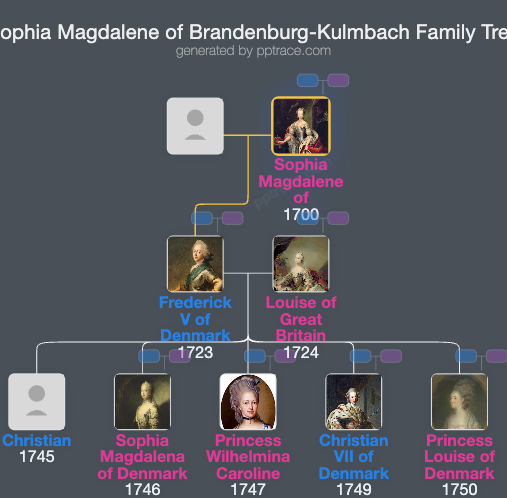
Family Tree
Tap  to expand more relatives
Introduction
Sophie Magdalene of Brandenburg-Kulmbach was born on 28 November 1700 in Castle Schonberg, Bavaria. Her parents were Christian Heinrich, Margrave of Brandenburg-Bayreuth-Kulmbach, and Countess Sophie Christiane of Wolfstein. She was raised at the court of Queen Christiane Eberhardine of Poland in Saxony. Sophie Magdalene had thirteen siblings.
In her early life, she served as a lady-in-waiting to Queen Christiane Eberhardine. During a European trip with Chancellor Ulrik Adolf Holstein, Crown Prince Christian of Denmark met Sophie Magdalene at Pretzsch Castle. She belonged to a relatively small and financially modest German princely family. King Frederick IV of Denmark authorized his son to seek a bride, and the Crown Prince married Sophie Magdalene on 7 August 1721 at Pretzsch Castle in Saxony.
A contemporary French envoy described the 20-year-old Crown Princess as proud and impressive, with light blue eyes, and dressed extravagantly with diamonds and precious stones. The envoy noted her pause for her less flattering remarks about her husband, who appeared small and frail.
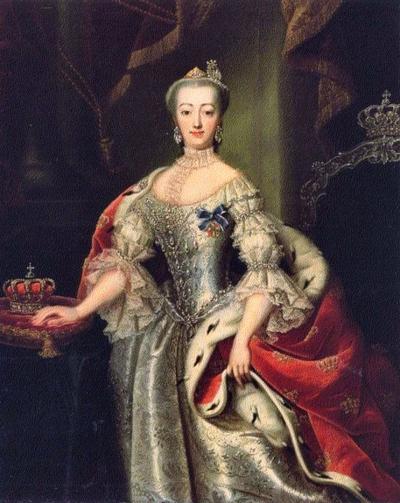
Following the death of Frederick IV on 12 October 1730, Sophie Magdalene became queen consort upon her husband's accession as King Christian VI. Their coronation took place on 6 June 1731 at Frederiksborg Palace. She was involved in creating a new Danish queen's crown, refusing to reuse the crown of the previous queen, Anna Sophie. She also established a collection of crown jewels, including gifts from King Christian VI.
As queen, Sophie Magdalene was known for her religious devotion and ceremonial splendor. Her reign saw the issuance of laws influenced by Pietist principles, such as bans on theater performances and Sunday rides, and regulations mandating church attendance. In 1737, she founded the Noble Vallø Foundation for Unmarried Daughters at Vallø Castle, a residence for elderly aristocratic women.
Despite her pietism, she maintained an affinity for luxury and courtly splendor, modeling her court life on the style of Louis XIV of France. She owned a lathe built by Diderich de Thurah, used for ivory and wood turning, and was interested in fashion and jewelry. Her preference for German culture and language persisted, with her court dominated by German favorites and relatives, including her sister Sophie Caroline, whom she appointed as abbess at Vallø.
Her German entourage held prominent positions at court, often favored over Danish nationals. Her relationships within the royal family included her brothers, who were Danish admirals. Correspondence indicates that she was jealous of her sister Sophie Caroline, leading to tensions which, however, did not result in her expulsion.
Sophie Magdalene's marriage remained close until her death, with her husband trusting her deeply. She was known for her jealous tendencies, such as her preference for unattractive ladies-in-waiting to prevent attracting the king's attention. She was not involved significantly in political affairs, and when her husband proposed her as regent during her son's minority, she declined.
Her children included Frederick V of Denmark, born in 1723, and Princess Louise, born in 1724, who married Ernest Frederick III, Duke of Saxe-Hildburghausen. Another daughter, Princess Louise, born in 1726, died aged 29.
Her husband died in 1746, succeeded by their son Frederick V. Later, in 1766, her grandson Christian VII ascended the throne. During her widowhood, she resided at Hirschholm Palace and Christiansborg Palace. She developed a close relationship with her grandson Christian VII, often hosting him at Hirschholm. She maintained a distanced relationship with her son, King Frederick V, and disfavored the favorite courtier Adam Gottlob Moltke.
Sophie Magdalene spent her final years in declining health and died at Christiansborg Palace on 27 May 1770. She was buried in Roskilde Cathedral.