Charles Grey, 1st Earl Grey
| Name | Charles Grey, 1st Earl Grey |
| Title | British Army general (1729-1807) |
| Gender | Male |
| Birthday | 1729-10-23 |
| nationality | United Kingdom of Great Britain and Ireland |
| Source | https://www.wikidata.org/wiki/Q320300 |
| pptrace | View Family Tree |
| LastUpdate | 2025-11-26T23:27:50.849Z |
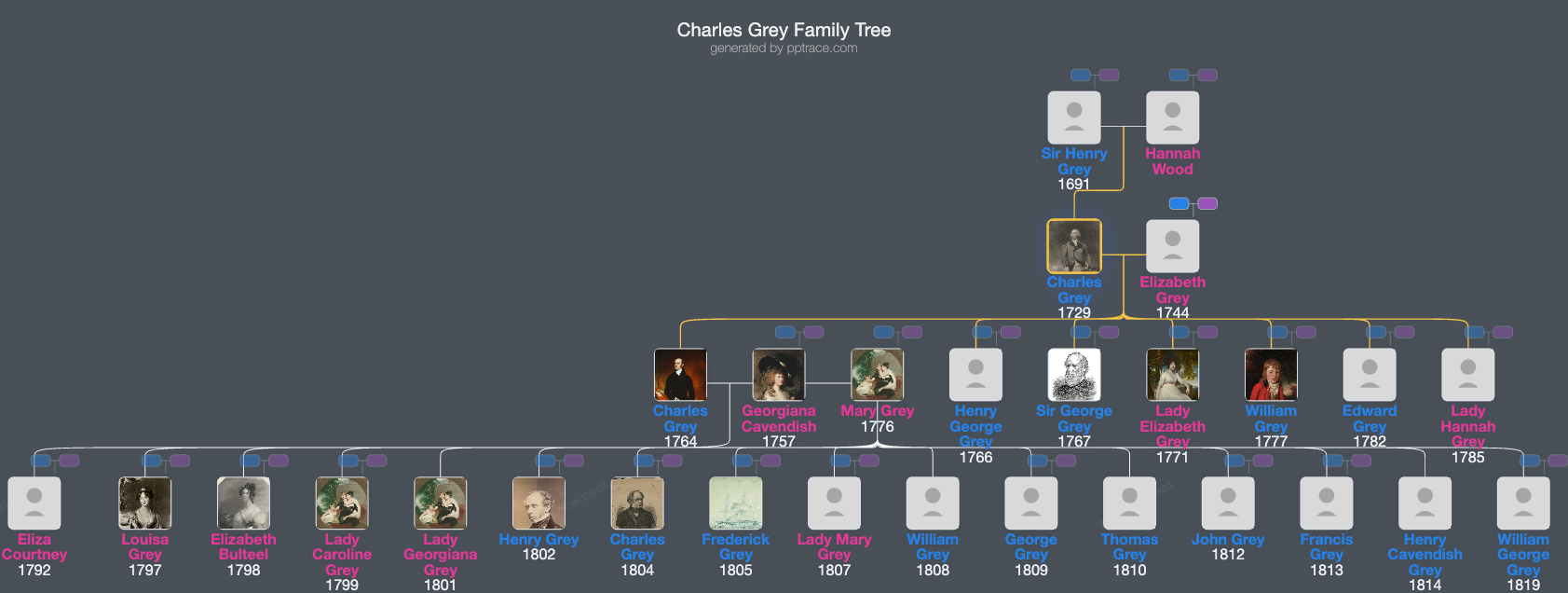
Family Tree
Tap  to expand more relatives
Introduction
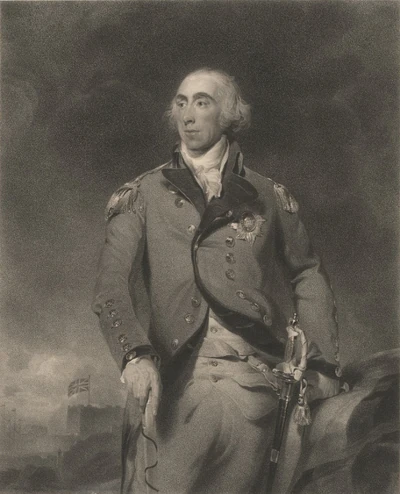
Charles Grey, 1st Earl Grey, was born around 23 October 1729, at Howick Hall, located 30 miles north of Newcastle upon Tyne and approximately one mile from the North Sea. His precise birth date is not documented; however, he was baptized on 23 October 1729, suggesting a likely October birth. Grey was the third son of Sir Henry Grey, 1st Baronet, of Howick, and Lady Hannah Grey (née Wood), daughter of Thomas Wood of Fallodon, Northumberland. Having two older brothers, Grey did not initially expect to inherit his family's titles and estates, prompting him to pursue a career in the British Army. His elder brothers Sir Henry and Thomas died without issue, rendering Grey the heir to the family estate.
In 1744, with financial support from his father, Grey purchased a commission as an ensign in the 6th Regiment of Foot. Early in his military career, he participated in the suppression of the Jacobite Rising of 1745 in Scotland, after which the regiment spent several years stationed in Gibraltar. He attained the rank of lieutenant in December 1752, also within the Sixth Regiment. By March 1755, Grey formed a new independent company and was appointed its captain. Two months later, he purchased a captaincy in the 20th Regiment of Foot, later known as the East Devonshire Regiment and eventually the Lancashire Fusiliers. During this period, James Wolfe served as lieutenant colonel in the same regiment.
Grey took part in the attack on Rochefort in 1757, which proved unsuccessful. During the Seven Years' War, he served as an adjutant on the staff of Duke Ferdinand of Brunswick and was wounded at the Battle of Minden on 1 August 1759. He also commanded a Light Company at the Battle of Campen on 14 October 1760, where he was wounded again. In 1761, as lieutenant colonel of the 98th Regiment of Foot, he participated in the Capture of Belle Île off Brittany. In 1762, he fought at the Battle of Havana and served on the staff of Wilhelm, Count of Schaumburg-Lippe, during the Spanish invasion of Portugal. He retired on half-pay in 1763 but was promoted to colonel in 1772 and served as aide-de-camp to King George III.
During the American War of Independence, Grey emerged as one of the more successful British military leaders. He was promoted to major general in 1777 and commanded the 3rd Brigade at the Battle of Brandywine. He became known as "No-Flint Grey," purportedly for ordering his men to remove flints from their muskets on a night approach in 1777, although records indicate he only directed muskets to be unloaded. He commanded this brigade at the Battles of Germantown and Monmouth. Following the controversial retreat from Monmouth, American General Charles Lee suggested Grey was a formidable adversary, reflecting Grey's respect among his counterparts.
In 1778, Grey conducted raids on New Bedford, destroying shipping and burning shops and houses, and on Martha's Vineyard, where livestock were seized. On 27 September 1778, he led a night attack at Old Tappan, New Jersey, known as the Baylor Massacre. Subsequently, Grey was recalled to England, invested as a knight of the Order of the Bath, and promoted to lieutenant general. He was later appointed commander-in-chief of British forces in America; however, hostilities concluded before he assumed this role.
As tensions escalated in Europe, Grey participated in the French Revolutionary Wars, beginning with his appointment in 1793 as commander of the West Indian expedition. Prior to this, he participated in the relief of Nieuwpoort, Belgium. In 1794, alongside Admiral Sir John Jervis, Grey led British forces to capture Martinique, taking control of Fort Royal, Fort Saint Louis, and Fort Bourbon within about six weeks. The British maintained control until the 1802 Treaty of Amiens, which returned the island to France. Grey also was involved in the invasion of Guadeloupe. Between 1797 and 1807, he served as Governor of Guernsey.
He returned to England in late 1794 and served as Commander of the Southern District from 1798 to 1799 before retiring. In recognition of his service, Grey was raised to the peerage as Baron Grey of Howick in January 1801. In 1806, he was further elevated to Earl Grey and Viscount Howick, both of Northumberland. Grey died on 14 November 1807 at approximately 78 years of age.
He was married to Elizabeth Grey (1744–1822), daughter of George Grey of Southwick. Their children included Charles Grey, 2nd Earl Grey, who served as Prime Minister of the United Kingdom; Sir George Grey, 1st Baronet, a Royal Navy officer; Sir Henry Grey, Colonel in the 13th Light Dragoons; Lady Elizabeth Grey; Lt. Col. William Grey; Edward Grey, Bishop of Hereford; and Lady Hannah Althea Grey. Grey and his wife also raised Eliza Courtney, the illegitimate child of their son Charles with the Duchess of Devonshire in 1792.