Sir George Grey, 1st Baronet
| Name | Sir George Grey, 1st Baronet |
| Title | Royal Navy officer |
| Gender | Male |
| Birthday | 1767-10-10 |
| nationality | United Kingdom of Great Britain and Ireland |
| Source | https://www.wikidata.org/wiki/Q7526887 |
| pptrace | View Family Tree |
| LastUpdate | 2025-11-26T23:27:58.915Z |
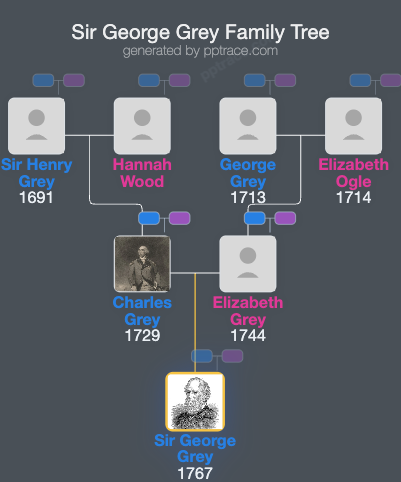
Family Tree
Tap  to expand more relatives
Introduction
Sir George Grey, 1st Baronet, was born on 10 October 1767 at Fallodon Hall in Northumberland. He was the third son of Lieutenant-General Charles Grey, 1st Earl Grey, and Elizabeth Grey, Countess Grey. Among his siblings were Charles Grey, 2nd Earl Grey, who served as Prime Minister of the United Kingdom and is known for his role in abolishing slavery in the British Empire in 1833; Lieutenant-General Sir Henry George Grey, who was Governor of the Cape Colony; and Edward Grey, Bishop of Hereford.
Grey joined the Royal Navy at the age of 14 in 1781. His early naval service included participation in the West Indies and home waters. He served aboard HMS Resolution under Captain Lord Robert Manners during the Battle of the Saintes in 1782, a major engagement against the French. His commission as a 4th Lieutenant was issued in 1784. Through recommendations by his father, Charles Grey, Grey was promoted to Captain of HMS Vesuvius on 7 August 1793. At the start of the war with France in 1793, he was serving on HMS Quebec before taking command of the bomb vessel HMS Vesuvius.
In October 1793, Grey served as flag captain for Vice-Admiral John Jervis on HMS Boyne. He was involved in joint operations in the Caribbean, capturing French colonies such as Martinique, Guadeloupe, and Saint Lucia. Grey’s role often included facilitating troop movements, transporting artillery, ammunition, and supplies, and engaging in combat actions.
On 1 May 1795, HMS Boyne caught fire while anchored off Spithead during marine exercises; the blaze resulted in the loss of eleven crew members from HMS Boyne and two from nearby HMS Queen Charlotte. The ship eventually ran aground and was destroyed by explosion. Grey was court-martialed but was acquitted, having not been aboard at the time of the incident.
In November 1796, Grey served on HMS Lively under Jervis and Robert Calder, operating in the Mediterranean. He participated in the Battle of Cape St Vincent on 14 February 1797, where HMS Victory experienced only one fatality. Later that year, Grey commanded HMS Ville de Paris and in September 1798 succeeded Robert Calder as Master and Commander of the Mediterranean Fleet, under orders from Earl Spencer.
In 1799, Grey was appointed Adjutant-General of the Fleet, serving on the ships Argo and Guerrier. During the short peace period starting in March 1801, Grey commanded a royal yacht at Weymouth and did not return to active naval service afterward.
From 1804 to 1806, Grey served as Commissioner at Sheerness Dockyard. During this tenure, on 23 December 1805, his yacht Chatham transported Horatio Nelson’s coffin, bearing Nelson’s body from HMS Victory to Greenwich Hospital. In 1806, Grey was appointed Commissioner at Portsmouth Dockyard, where he oversaw operational activities and maintained correspondence related to dockyard management until 1827. His communications addressed issues such as worker conditions, accidents, and operational protocols.
Grey was involved in legal and administrative disputes over jurisdiction with the Portsmouth local authorities in 1807. He was also among the supporters of religious and charitable activities, serving as President of the Portsmouth Dock Yard Bible Association and supporting Missions to Seafarers alongside his wife, Mary Whitbread. Mary Grey distinguished herself as the first woman recorded to support seamen’s missions actively.
In 1814, during a royal visit, Grey’s residence hosted notable figures including Emperor Alexander I of Russia and Catherine, Grand Duchess of Oldenburg. On 29 July 1828, Grey was created a Knight Commander of the Most Honourable Order of the Bath.
He maintained a longstanding friendship with Admiral John Jervis until Jervis’s death in 1823. Grey also served as Marshal of the Vice-Admiralty Court at Barbados, was an Alderman of Portsmouth, and Vice President of the Naval and Military Bible Society.
Sir George Grey died at the Portsmouth Dockyard residence on 3 October 1828. His funeral was reported in the Hampshire Telegraph, with prominent military and naval officers participating, and was attended by hundreds of dockyard workers and artificers.