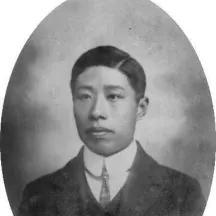
Li Shanxiang
| Name | Li Shanxiang |
| Title | Patriotic industrialist. |
| Gender | Male |
| Birthday | 1880-00-00 |
| nationality | People's Republic of China |
| Source | https://www.wikidata.org/wiki/Q106498985 |
| pptrace | View Family Tree |
| LastUpdate | 2025-10-18T22:32:25.994Z |
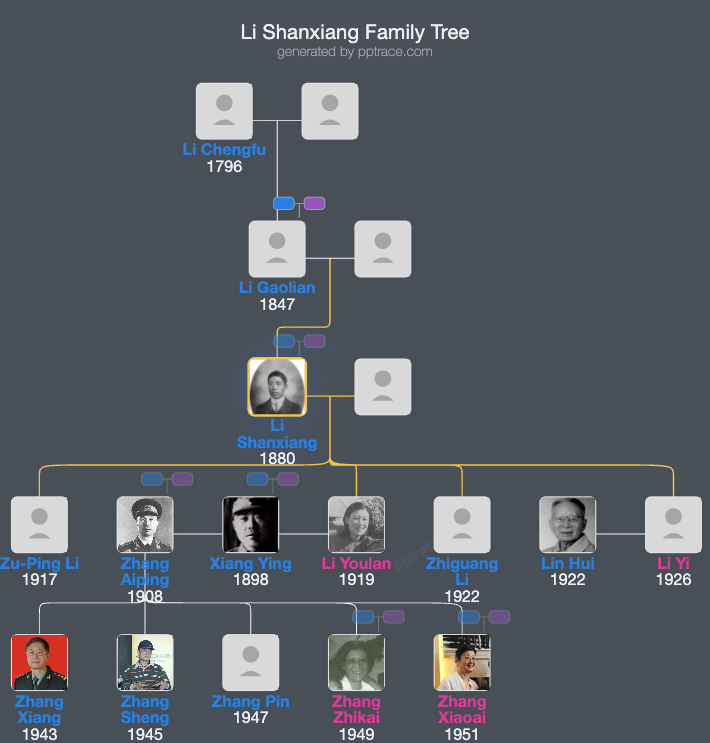
Family Tree
Tap  to expand more relatives
Introduction
Li Shanxiang, born August 25, 1880, in Beijing, traced his ancestral home to Gangkou Village, Zhenhai County, Zhejiang Province. His father was Li Lianshui. The family farmed, but later his great-uncle Li Shiting expanded shipping, finance, and real estate ventures in Shanghai, laying an early foundation of wealth. Influenced by his family in his youth, he pursued broad learning and ideas. Around the time of the Xinhai Revolution, he participated in the New Zhejiang Comrades Association. In 1911 he took part in the Xinhai Revolution and served as the Civil Affairs Director (County Magistrate) of Zhenhai County.
During his tenure, because he insisted on fairness, he was attacked by local magnates and petty gentry, so he resigned and went to the Northeast to develop industry. In 1912 Li Shanxiang, with his wife and two boy apprentices, went to Jinzhou and other places, founding Hengkang Farm, purchasing American moldboard plows, introducing Siemens generators and installing Siemens telephones, operating trading houses and an oil mill, and promoting economic activity in western Liaoning. In 1928, in Jinzhou, he established Shengsheng Orchard Co., Ltd., responsible for fruit-tree breeding and propagation techniques, and created the Gengyu Orchard Arts Institute, with a primary school division, a work-study division, and a research division, providing free admission and lending books. To train horticultural talents, Li invited Tao Xingzhi and other educators to teach at the school, and opened branch schools at Baolongling and Shuipingying. In 1922, together with Jinzhou Station Master Chen Shaoting and others, he co-founded Wansheng Soy Sauce Garden, promoting the development of soy sauce and curd production in the Jinzhou area.
After the September 18 Incident, the Japanese army occupied Jinzhou; Li refused the proposal to become mayor of Jinzhou and returned to Xiaogang. Records indicate that during the War of Resistance against Japan he funded rescue teams and stretcher teams, established refugee reception centers and orphanages, and mobilized family members to participate in rescue and resistance work. His five children, two wives, and three daughters-in-law—ten people in total—joined the Chinese Communist Party and participated in anti-Japanese activities. His second daughter Li Youlan married New Fourth Army commander Zhang Aiping. In 1940 Li was elected director of the Zhenhai County Grain Allocation Committee, responsible for grain distribution and price control.
After the war of resistance was won, Li returned to Jinzhou’s Nanshan Shengsheng Orchard to continue operations; after Jinzhou’s liberation in 1946, he donated Shengsheng Orchard to the state without compensation. Shengsheng Orchard and related buildings were later designated as cultural relics protection units. In 1950 he was elected a representative to Jinzhou’s first People’s Congress; in 1951 he was elected as a consultative member of the Liaoxi Provincial People’s Congress. He died on May 19, 1959, at the age of 80. His children and family continued to develop in education, construction, military, and culture, forming a lasting social influence for the family.