Heneage Finch
| Name | Heneage Finch |
| Title | English nobleman, lawyer, and politician; (1580-1631) |
| Gender | Male |
| Birthday | 1580-00-00 |
| nationality | Kingdom of England |
| Source | https://www.wikidata.org/wiki/Q13502830 |
| pptrace | View Family Tree |
| LastUpdate | 2025-11-26T23:23:53.024Z |
Family Tree
Tap  to expand more relatives
Introduction
Sir Heneage Finch was born on December 15, 1580, at The Moat near Canterbury, England. He was the fifth of seven sons born to Sir Moyle Finch, 1st Baronet, and Elizabeth Heneage. His family background included notable figures such as his paternal grandfather, Sir Thomas Finch, a military commander, and through his mother, Sir Thomas Heneage, Chancellor of the Duchy of Lancaster and Vice-Chamberlain of the Household, was his maternal grandfather and godparent. Among his siblings were Theophilus, Thomas, and Francis Finch. His sister Anne was recognized as a writer and was married to Sir William Twysden; another sister, Catherine, married Sir John Wentworth, 1st Baronet of Gosfield.
Finch's mother was elevated to the peerage as Viscountess Winchilsea in 1623, and further honored as Countess of Winchilsea in 1628. She died in 1634, and Finch’s elder brother Thomas succeeded their eldest brother Theophilus in both the baronetcy and family estates.
Educationally, Finch matriculated at Trinity College, Cambridge, around 1592, and received a Bachelor of Arts degree in 1596. He was admitted to Inner Temple in 1597 and was called to the bar in 1606.
Finch's political career began with his election as Member of Parliament for Rye in 1607, in a by-election prompted by Thomas Hamon’s death. His election was facilitated by his brother-in-law Sir William Twysden through a recommendation from Henry Howard, 1st Earl of Northampton. However, due to Parliament's recess, Finch did not take his seat until February 1610. He was not re-elected in 1614 and was succeeded by Edward Hendon.
After his initial parliamentary service, Finch entered royal service through Prince Charles. In December 1620, he was nominated by the Duke of Cornwall for a parliamentary seat at Helston, but the seat was ultimately secured by William Noy for Henlston, and Finch was allocated as MP for West Looe.
In 1621, Finch succeeded Robert Shute as Recorder of London, a position he held until his death in 1631. His legal career advanced significantly between 1621 and 1624; he served as summer reader at the Inner Temple in 1622, was knighted on June 22, 1623, and became a serjeant-at-law.
Throughout the early 1620s, Finch was elected to represent the City of London and served until the dissolution of Parliament. Under King Charles I, Finch was re-elected as MP for the City of London in 1625 and 1626. In 1626, he was chosen to serve as Speaker of the House of Commons.
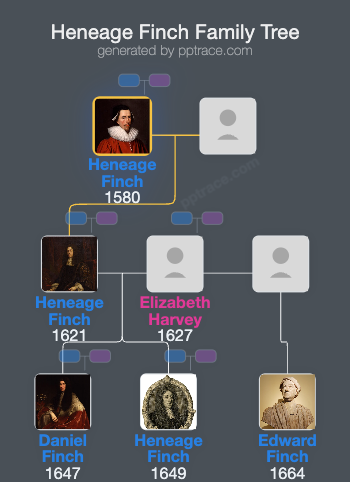
Finch was married twice. His first marriage was to Frances Bell, daughter of Sir Edmond Bell, sometime after 1607. They had four children: Heneage Finch, who became the 1st Earl of Nottingham; Francis Finch; Elizabeth Finch; and John Finch. Frances Bell died in 1627.
His second marriage was to Elizabeth Cradock (née Bennett) on April 16, 1629. Elizabeth was the widow of Richard Bennett, a wealthy London merchant, and daughter of William Cradock. Their children included Frances Finch, who married Sir Clifford Clifton, and Anne Finch, a philosopher associated with the Cambridge Platonists and an influence on Leibniz, who married Edward Conway, Viscount Conway.
Sir Heneage Finch died on December 5, 1631, at the age of 50, and was buried at Ravenstone, Buckinghamshire. His widow, Elizabeth, died in 1661.