Heneage Finch, 1st Earl Of Aylesford
| Name | Heneage Finch, 1st Earl Of Aylesford |
| Title | English lawyer and politician |
| Gender | Male |
| Birthday | 1649-01-01 |
| nationality | Kingdom of England |
| Source | https://www.wikidata.org/wiki/Q5714099 |
| pptrace | View Family Tree |
| LastUpdate | 2025-11-26T23:23:53.882Z |
Family Tree
Tap  to expand more relatives
Introduction
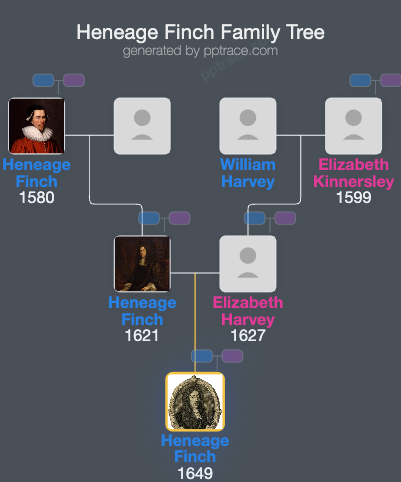
Heneage Finch, 1st Earl of Aylesford, PC, KC, was an English lawyer and politician born around 1649. He died on 22 July 1719. He was the second son of Heneage Finch, 1st Earl of Nottingham, and Elizabeth Hervey, eldest daughter of Daniel Hervey. His paternal grandparents were Hon. Sir Heneage Finch, Speaker of the House of Commons, and Frances Bell, daughter of Sir Edmond Bell of Beaupré Hall.
Finch received education at Westminster School and matriculated at Christ Church, Oxford on 18 November 1664. In 1673, he became a barrister of the Inner Temple, received the rank of king's counsel and became a bencher in 1677. In 1679, during his father's tenure as chancellor, Finch was appointed Solicitor General. He was elected to Parliament representing Oxford University and later Guildford.
Throughout his legal career, Finch held several significant positions. In 1682, he represented the crown in the case against the Corporation of London, and in 1683, he prosecuted Lord Russell, displaying a vigorous style according to Gilbert Burnet. In 1684, he participated in the trial of Algernon Sidney, arguing that Sidney’s unpublished treatise was an overt act of rebellion, supported by the doctrine that writing equates to action. That same year, he served as counsel for King James II in his libel suit against Titus Oates and prosecuted Oates for perjury in 1685.
Despite his role as a Tory and a crown lawyer, Finch was a committed churchman. In 1686, he refused to defend James II's royal dispensing power, which led to his dismissal. He notably defended the Seven Bishops in 1688 but made tactical errors that almost jeopardized their case. Finch served as a Member of Parliament for Oxford University and was part of the convention parliament that followed. He generally opposed the House of Orange and supported a regency for James II.
Finch was involved in a number of legislative debates. He voted for reversing Lord Russell’s attainder in 1689 and opposed the Triennial Bill of 1692. In 1696, he spoke against the bill of association and test, asserting that William III should not be acknowledged as the rightful king. He also argued against the crown in the bankers’ case of 1694.
In 1703, Finch was created Baron Guernsey and appointed to the Privy Council. After the accession of George I in 1714, he was elevated to the earldom of Aylesford and appointed Chancellor of the Duchy of Lancaster, a position he held until February 1716.
Finch was recognized for his oratory and legal skills. Contemporary accounts described him as one of the greatest orators in England, a firm supporter of the crown’s prerogative, and a person of integrity. His legal arguments are documented in several State Trials. There is also a historical attribution, albeit uncertain, of authorship of certain pamphlets.
On 16 May 1678, Finch married Elizabeth Banks, daughter of Sir John Banks of Aylesford. They had three sons and six daughters. His children included Lady Elizabeth Finch, who married Robert Benson, 1st Baron Bingley; Heneage Finch, 2nd Earl of Aylesford; Lady Anne Finch, who married William Legge, 1st Earl of Dartmouth; Hon. John Finch; and Lady Frances Finch. His eldest son succeeded him as the 2nd Earl of Aylesford upon his death.