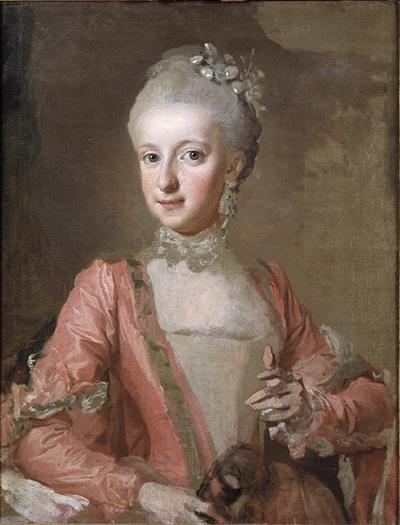
Sophia Albertina Of Sweden
| Name | Sophia Albertina Of Sweden |
| Title | Princess-Abbess of Quedlinburg |
| Gender | Female |
| Birthday | 1753-10-18 |
| nationality | Sweden |
| Source | https://www.wikidata.org/wiki/Q261929 |
| pptrace | View Family Tree |
| LastUpdate | 2025-11-12T01:15:47.710Z |
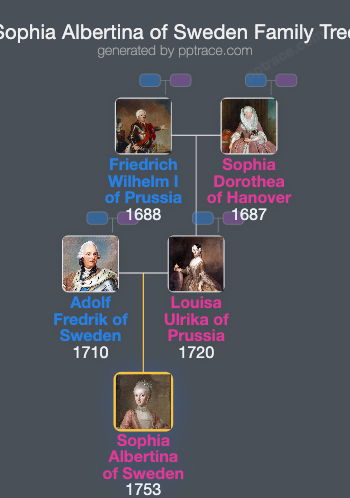
Family Tree
Tap  to expand more relatives
Introduction
Princess Sophia Albertina of Sweden (full name: Sophia Maria Lovisa Fredrika Albertina) was born on October 8, 1753, in Stockholm, Sweden. She died on March 17, 1829, in Stockholm. She was a daughter of King Adolf Frederick of Sweden and Queen Louisa Ulrika of Prussia. As a member of the Swedish royal family, she was a sister to Gustav III of Sweden and held the titles of princess of Sweden and princess of Holstein-Gottorp. In 1814, with the accession of Norway to the Swedish crown and the political changes within the royal family, she was designated as a "Royal Princess (of no country)."
Sophia Albertina was named in honor of her grandmothers: Queen Sophia Dorothea of Hanover and Margravine Albertina Frederica of Baden-Durlach. Her early education was supervised by prominent tutors, including Baroness Ulrica Schönström, Baroness Kristina Kurck, and Countess Magdalena Stenbock. Her court preceptors included Eric af Sotberg as her governor, French-language tutor Louise Du Londel, dance instructor Marguerite Morel, artist Jean Eric Rehn, and musician Francesco Uttini.
In 1767, she was designated as Coadjutrix of Quedlinburg Abbey, a Lutheran convent in the Holy Roman Empire, through her maternal uncle Frederick the Great of Prussia. She succeeded her aunt, Anna Amalia of Prussia, as Princess-Abbess of Quedlinburg in 1787, ruling over a small German state directly under the Holy Roman Empire until the mediatization of 1802, when the territory was annexed by Prussia.
During her lifetime, she maintained residences in Stockholm, including a palace now known as Arvfurstens Palats, and spent periods at Quedlinburg. Her governance as abbess involved establishing schools, founding a theatre, and managing local affairs. Her rule was characterized by active participation in civic projects and cultural life.
Her private life has been subject to speculation. Early considerations included potential marriages to various princely figures, but no marriage occurred. Rumors of an illegitimate child in the 1780s have persisted, with suggestions that she may have given birth to an illegitimate child named Sophia or Peter Niklas. The father of this child has been linked to individuals such as Count Fredrik Vilhelm von Hessenstein or Gustav Badin, her foster brother. These allegations remain unconfirmed.
In 1795, the Lolotte Forssberg affair attracted attention. Forssberg was a chamber maid and foster sibling of Sophia Albertina; an anonymous letter suggested Forssberg was her secret sister. Sophia Albertina investigated and eventually acknowledged Forssberg as her illegitimate half-sister, possibly with her father being Ulla von Liewen, a lady-in-waiting and her own courtier. Forssberg was treated as her sister and remained close to her throughout her life.
In her later years, after the dissolution of Quedlinburg Abbey in 1802, Sophia Albertina returned to Sweden. She was affected by geopolitical changes, including the Swedish loss of the territory in 1807 and the political upheavals surrounding the deposition of her nephew Gustaf IV Adolf in 1809. During the early 19th century, she maintained close ties with the Swedish royal family and was active in court ceremonies, including participating in the wedding of Crown Prince Charles Louis (later Charles XV) in 1823 and witnessing his birth in 1826.
Throughout her life, she was involved in cultural activities such as theatre and painting—in particular, pastel portraits and caricatures—and was a member of the Accademia di San Luca in Rome. She also engaged in charitable work, founding the society Välgörande fruntimmerssällskapet in 1819. She was considered an important figure within the Swedish royal court until her death in 1829.
The Sofia Albertina Church in Landskrona, opened in 1788, is named after her.