William Polk
| Name | William Polk |
| Title | American politician and military officer (9 July 1758 – 14 January 1834) |
| Gender | Male |
| Birthday | 1758-07-09 |
| nationality | United States of America |
| Source | https://www.wikidata.org/wiki/Q8016984 |
| pptrace | View Family Tree |
| LastUpdate | 2025-11-16T10:09:18.100Z |
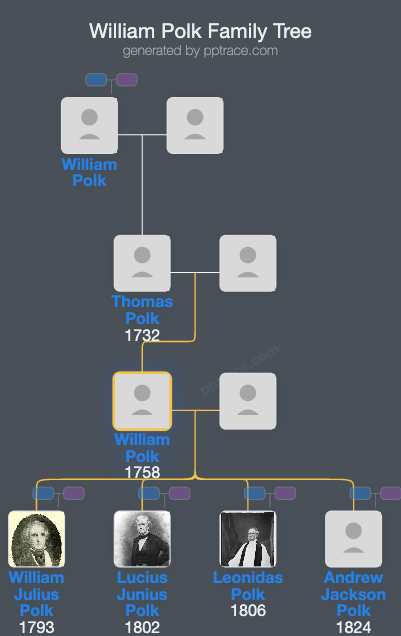
Family Tree
Tap  to expand more relatives
Introduction
William Polk was born in Mecklenburg County, North Carolina, on July 9, 1758. He was the eldest child of Thomas Polk and Sussana Spratt. The Polk family was actively involved in the revolutionary movement against British authority, with Thomas Polk serving as commander of the local militia and being believed to have played a role in the adoption of the Mecklenburg Resolves on May 31, 1775. Thomas Polk also served as colonel of the 4th North Carolina Regiment in the Continental Line. William Polk had three brothers who also served as officers during the American Revolutionary War; one of his brothers, Thomas Polk, was killed at the Battle of Eutaw Springs, serving alongside William. William Polk was reportedly close friends with Andrew Jackson.
During the onset of the American Revolution, William Polk left Queens College to accept a commission as second lieutenant in his uncle Ezekiel Polk’s company of the Third South Carolina Regiment, commanded by Col. William Thomson. He was wounded severely in the left shoulder at Great Cane Brake on December 23, 1775, during a campaign against Tory forces in South Carolina. He was transported 120 miles to his father’s home in North Carolina for recuperation. His wound was noted as possibly the first American bloodshed south of Lexington and Concord.
In November 1776, the Provincial Congress of North Carolina at Halifax elected Polk as major of the 9th North Carolina Regiment in the North Carolina Continental Line. The regiment, initially under-recruited, was ordered to Maryland and then to Trenton, New Jersey, to join General George Washington’s army. Polk participated in the Battle of Brandywine on September 11, 1777. During the Battle of Germantown on October 4, 1777, he was shot in the mouth, losing four teeth and shattering his jawbone. He remained with his regiment during the winter encampment at Valley Forge, 1777 and 1778.
Following the depletion of North Carolina regiments in March 1778, Polk was removed from active service and returned to North Carolina, where he engaged in recruiting and skirmishes against Tories until April 1780. After the fall of Charleston, he served as an aide to Major General Richard Caswell at the Battle of Camden in August 1780. He fought at Camden and later joined militia efforts to aid Daniel Morgan after the Battle of Cowpens. In early 1781, Polk was present during Cornwallis’s crossing of the Catawba River and was involved in engagements with Cornwallis’s forces, including the Battle of Eutaw Springs, on September 8, 1781. During this battle, Polk’s horse was shot dead, and a British soldier attempted to stab him, but he was rescued by a regiment sergeant. His brother Lieutenant Thomas Polk was killed in the same engagement. General Nathanael Greene, commanding the American forces, commended Polk’s conduct after the battle.
Following the end of hostilities, William Polk returned to North Carolina. In 1783, the North Carolina General Assembly appointed him as Surveyor General of the Middle District. He also acquired land in the region now comprising Tennessee. Polk was elected to the North Carolina House of Commons multiple times, serving in 1786, 1787, and 1790. In 1791, he contested for the position of Speaker of the House but was defeated by Stephen Cabarrus. President George Washington appointed him as Supervisor of Internal Revenue for North Carolina in March 1791, a role he held for seventeen years.
Polk was among the founding members of the North Carolina Society of the Cincinnati on October 23, 1783. After the death of his first wife in 1799, he moved to Raleigh, North Carolina. That same year, he was elected Grand Master of Masons of North Carolina, serving until December 1802. Federalist politicians nominated him for governor in 1802, but he was defeated by John Baptista Ashe, who died before assuming office. In 1811, Polk became the first president of the State Bank of North Carolina, serving for eight years.
In March 1812, President James Madison offered Polk a commission as brigadier general in the U.S. Army, which he declined due to his opposition to the war with Britain. He later changed his position after the British attack on Washington in August 1814, and he offered his services to North Carolina but was not called into service. In June 1818, Polk became one of the first vice presidents of the Raleigh Auxiliary of the American Colonization Society, which aimed to resettle free African Americans in colonies abroad. William Polk died on January 14, 1834.