Leonidas Polk
| Name | Leonidas Polk |
| Title | Confederate General (1806-1864) |
| Gender | Male |
| Birthday | 1806-04-10 |
| nationality | United States of America |
| Source | https://www.wikidata.org/wiki/Q1368292 |
| pptrace | View Family Tree |
| LastUpdate | 2025-11-29T01:00:20.428Z |
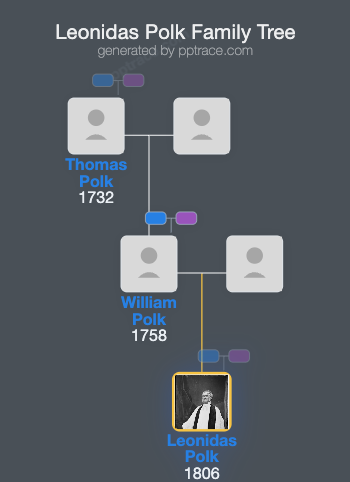
Family Tree
Tap  to expand more relatives
Introduction
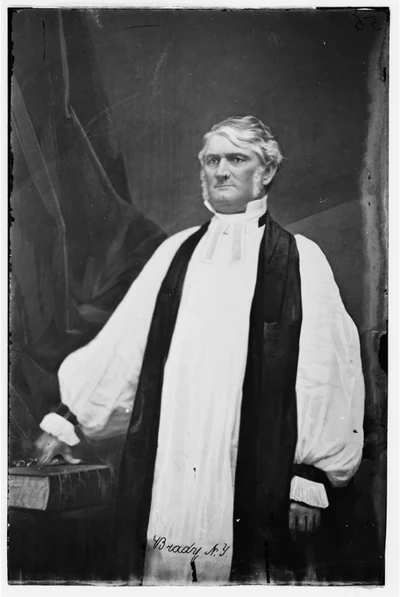
Leonidas Polk (April 10, 1806 – June 14, 1864) was an American religious leader and military officer during the 19th century. He held the position of bishop of the Episcopal Diocese of Louisiana and was the founder of the Protestant Episcopal Church in the Confederate States of America, a secessionist branch that separated from the Episcopal Church of the United States. Polk was also a planter in Maury County, Tennessee, and a second cousin of President James K. Polk.
Born in Raleigh, North Carolina, to Colonel William Polk and Sarah Hawkins Polk, Leonidas Polk was of Scottish and Huguenot descent. His father was a Revolutionary War veteran and a wealthy landowner, serving as the chief surveyor of the central Tennessee district, which enabled him to acquire approximately 100,000 acres of land. Polk's early education included a brief period at the University of North Carolina at Chapel Hill before he entered the United States Military Academy at West Point. He graduated eighth in his class on July 1, 1827, and was commissioned as a brevet second lieutenant in the artillery but resigned from the Army on December 1, 1827.
After leaving West Point, Polk attended the Virginia Theological Seminary and became an assistant to Bishop Richard Channing Moore at Monumental Church in Richmond, Virginia. He was ordained a deacon in April 1830 after being confirmed as an Episcopalian. In that same year, Polk married Frances Ann Devereux, with whom he had eight children. His wife was the granddaughter of theologian Jonathan Edwards.
In 1832, Polk relocated his family to Maury County, Tennessee, where he built Ashwood Hall, a Greek Revival mansion. By 1840, Polk was the largest slave owner in Maury County, owning 111 slaves; by 1850, census records indicate he owned 400 slaves, with estimates suggesting as many as 1,000. He also established St. John's Church at Ashwood and served as a priest at St. Peter's Church in Columbia, Tennessee.
Polk was appointed Missionary Bishop of the Southwest in September 1838 and later became the first Bishop of Louisiana in October 1841. He was a prominent founder of the University of the South in Sewanee, Tennessee, which he envisioned as a leading institution comparable to Oxford and Cambridge. The university's cornerstone was laid under Polk's supervision in October 1860.
During the American Civil War, Polk aligned with the Confederacy, advocating for the secular separation of the Confederate Episcopal Church from the Episcopal Church of the United States. He actively participated in military affairs after being commissioned as a major general in the Confederate States Army on June 25, 1861. Polk was involved in several significant battles, including the Battle of Shiloh, the Battle of Perryville, the Battle of Stones River, the Tullahoma Campaign, the Battle of Chickamauga, the Meridian Campaign, and the Atlanta campaign. His military career was marked by conflicts with fellow Confederate generals, notably General Braxton Bragg, and limited success in combat.
Polk was considered a political and controversial military figure, partly due to his connections and familiarity with the Mississippi Valley. His role was influenced by Confederate President Jefferson Davis, who appointed him to high military positions despite Polk's limited combat experience.
While serving under General Joseph E. Johnston during the Atlanta campaign, Leonidas Polk was killed in action in 1864. His death occurred during the ongoing conflict as the Confederacy faced increasing military challenges.