Henry James, Sr.
| Name | Henry James, Sr. |
| Title | American Swedenborgian theologian (1811–1882) |
| Gender | Male |
| Birthday | 1811-06-03 |
| nationality | United States of America |
| Source | https://www.wikidata.org/wiki/Q2694988 |
| pptrace | View Family Tree |
| LastUpdate | 2025-11-17T06:38:34.940Z |
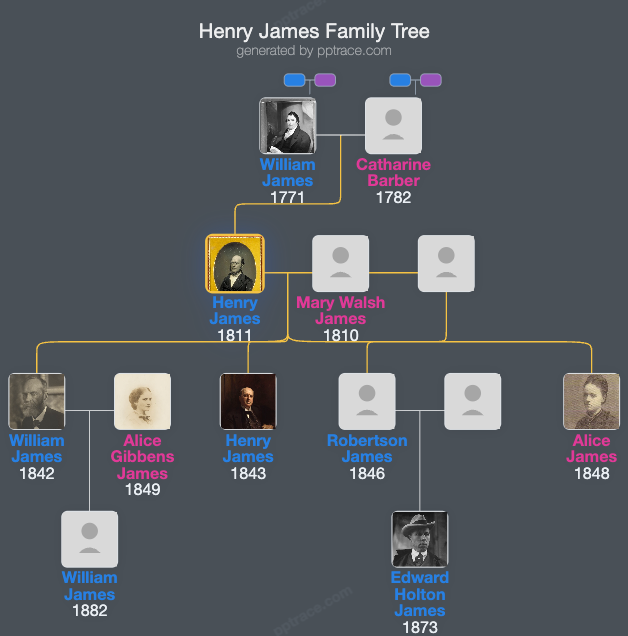
Family Tree
Tap  to expand more relatives
Introduction
Henry James Sr. (June 3, 1811 – December 18, 1882) was an American theologian and the father of William James, a philosopher; Henry James, a novelist; and Alice James, a diarist. He was born in Albany, New York, and was one of twelve children of Catharine (née Barber) James and William James. His father emigrated from Bailieborough, County Cavan, Ireland, around 1789, and amassed a fortune approximately equating to $1.2 million through real estate, money lending, and involvement with the Erie Canal.
At the age of thirteen, James Sr. experienced a life-altering injury when he was severely burned in a barn fire, resulting in the loss of a leg, which led to three years of being bedridden and a deep focus on study. He attended The Albany Academy and graduated from Union College in 1830. His father, a Presbyterian, disapproved of his religious ideas; however, after the father's will was contested, James Sr. became independently wealthy. He studied at Princeton Theological Seminary from 1835 to 1837 but abandoned the pursuit of becoming a minister due to philosophical difficulties. Subsequently, he traveled to England for about a year before returning to New York in 1838.
In 1838, upon returning to New York, James Sr. prepared an edition of Robert Sandeman's *Letters on Theron and Aspasio*. He regarded Sandeman's work as an authentic exposition of Gospel truth, appreciating its egalitarian message concerning spiritual acceptance regardless of social status or virtue.
Around 1841, James Sr. developed an interest in Swedenborgianism after reading articles by J. J. Garth Wilkinson. He formed friendships with figures such as Ralph Waldo Emerson and was introduced to Thomas Carlyle, but he did not find Emerson's thought entirely satisfying. His primary spiritual influence came from Emanuel Swedenborg (1688–1772), a Swedish scientist and religious visionary. On a solitary evening in May 1844 while living in Windsor, England, James Sr. experienced a profound spiritual event, which he later termed a "vastation," characterized by intense terror and a sense of invisible, malevolent presence. This crisis lasted two years and was resolved through engagement with Swedenborg's writings and Christian mysticism.
James Sr. believed that the root of human depravity was attachment to the self and that true salvation involved liberation from illusions of selfhood and natural appearances—such as time, space, and individuality—through intuition of a fully spiritual reality, which he associated with God. He maintained a lifelong attachment to Swedenborgian ideas and traveled with their texts, sharing his spiritual discoveries in lectures from 1845 onward. His writings include volumes explaining his spiritual philosophy and mysticism.
In social thought, James Sr. expressed interest in utopian experiments like Brook Farm (operational from 1841 to 1847) and Fourierism, the socialist philosophy of Charles Fourier. He criticized contemporary American materialism and held reformist views such as the abolition of slavery and the liberalization of divorce laws. His critique of society was rooted in his spiritual philosophy, which regarded creation as a spiritual process and the problem of evil as stemming from delusions of selfhood. His theological perspective was at odds with the naturalism prevalent in 19th-century religious thought; he viewed true reality as thoroughly spiritual and believed that evil arose from attachment to the self.
Throughout his later years, despite limited public recognition and skepticism from his contemporaries, James Sr. engaged actively in discussion and maintained a circle of friends and intellectual contacts. He favored informal, intimate gatherings over formal society, emphasizing affection and thought. His reflection on his own disposition indicated a preference for the fireside rather than public forums.
Henry James Sr. passed away in 1882. His influence persisted through his children, his writings on spiritual and social thought, and his role within the circle of American intellectuals of his time.