Henry James
| Name | Henry James |
| Title | American and British writer (1843–1916) |
| Gender | Male |
| Birthday | 1843-04-15 |
| nationality | United States of America |
| Source | https://www.wikidata.org/wiki/Q170509 |
| pptrace | View Family Tree |
| LastUpdate | 2025-11-17T06:38:35.694Z |
Family Tree
Tap  to expand more relatives
Introduction
Henry James (born April 15, 1843, in New York City – died February 28, 1916, in London) was an American-British novelist, critic, and short story writer. His literary work is recognized as a transition between the styles of realism and modernism, and he is considered one of the most significant novelists in the English language.
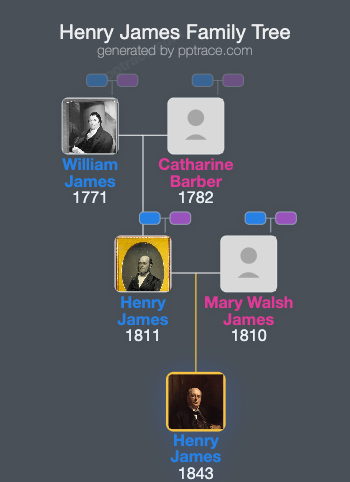
James was the son of Henry James Sr., a theologian, philosopher, and lecturer, and Mary Walsh. His family was of Irish and Scottish descent. He had three brothers, William James, a philosopher and psychologist; Wilkinson (Wilkie) James; and Robertson James. His sister Alice James was a diarist. The family left New York for Europe before James was one year old, residing temporarily in Windsor Great Park, England. They returned to New York in 1845 and spent portions of his childhood living between Albany and Manhattan.
James's education was eclectic, influenced by scientific and philosophical interests, and was supplemented by tutoring and travel across Europe and the United States. Between 1855 and 1860, the family traveled extensively in Europe, including stays in London, Paris, Geneva, Bonn, and Boulogne-sur-Mer. During this time, James became fluent in French and developed an affinity for French literature, notably Balzac, whom he later regarded as his greatest literary influence.
In 1860, the family returned to Newport, Rhode Island, where James interacted with figures such as Thomas Sergeant Perry and artist John La Farge. These relationships introduced him to prominent literary and artistic circles and to European writers. He first attended Harvard Law School in 1862 but soon shifted his focus to literature, engaging with writers such as William Dean Howells, Charles Eliot Norton, Oliver Wendell Holmes Jr., and the Fields family.
James's early publications included reviews and short stories, with his first work appearing in 1863. He contributed to periodicals such as the Atlantic Monthly and The Nation. His first novel, "Watch and Ward," was published in serial form in 1871 and later as a book in 1878.
During a trip to Europe in 1869–70, James met notable writers including John Ruskin, Charles Dickens, Matthew Arnold, William Morris, and George Eliot. The trip greatly influenced his aesthetic and literary sensibilities, and he traveled extensively across the continent, supporting himself through freelance writing and correspondence assignments in Paris and Rome.
In 1876, James settled in England, eventually acquiring British citizenship in 1915. He spent much of his life abroad, living in various European countries, and became a British subject shortly before his death. His literary output includes novels, short stories, critical essays, travel writings, biographies, autobiography, and plays.
James is best known for novels exploring social and marital relationships among émigré Americans, the English, and Europeans, such as "The Portrait of a Lady." His later works, including "The Ambassadors," "The Wings of the Dove," and "The Golden Bowl," are noted for their experimental narrative techniques and psychological depth, often employing ambiguous motives and impressions reminiscent of Impressionist painting. His novella "The Turn of the Screw" is regarded as one of the most analyzed ghost stories in English literature and has been widely adapted across media. Other notable stories include "The Jolly Corner."
Henry James was nominated for the Nobel Prize in Literature in 1911, 1912, and 1916. His influence extends to many writers and critics, including Jorge Luis Borges, who praised his work for its unparalleled originality in fantastic literature.