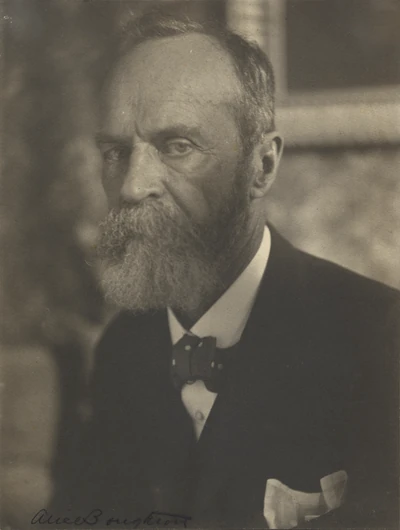
William James
| Name | William James |
| Title | American philosopher, psychologist, and pragmatist (1842–1910) |
| Gender | Male |
| Birthday | 1842-01-11 |
| nationality | United States of America |
| Source | https://www.wikidata.org/wiki/Q125249 |
| pptrace | View Family Tree |
| LastUpdate | 2025-11-17T06:38:37.320Z |
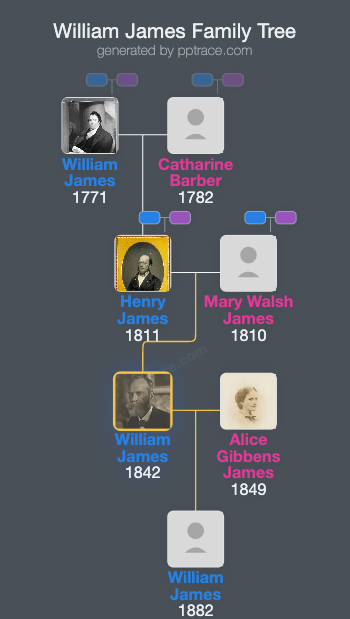
Family Tree
Tap  to expand more relatives
Introduction
William James (January 11, 1842 – August 26, 1910) was an American philosopher and psychologist known for his contributions to the development of psychology and philosophy in the United States. He was the first individual to offer a psychology course in the United States and is recognized as a leading thinker of the late 19th century. James is often referred to as the "father of American psychology."
James was born at the Astor House in New York City. His father was Henry James Sr., a Swedenborgian theologian with independent wealth, and his mother was Mary Robertson Walsh. He was part of a family that included notable siblings, such as the novelist Henry James and the diarist Alice James.
He received a diverse education, developing fluency in German and French. The family traveled to Europe multiple times during his childhood. Originally interested in becoming a painter, James apprenticed in William Morris Hunt's studio in Newport, Rhode Island. However, under his father’s influence, he pursued studies in medicine, enrolling at Harvard College's Lawrence Scientific School in 1861 to study physiology, with particular interest in the nervous system and psychology.
James experienced various health issues throughout his early life, including ailments affecting his eyes, back, stomach, and skin, as well as periods of depression and thoughts of suicide. During the American Civil War, his brothers Garth Wilkinson and Robertson fought in the conflict, but James himself was an advocate of peace and suggested alternative service for youth.
In 1864, James began medical studies at Harvard Medical School but interrupted his education to join a scientific expedition to the Amazon River with Louis Agassiz, which he abandoned due to seasickness and smallpox. His health continued to interfere with his studies, leading him to travel to Germany seeking cures. He remained there from 1867 to 1868, during which he published some of his early written works.
He earned his MD degree in June 1869 but did not practice medicine. Instead, he dedicated himself to philosophy and psychology, which he regarded as his true interests. His philosophical pursuits culminated in significant texts such as "The Principles of Psychology," "Essays in Radical Empiricism," and "The Varieties of Religious Experience."
William James held faculty positions predominantly at Harvard University. His academic career progressed from instructor to full professor and endowed chair in psychology. He taught his first experimental psychology course at Harvard during the 1875–1876 academic year and was involved in intellectual circles such as The Metaphysical Club, which included contemporaries like Charles Sanders Peirce, Oliver Wendell Holmes, and others.
James's areas of academic interest encompassed psychology, philosophy, epistemology, education, and religion. He played a key role in establishing the school of pragmatism alongside Peirce and helped develop the philosophical perspective of radical empiricism. His influence extended to many prominent scholars and writers, including W. E. B. Du Bois, Bertrand Russell, Ludwig Wittgenstein, and Richard Rorty.
In 1878, William James married Alice Howe Gibbens, and together they had five children: Henry, William, Herman (who died in infancy), Margaret, and Alexander. His personal life was marked by health challenges, including worsening heart issues in his later years. In 1910, he traveled to Europe to seek experimental treatments but returned home shortly before his heart failed. William James died at his residence in Chocorua, New Hampshire, on August 26, 1910. He was buried in Cambridge Cemetery, Massachusetts.
James was a founding member of the American Society for Psychical Research and served as president of the British Society for Psychical Research during 1884 and 1885. His work and influence remain significant within psychology and philosophy, with rankings citing him as one of the most eminent psychologists of the 20th century.