Victor Cavendish, 9th Duke Of Devonshire
| Name | Victor Cavendish, 9th Duke Of Devonshire |
| Title | British politician (1868-1938) |
| Gender | Male |
| Birthday | 1868-05-31 |
| nationality | United Kingdom |
| Source | https://www.wikidata.org/wiki/Q2411883 |
| pptrace | View Family Tree |
| LastUpdate | 2025-11-26T23:33:16.808Z |
Family Tree
Tap  to expand more relatives
Introduction
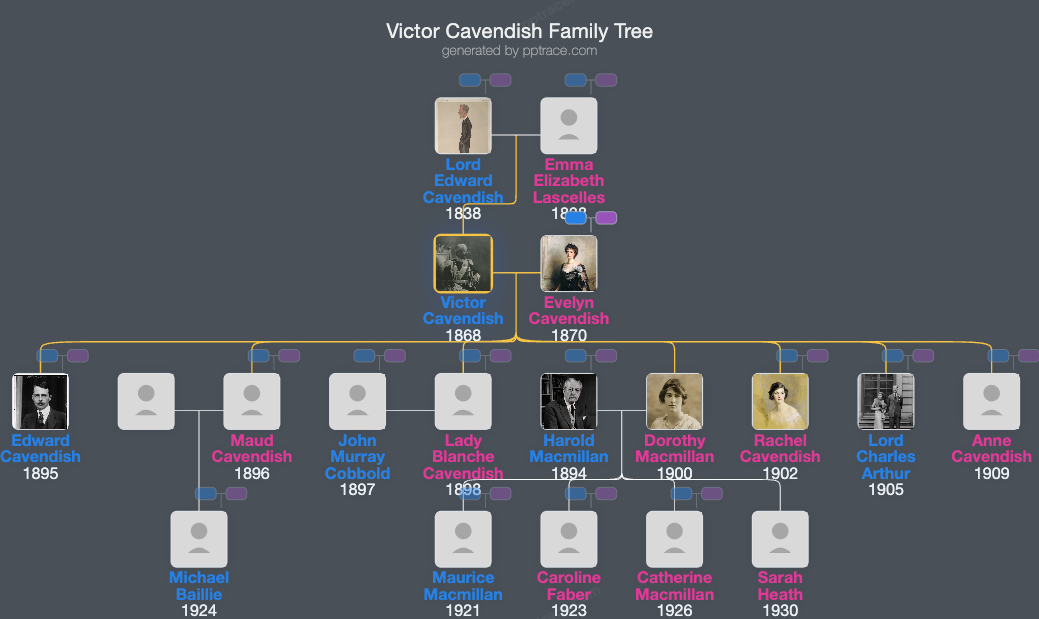
Victor Christian William Cavendish, 9th Duke of Devonshire (31 May 1868 – 6 May 1938), was a British peer and politician who served as Governor General of Canada. He was born at Devonshire House in Mayfair, London, as the eldest son of Lord Edward Cavendish and Emma Lascelles. His family was prominent, with his grandfather serving as Chancellor of the University of Cambridge and his relatives including Spencer Cavendish, 8th Duke of Devonshire, and Lord Frederick Cavendish.
Cavendish received his education at Eton College before attending Trinity College, Cambridge, where he enrolled on 30 May 1887. During his studies, he served as secretary of the Pitt Club and was initiated into Isaac Newton University Lodge. He graduated with a Bachelor of Arts in 1891. He also studied law at The Honourable Society of the Inner Temple and accounting through private means. Additionally, he served part-time in the Derbyshire Yeomanry, being commissioned as a second lieutenant in 1890, promoted to major in 1901, and retiring in 1911.
In 1892, Cavendish married Lady Evelyn Petty-FitzMaurice, daughter of Henry Petty-FitzMaurice, 5th Marquess of Lansdowne. The marriage produced seven children: Edward William Spencer Cavendish, who became the 10th Duke of Devonshire; Lady Maud Louisa Emma Cavendish; Lady Blanche Katharine Cavendish; Lady Dorothy Evelyn Cavendish; Lady Rachel Cavendish; Lord Charles Arthur Francis Cavendish; and Lady Anne Cavendish.
Cavendish entered politics shortly before his father's death in 1891, winning his father's parliamentary seat for West Derbyshire unopposed. He served as a Member of Parliament for 17 years, holding various positions including Treasurer of the Household (1900–1903), Financial Secretary to the Treasury (1903–1905), and being sworn into the Privy Council in 1905. In 1908, he succeeded his uncle as the 9th Duke of Devonshire, which rendered him ineligible to sit in the House of Commons and transferred his role to the House of Lords. That year, he was appointed Lord Lieutenant of Derbyshire.
He was active in local governance, serving as mayor of Eastbourne (1909–1910) and Chesterfield (1911–1912). In the House of Lords, he served as Conservative Chief Whip from 1911 and as joint Government Chief Whip during World War I, also serving as Civil Lord of the Admiralty. He was involved in the iron and steel industry, presiding over the Iron and Steel Institute from 1910 to 1912.
In August 1916, King George V appointed Cavendish as Governor General of Canada, a recommendation made by Prime Minister H. H. Asquith. His appointment initially faced controversy, as Canadian Prime Minister Robert Borden had not been consulted. Cavendish was sworn in on 11 November 1916 in Halifax. His tenure coincided with the ongoing World War I and a period of social unrest in Canada. Notably, he was responsible for introducing conscription, which was a divisive issue and led to the Conscription Crisis of 1917. He also visited Nova Scotia to survey the damage caused by the Halifax Explosion in December 1917.
During his time as Governor General, Devonshire engaged in extensive tours across Canada and worked to promote unity amid national tensions. He maintained close contact with Canadian political leaders, consulted on war efforts, and emphasized the development of agriculture. His leadership was eventually viewed as effectively managing Canada's war efforts and fostering national pride.
Following his term as Governor General, Devonshire served as Secretary of State for the Colonies from 1922 to 1924. He subsequently retired to his estate in Derbyshire, where he died on 6 May 1938. He was the last Duke of Devonshire to hold a cabinet position.