Edward Cavendish, 10th Duke Of Devonshire
| Name | Edward Cavendish, 10th Duke Of Devonshire |
| Title | head of the Devonshire branch of the Cavendish family (1895-1950) |
| Gender | Male |
| Birthday | 1895-05-06 |
| nationality | United Kingdom |
| Source | https://www.wikidata.org/wiki/Q2761950 |
| pptrace | View Family Tree |
| LastUpdate | 2025-11-26T23:33:19.623Z |
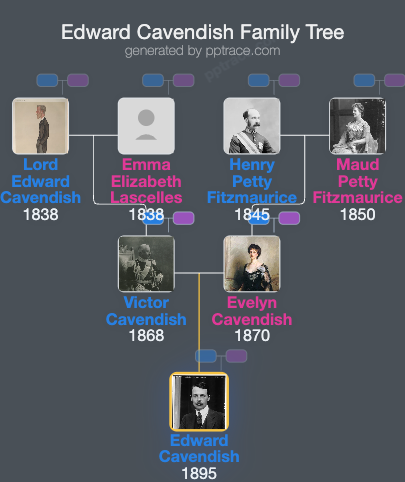
Family Tree
Tap  to expand more relatives
Introduction
Edward William Spencer Cavendish, 10th Duke of Devonshire (6 May 1895 – 26 November 1950), was a British nobleman and politician. He was born at 37, Park Lane, Mayfair, and was the son of Victor Cavendish, who became the 9th Duke of Devonshire, and Lady Evelyn Petty-Fitzmaurice. In 1908, upon his father's accession to the dukedom, he assumed the courtesy title of Marquess of Hartington.
He received education at Eton College and Trinity College, Cambridge. As the heir apparent to the dukedom, he became owner of Chatsworth House and was a substantial landowner across Great Britain and Ireland.
Cavendish joined the Territorial Army in 1913 as a second lieutenant in the Derbyshire Yeomanry. During the First World War, he served with distinction, initially as an aide-de-camp at GHQ of the British Expeditionary Force. In 1916, he was promoted to captain and served in Egypt during the Dardanelles campaign. He later served in France, was attached to Military Intelligence, and worked with the War Office and British Military Mission in Paris. He was mentioned in despatches twice and was appointed a Member of the Order of the British Empire (MBE) following the Treaty of Versailles signing in 1919. He also received the French Legion of Honour.
Post-war, he continued service with his regiment, which evolved into the 24th (Derbyshire Yeomanry) Armoured Car Company of the Royal Tank Regiment in 1923. His promotions included major in 1932 and lieutenant colonel in 1935. He was awarded the Territorial Decoration and served as Honorary Colonel for units within the Territorial Army.
In political life, he contested parliamentary seats unsuccessfully in 1918 for North East Derbyshire and in 1922 for West Derbyshire. He was elected MP for West Derbyshire in 1923, holding the seat until 1938 when he succeeded his father and entered the House of Lords. During World War II, he served as a Parliamentary Under Secretary of State for India and Burma (1940–1943) and for the Colonies (1943–1945) under Winston Churchill's government. He also served in various local government roles in Derbyshire, including as a Justice of the Peace (appointed 1917), Deputy Lieutenant (1936), and Lord Lieutenant (from 1938 until his death). He was Mayor of Buxton from 1920 to 1921.
Beyond politics, Cavendish held multiple civil positions. He was chairman of the Overseas Settlement Board in 1936, served as High Steward of the University of Cambridge, and was Chancellor of the University of Leeds from 1938 until 1950. He was a director of The Alliance Insurance Company of Britain and the Bank of Australasia, and president of the Zoological Society of London in 1948. In addition, he was active within Freemasonry, serving as Grand Master of the United Grand Lodge of England from 1947 to 1950.
In his personal life, Cavendish married Lady Mary Gascoyne-Cecil in 1917. She was granddaughter of Prime Minister Robert Gascoyne-Cecil, 3rd Marquess of Salisbury. The couple had five children:
- William John Robert Cavendish, Marquess of Hartington (1917–1944), married Kathleen Kennedy, sister of John F. Kennedy; was killed in action during World War II.
- Andrew Robert Buxton Cavendish, 11th Duke of Devonshire (1920–2004), married the Hon. Deborah Freeman-Mitford.
- Lady Mary Cavendish (1922–1922), who died in infancy.
- Lady Elizabeth Georgiana Alice Cavendish (1926–2018).
- Lady Anne Evelyn Beatrice Cavendish (1927–2010), who married Michael Lambert Tree.
The Duke's sister Dorothy Cavendish was married to Prime Minister Harold Macmillan, and his younger brother Charles Cavendish married American dancer Adele Astaire.
Cavendish died suddenly of a heart attack at age 55 at his residence, Compton Place, Eastbourne. His death occurred in the presence of Dr. John Bodkin Adams, a physician later suspected of serial killings. Adams signed the death certificate indicating natural causes; no formal police investigation was conducted at the time. Adams was later tried and acquitted for the murder of Edith Alice Morrell, another of his patients. The loss of the estate to death duties led to the transfer of properties including Hardwick Hall to the National Trust and the sale of numerous assets. His body was interred in the churchyard at Edensor, Derbyshire.
In 1946, he transferred most of his assets to his only surviving son to mitigate estate taxes, but his death less than four years later resulted in a substantial tax liability, affecting the inheritance and management of the family estate.