Sir John Gladstone, 1st Baronet
| Name | Sir John Gladstone, 1st Baronet |
| Title | British politician |
| Gender | Male |
| Birthday | 1764-12-11 |
| nationality | United Kingdom of Great Britain and Ireland |
| Source | https://www.wikidata.org/wiki/Q7527795 |
| pptrace | View Family Tree |
| LastUpdate | 2025-11-26T23:30:10.581Z |
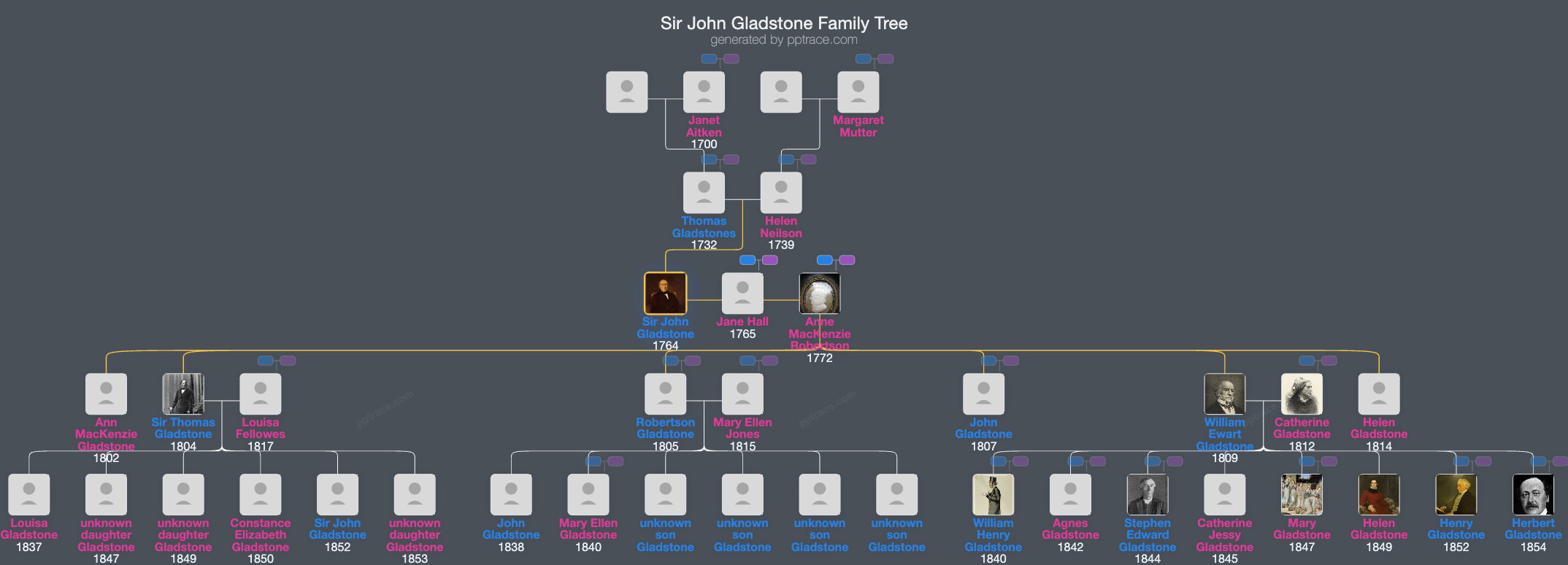
Family Tree
Tap  to expand more relatives
Introduction
Sir John Gladstone, 1st Baronet (11 December 1764 – 7 December 1851), was a Scottish merchant and politician. He was born in Leith, Midlothian, as the eldest son of Thomas Gladstones, a merchant, and Helen Neilson. Gladstone was the second of sixteen children in his family. His early education concluded at age 13 with a "plain" education comprising reading, basic Latin, writing, and arithmetic. He apprenticed to Alexander Ogilvy at the Edinburgh Roperie and Sailcloth Company ropeworks, before entering his father's business in corn and flour trading.
In 1784, Gladstone traveled to the German Baltic ports to purchase grain, and in 1786, he visited Liverpool, Manchester, and London to sell his father's commodities. With his father's support, he moved to Liverpool in 1787, where he adopted the surname Gladstone (dropping the final 's' officially in 1835). Gladstone established a partnership with Edgar Corrie and Jackson Bradshaw, forming the firm Corrie, Gladstone & Bradshaw, which grew significantly in wealth. He spent a year in the United States acquiring various goods and, upon returning, expanded his mercantile activities.
Gladstone married Jane Hall in 1792; she was the daughter of a Liverpool merchant. She died in 1798. In 1800, Gladstone remarried, to Anne Mackenzie Robertson, daughter of Andrew Robertson, a solicitor and provost of Dingwall. The couple had six children: Anne Mackenzie Gladstone, Sir Thomas Gladstone, Robertson Gladstone, John Neilson Gladstone, William Ewart Gladstone, and Helen Jane Gladstone.
In terms of religious life, Gladstone shifted from Presbyterianism to the Church of England around 1804. The Gladstone family moved to Seaforth House near Liverpool in 1813, a mansion set on 100 acres of land. Gladstone built St Thomas's Anglican Church at Seaforth and also established a school attached to St Andrew's Episcopal Church.
Gladstone's business ventures included extensive trade with Russia, and he was involved in importing sugar and other goods. In 1814, following the end of the East India Company's monopoly, his firm was among the first to send a private ship to Calcutta. His investments extended to property development in Liverpool.
Gladstone owned large sugar plantations in Jamaica and Demerara (present-day Guyana). The Demerara Rebellion of 1823, a significant slave uprising, originated on his plantation. The revolt was suppressed with military force. Jack Gladstone, an enslaved man working as a cooper on Gladstone’s plantation, was named after him. Following the abolition of slavery in the British Empire, Gladstone received a large compensation payment through the Slave Compensation Act 1837, the largest among all claimants, for the emancipation of over 2,500 slaves across multiple plantations. The total compensation received amounted to approximately £106,769, equivalent to around £12.25 million in 2023.
After slavery was abolished, Gladstone sought to employ indentured laborers from British India in his plantations. He expressed interest in importing Indian workers and described conditions in a letter dated 4 January 1836. His accounts of these conditions were optimistic, but the reality of the indentured labor system involved severe exploitation, including poor wages, malnutrition, and overwork.
In his political career, Gladstone served as a Member of Parliament from 1818 to 1827. He died in 1851, with his involvement in slavery impacting the proslavery ideology of his son William Ewart Gladstone during the early part of his political career.