Robertson Gladstone
| Name | Robertson Gladstone |
| Title | British politician (1805-1875) |
| Gender | Male |
| Birthday | 1805-11-15 |
| nationality | — |
| Source | https://www.wikidata.org/wiki/Q7352100 |
| pptrace | View Family Tree |
| LastUpdate | 2025-11-26T12:44:57.623Z |
Family Tree
Tap  to expand more relatives
Introduction
Robertson Gladstone was born on 15 November 1805 and died on 23 September 1875. He was an English merchant and politician, the second son and third child of Sir John Gladstone and the brother of William Ewart Gladstone, who served as Prime Minister of the United Kingdom on four separate occasions.
He was raised in Liverpool, residing initially at the family home in Rodney Street and later at Seaforth House from 1813. For his education, Gladstone attended Eton College along with his older brothers Thomas and William. However, his education did not motivate him toward a political career, and it was considered that Eton did not suit him due to disciplinary issues under headmaster John Keate. Subsequently, John Gladstone arranged for Robertson to become a merchant, initially serving as his assistant and later as a business partner.
In September 1821, at age sixteen, Gladstone was sent to Glasgow College, where he studied mathematics, moral philosophy, and natural philosophy. During his time in Glasgow, he lodged with family members including his aunt Mary Gladstone and her husband, Dr. John Nimmo. After completing his studies, he returned to Liverpool to work in his father's empresarial offices.
In 1827, Robertson traveled with his brother Thomas to Naples, observing the eruption of Mount Vesuvius. In 1828, he sought permission to visit the family estates in the West Indies and traveled to Demerara in British Guiana, arriving in November of that year. He remained there until March 1829, a period he documented in his "Journal of a Voyage & Residence in the Colony of Demerara," which is held at the Liverpool Athenaeum library. On his return journey, he visited the United States and stopped in Philadelphia.
In 1830, Gladstone built a residence at Cuckoo Lane, Woolton, Liverpool. He became a member of a Masonic lodge in Liverpool in 1833. His political activity included being elected as a councilor for Liverpool's Abercromby ward during the 1838 municipal elections, after multiple attempts. He served as Mayor of Liverpool from 1842 to 1843 and remained involved in local politics and administrative committees throughout his life. In 1863, he proposed Charles Mozley for mayor, who subsequently became Liverpool’s first Jewish mayor.
Gladstone held various roles including justice of the peace (J.P.) for Lancashire, trustee of the Liverpool Union Mill and Bread Company, and member of the city’s health committee. His political stance evolved toward more left-leaning, semi-socialist ideas over time.
In his business career, Robertson Gladstone was involved in banking, railway companies, and plantation ownership. He became a partner in Heywood's Bank, where his father-in-law also held a stake. He served as Deputy Chairman of the Grand Junction Railway and participated in various other railway committees. He was the first President of the Liverpool Financial Reform Association, established in 1848, which was noted for its advocacy of free trade.
Gladstone inherited his father’s Liverpool firm in 1851 and owned multiple properties in Liverpool's affluent districts, including 24 Abercromby Square, which is now part of the University of Liverpool. His land development efforts included the development of land north of Seaforth for new dockyards.
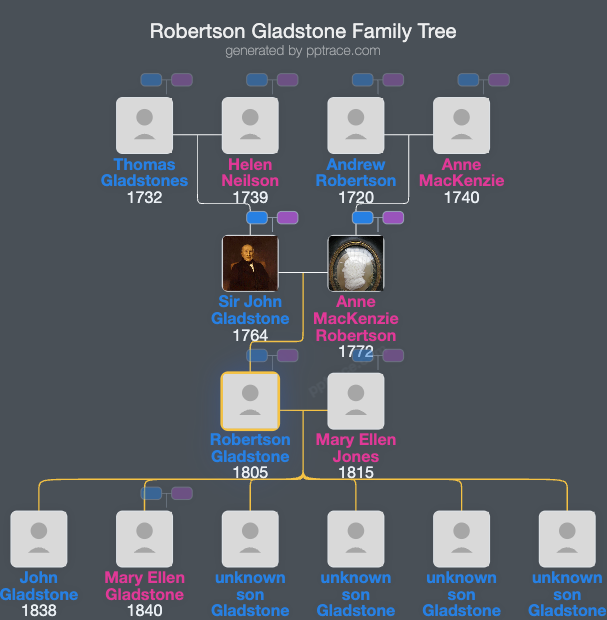
He married Mary Ellen Jones on 28 January 1836 at St George's Church, Liverpool. Mary Ellen was the daughter of banker Hugh Jones. The marriage caused some familial disagreements due to religious differences; the Jones family were Unitarian, whereas the Gladstones were Anglican evangelicals. The couple had eight children, all of whom remained unmarried or childless. Their residence was Court Hey Hall.
Gladstone's wife died in 1865, leaving him without her companionship. He was described as a physically large man with a weight of approximately 20 stones. His later years included the sale of much of his property portfolio in a Liverpool auction in 1876 following his death. His estate was valued at under £120,000, with a bequest of £500 to local charities and schools.
He died at Court Hey in 1875, and his sons Robertson and Arthur served as executors of his estate.