John Gladstone
| Name | John Gladstone |
| Title | British politician (1807-1863) |
| Gender | Male |
| Birthday | 1807-01-18 |
| nationality | United Kingdom of Great Britain and Ireland |
| Source | https://www.wikidata.org/wiki/Q6250233 |
| pptrace | View Family Tree |
| LastUpdate | 2025-11-26T12:45:00.264Z |
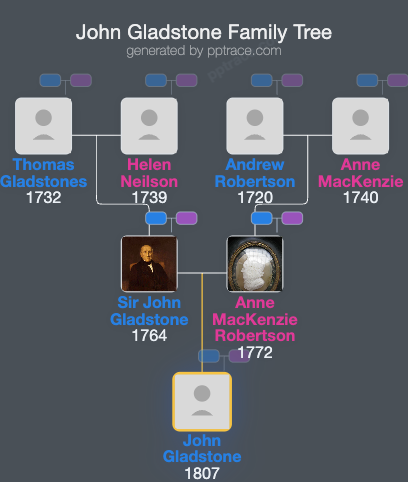
Family Tree
Tap  to expand more relatives
Introduction
Captain John Neilson Gladstone (18 January 1807 – 7 February 1863) was a British politician affiliated with the Conservative Party and served as an officer in the Royal Navy. He was the fourth child of Sir John Gladstone, a Scottish-born businessman based in Liverpool, and his wife Anne MacKenzie née Robertson from Dingwall. His familial relations include his younger brother William Ewart Gladstone, who later became British Prime Minister, and an older brother Thomas, who also served as a Member of Parliament (MP).
John Neilson Gladstone received education at Eton College and attended Christ Church, Oxford. In 1820, he enrolled at the Royal Naval College in Portsmouth and spent eight years at sea. Despite his maritime career, he was eventually promoted to Captain in the Royal Navy. In 1832, he accompanied his naval brother William on a European tour that lasted 179 days. They traveled by post-chaise across various European cities, including Brittany, Turin, Genoa, Rome, Naples, Venice, and the Swiss Lakes, before returning to London in July of that year.
In 1839, Gladstone married Elizabeth Honoria Bateson, daughter of William Bateson. The couple purchased Bowden Park near Chippenham in Wiltshire, where he resided after his marriage.
Transitioning from naval service to politics, Gladstone unsuccessfully attempted to secure a ship at sea with the Royal Navy. Instead, he entered politics as a Conservative candidate, winning a seat in Walsall at a by-election on 4 February 1841. The subsequent general election in June of that year involved a dispute over electoral practices, with allegations against him related to funding from slavery for election expenses. These claims were denied, with assertions that his family was not involved in slave plantations either before or after abolition, and that rumors regarding compensation payments were exaggerated.
He was re-elected as MP for Ipswich in 1842, serving until 1847. During his time in Parliament, he opposed the repeal of the Corn Laws, expressing concerns that the removal of protective tariffs would harm agriculture and bankrupt small farmers, while also opposing Prime Minister Sir Robert Peel’s policy. Gladstone articulated his position in Parliament, emphasizing the importance of agriculture and caution regarding legislative changes.
Gladstone supported the salvage operation for the wreck of HMS Thetis by the Admiralty in April 1847. He was subsequently elected MP for Devizes in 1852, lost this seat in 1857, but was re-elected in 1859.
John Neilson Gladstone died at Bowden Park in February 1863. His death was observed as an emotional occasion, with his brother William arriving shortly before his passing and attending his bedside. William later documented his brother’s final days in his diaries. Gladstone left behind seven daughters and a son. After his death, William managed the funeral arrangements and allocated funds from his brother’s estate to support his Midlothian campaign. Subsequently, a parliamentary seat was filled through a writ moved five days later in the House of Commons.
References in the record include entries from William Richard O'Byrne's "A Naval Biographical Dictionary," legislative debates from the Hansard records, and secondary accounts such as Roy Jenkins' biography of Gladstone. External links provide access to parliamentary contributions and legacy profiles related to John Neilson Gladstone.