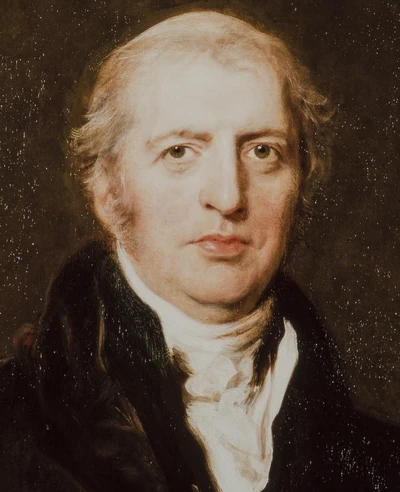
Robert Jenkinson, 2nd Earl Of Liverpool
| Name | Robert Jenkinson, 2nd Earl Of Liverpool |
| Title | Prime Minister of the United Kingdom from 1812 to 1827 |
| Gender | Male |
| Birthday | 1770-06-07 |
| nationality | United Kingdom of Great Britain and Ireland |
| Source | https://www.wikidata.org/wiki/Q312569 |
| pptrace | View Family Tree |
| LastUpdate | 2025-11-26T23:26:08.735Z |
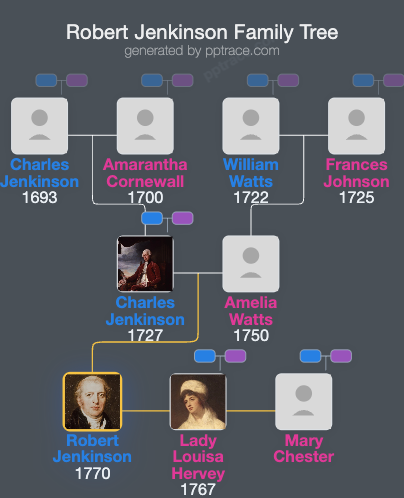
Family Tree
Tap  to expand more relatives
Introduction
Robert Banks Jenkinson, 2nd Earl of Liverpool (7 June 1770 – 4 December 1828), was a British politician and statesman who served as Prime Minister of the United Kingdom from 1812 to 1827. He was a member of the Conservative Party, historically known as the Tories. His political career included roles as Foreign Secretary, Home Secretary, and Secretary of State for War and the Colonies prior to his premiership.
Born in London, Jenkins was the son of Charles Jenkinson, who was later created the 1st Earl of Liverpool. His mother was Amelia Watts. His maternal great-grandmother, Isabella Beizor, was of Portuguese descent with possible Indian ancestry. Jenkins was baptised on 29 June 1770 at St. Margaret's, Westminster. His mother died shortly after his birth. During his childhood, he was cared for by his paternal grandmother in Winchester, with additional involvement from his maternal and paternal aunts.
He attended Charterhouse School and later matriculated at Christ Church, Oxford, in April 1787. During his time at Oxford, he formed a lifelong friendship with George Canning, with whom he established a debating society. He graduated with a Master of Arts degree in May 1790. Witnessing the Storming of the Bastille during a summer in Paris in 1789, he was deeply influenced by the French Revolution.
Jenkinson's political career commenced in 1790 when he was elected to represent the constituencies of Rye and Appleby; he chose Rye. He was under age at election and did not take his seat until after his twenty-first birthday. His early parliamentary activity included opposition to abolition of the slave trade and involvement in foreign policy debates. He was appointed to the India Board in 1793. During the War of the First Coalition with France, he became colonel of the Cinque Ports Light Dragoons in 1794.
In 1795, he married Lady Louisa Hervey, daughter of the Earl of Bristol. His father was elevated to the peerage as Earl of Liverpool in 1796, granting Jenkins the courtesy title of Lord Hawkesbury. The family served in various military and governmental capacities, with Jenkins participating in military campaigns in Scotland and later holding several government ministerial roles.
Jenkins became a Privy Councillor in 1799, and in 1801 he was appointed Secretary of State for Foreign Affairs in the government of Henry Addington. His diplomatic role involved negotiations of the Treaty of Amiens with France. In 1803, he was elevated to the peerage as Baron Hawkesbury and later continued in high office during the regnant ministries, serving as Home Secretary after Pitt's return to power in 1804. Following Pitt's death in 1806, he was instrumental in advising the appointment of the Duke of Portland as Prime Minister.
In 1808, upon his father's death, he became the Lord Liverpool. During his career, he held the position of Secretary of State for War and the Colonies starting in November 1809, supporting military campaigns such as the Peninsular War. He was also involved in militia service from 1810.
Liverpool assumed the office of Prime Minister on 8 June 1812, following the assassination of Spencer Perceval. His tenure encompassed significant events including the defeat of Napoleon at the Battle of Waterloo, the Congress of Vienna, the War of 1812 with the United States, the Peterloo Massacre, the Cato Street Conspiracy, and the Queen Caroline affair.
His government initially implemented repressive measures to maintain domestic order, introduced the Corn Laws, and repealed income tax. In the 1820s, his administration shifted towards more liberal policies, including reforms of criminal law and prison systems. Throughout his premiership, Liverpool managed the contentious issue of Catholic emancipation. He resigned in February 1827 due to ill health, specifically a stroke, and died later that year on 4 December 1828. He was married twice but had no children; upon his death, the earldom passed to his younger half-brother.