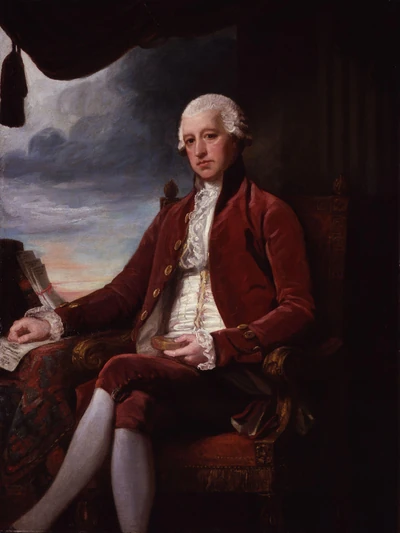
Charles Jenkinson, 1st Earl Of Liverpool
| Name | Charles Jenkinson, 1st Earl Of Liverpool |
| Title | British politician |
| Gender | Male |
| Birthday | 1727-04-26 |
| nationality | Great Britain |
| Source | https://www.wikidata.org/wiki/Q2654558 |
| pptrace | View Family Tree |
| LastUpdate | 2025-11-26T23:26:09.663Z |
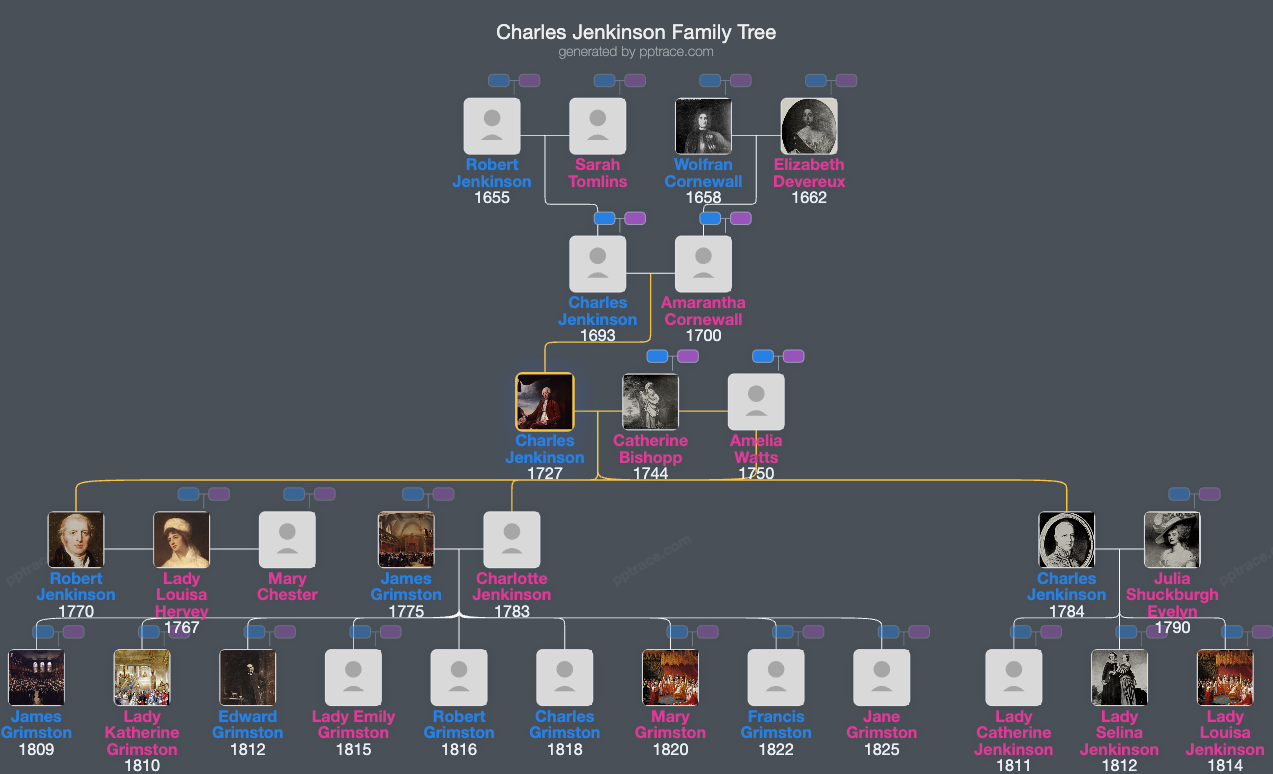
Family Tree
Tap  to expand more relatives
Introduction
Charles Jenkinson, 1st Earl of Liverpool (26 April 1729 – 17 December 1808), was a British statesman who held various political positions in 18th and early 19th century Britain. He was known as Lord Hawkesbury from 1786 until he was elevated to the earldom in 1796. His son, Robert Jenkinson, served as Prime Minister of the United Kingdom.
Early life and family background:
He was born in Winchester as the eldest son of Colonel Charles Jenkinson (1693–1750) and Amarantha Cornewall, daughter of Wolfran Cornewall. His family descended from Anthony Jenkinson (died 1611), a sea captain, merchant, and traveler who was the first known Englishman to reach Central Asia. The Jenkinson family was also associated with Sir Robert Jenkinson, 2nd Baronet, of Walcot, Oxfordshire.
Education:
He attended Charterhouse School and then University College, Oxford, where he graduated with a Master of Arts degree in 1752.
Political career:
In 1761, Jenkinson entered Parliament representing Cockermouth, and was appointed Under-Secretary of State under Lord Bute. He gained favor with King George III, and following Bute’s retirement, he became the leader of the "King's Friends" in the House of Commons. In 1763, he was appointed joint Secretary to the Treasury by George Grenville. After a brief period of retirement, he served as a Lord of the Admiralty and then as a Lord of the Treasury during the Grafton administration.
His political positions expanded in the following years:
- 1772: Appointed Privy Councillor, Vice Treasurer of Ireland.
- 1775: Purchased the sinecure of Clerk of the Pells in Ireland and became Master of the Mint of Ireland.
- 1778–1782: Served as Secretary at War under Lord North.
- 1786–1804: Served as President of the Board of Trade and Chancellor of the Duchy of Lancaster.
He was created Baron Hawkesbury of Hawkesbury in 1786, and in 1796, he was elevated to Earl of Liverpool. In 1790, he succeeded his cousin as the 7th Baronet of Walcot, inheriting family estates. His residences included Addiscombe Place in Surrey and Hawkesbury in Gloucestershire.
Later life and death:
He died in London on 17 December 1808.
Family:
Jenkinson was married twice. His first marriage was in 1769 to Amelia Watts, daughter of William Watts, governor of Fort William, Bengal. Their only child, Robert, was born in 1770 and later became Prime Minister. Amelia died shortly after childbirth. His second marriage was in 1782 to Catherine Cope (née Bishopp), widow of Sir Charles Cope, 2nd Baronet. They had a son, Charles, who became the 3rd Earl of Liverpool, and a daughter, Charlotte, who married James Grimston, 1st Earl of Verulam. His stepdaughter, Arabella Diana Cope, married John Sackville, 3rd Duke of Dorset, and Charles Whitworth, 1st Earl Whitworth.
Legacy:
Apart from his political writings, notably "Treatise on the Coins of the Realm" (1805), which was not considered highly distinguished according to the Encyclopædia Britannica. Geographical locations such as the Hawkesbury River in New South Wales, Australia, and Hawkesbury, Ontario, Canada, were named after him shortly after his creation as Baron Hawkesbury. Two ships bore the name Lord Hawkesbury: an 1781 whaler and the East Indiaman launched in 1787.
References:
- Cokayne, George Edward (1906). Complete Baronetage.
- Petrie, Charles (1954). Lord Liverpool and His Times.
- Britannica, 1911 edition entry on Liverpool, Earls of.
- Further scholarly sources include entries from the Oxford Dictionary of National Biography and the Dictionary of National Biography.