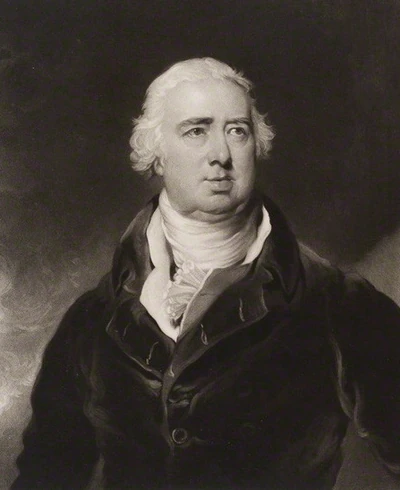
Thomas Dundas, 1st Baron Dundas
| Name | Thomas Dundas, 1st Baron Dundas |
| Title | Scottish politician (1741-1820) |
| Gender | Male |
| Birthday | 1741-02-16 |
| nationality | Scotland |
| Source | https://www.wikidata.org/wiki/Q7018876 |
| pptrace | View Family Tree |
| LastUpdate | 2025-11-26T23:24:01.602Z |
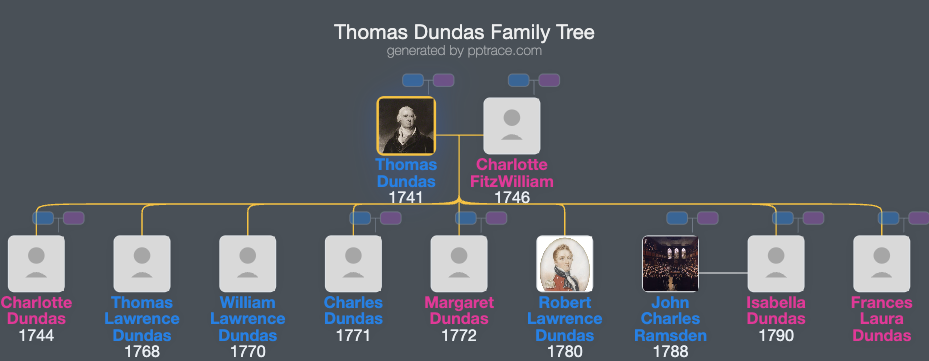
Family Tree
Tap  to expand more relatives
Introduction
Thomas Laurence Dundas, 1st Baron Dundas, FRS, was born on 16 February 1741 and died on 14 June 1820. He was a British politician known for representing Richmond and Stirlingshire in the House of Commons of Great Britain from 1763 to 1794. In 1794, he was elevated to the peerage of Great Britain as Baron Dundas.
Family and Early Life:
He was the only son of Sir Lawrence Dundas, 1st Baronet, often referred to as the "Nabob of the North," and Margaret Bruce (1716–1802). Dundas received education at Eton College and St. Andrews University. Following his formal education, he completed the Grand Tour, a traditional trip through Europe undertaken by young aristocrats.
Political Career and Titles:
While serving as a Member of Parliament, Dundas initially represented Richmond from 1763 until 1768 and subsequently represented Stirlingshire from 1768 until 1794. In August 1794, he was granted the peerage as Baron Dundas of Aske. Beyond his parliamentary duties, he held multiple roles including Lord Lieutenant and Vice Admiral of Orkney and Shetland, Councillor of State to the Prince of Wales (later King George IV), President of the Society of Scottish Antiquaries, and Colonel of the North York Militia.
Property and Inheritance:
In 1762, Dundas acquired Marske Hall in North Yorkshire following the death of Sir William Lowther, 3rd Baronet. He succeeded his father as the 2nd Baronet in 1781, inheriting Aske Hall, also located in North Yorkshire. His familial estates and policies were part of his inheritance from his father.
Interest in Maritime Innovation:
Dundas shared his familial interest in the Forth and Clyde Canal, which was under construction from 1768 to 1790. He was aware of early experiments with steam-powered vessels on the canal, particularly those conducted in 1789 by Patrick Miller of Dalswinton with a double-hulled paddle boat powered by a steam engine, and William Symington's work on steam navigation.
In 1800, Dundas, serving as Governor of the Forth and Clyde Canal Company, commissioned Symington to design a steam-powered tugboat. The initial model, presented in June 1800, was based on a design by Captain John Schank. The constructed boat, tested successfully on the River Carron in June 1801, was intended to tow vessels along the canal. Although the boat demonstrated successful trials, concerns about wave damage to canal banks led to the discontinuation of further developments at that time.
Subsequently, Symington developed an improved design, resulting in the famous "Charlotte Dundas," named after Dundas's daughter. Symington's model garnered attention and was shown to influential figures, including the Duke of Bridgewater, who ordered eight similar boats—an order that was canceled shortly before delivery due to the Duke's death. The Charlotte Dundas conducted successful trials in 1803, but broader adoption was hindered by safety concerns, particularly about erosion of canal banks.
Marriage and Family:
On 24 May 1764, Dundas married Lady Charlotte FitzWilliam, daughter of William FitzWilliam, 3rd Earl FitzWilliam. They had fourteen children, including:
- Lawrence Dundas, who became the 1st Earl of Zetland
- Anne Dundas (born 1767)
- Thomas Dundas (born 1768; died in childhood)
- Lt-Col. William Lawrence Dundas (1770–1796), who died in Santo Domingo
- Charles Lawrence Dundas (1771–1810), who married Lady Caroline Beauclerk
- Margaret Dundas (1772–1852), married Archibald Spiers
- Charlotte Dundas (1774–1855), married Rev. William Wharton
- Thomas Lawrence Dundas (1775–1848)
- Frances Laura Dundas (1777–1844)
- George Heneage Lawrence Dundas (1778–1834)
- Sir Robert Lawrence Dundas (1780–1844)
- Dorothy Dundas (1785–1790)
- Mary Dundas (1787–1830), married Charles FitzWilliam, 5th Earl FitzWilliam
- Isabella Dundas (1790–1887), married John Charles Ramsden
References and External Links:
Additional information about William Symington and the development of steam navigation, as well as details on Dundas's estates, can be found in relevant historical records and publications.