Robert Lawrence Dundas
| Name | Robert Lawrence Dundas |
| Title | British Member of Parliament and military commander (1780-1844) |
| Gender | Male |
| Birthday | 1780-07-27 |
| nationality | United Kingdom of Great Britain and Ireland |
| Source | https://www.wikidata.org/wiki/Q26213078 |
| pptrace | View Family Tree |
| LastUpdate | 2025-11-26T23:24:00.748Z |
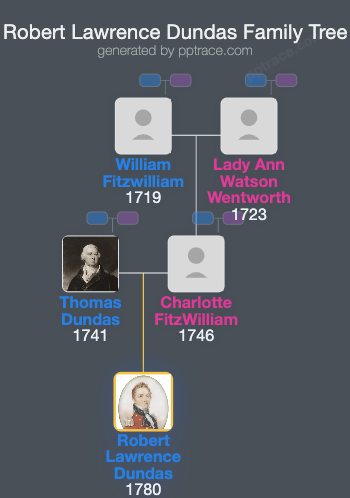
Family Tree
Tap  to expand more relatives
Introduction
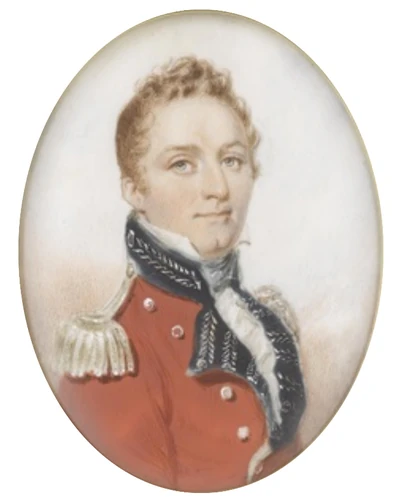
Lieutenant-General Sir Robert Lawrence Dundas (27 July 1780 – 23 November 1844) was a British military officer and politician. Born in Middlesex, he was the seventh son of Thomas Dundas and Lady Charlotte Fitzwilliam. His paternal grandfather was Sir Lawrence Dundas, 1st Baronet, and his maternal grandfather was William Fitzwilliam, 3rd Earl Fitzwilliam. His father succeeded to the baronetcy in 1781 and was elevated to the peerage as Baron Dundas in 1794. Dundas had several prominent siblings, including Lawrence Dundas, 1st Earl of Zetland; Charles Lawrence Dundas; and Rear Admiral George Heneage Lawrence Dundas.
He commenced his military career on 1 December 1797, when he was commissioned as a second lieutenant. Dundas served as an engineer officer during the Anglo-Russian invasion of Holland. In 1800, he achieved the rank of lieutenant, and in 1801, he participated in the French campaign in Egypt, notably at the Battle of Alexandria. The following year, he was promoted to captain, and in 1804, he attained the rank of major. His service in 1805 included deployment in northern Germany with the Royal Staff Corps.
During the Peninsular War, Dundas participated in several key battles, including Talavera (1809), Buçaco (1810), Fuentes de Oñoro (1811), Salamanca (1812), Vitoria (1813), the battles in the Pyrenees (1813), the Nivelle (1813), the Nive (1813), and Toulouse (1814). His contributions during this period earned him the Army Gold Medal with Gold Cross and three clasps. Additionally, he was awarded the Knight of the Portuguese Order of the Tower and Sword in 1814 and was appointed a Knight Commander of the Order of the Bath (KCB) in 1815.
Throughout his military career, Dundas received numerous promotions: to Lieutenant-Colonel in 1811, full Colonel in 1821, Major-General in 1830, and Lieutenant-General in 1841. In June 1840, he was appointed colonel of the 59th (2nd Nottinghamshire) Regiment of Foot.
In his political career, Dundas served as a Member of Parliament for several constituencies. He represented Malton from 1807 to 1812, East Retford from 1826 to 1827, and Richmond from 1828 to 1834 and again from 1839 to 1841 as a member of the Whig party.
Dundas was unmarried and resided at Loftus Hall in Yorkshire until his death. He died at the age of 64 on 23 November 1844.