Lewis Thomas Watson
| Name | Lewis Thomas Watson |
| Title | British Member of Parliament (1754-1806) |
| Gender | Male |
| Birthday | 1754-04-18 |
| nationality | Great Britain |
| Source | https://www.wikidata.org/wiki/Q26419739 |
| pptrace | View Family Tree |
| LastUpdate | 2025-11-26T12:19:52.925Z |
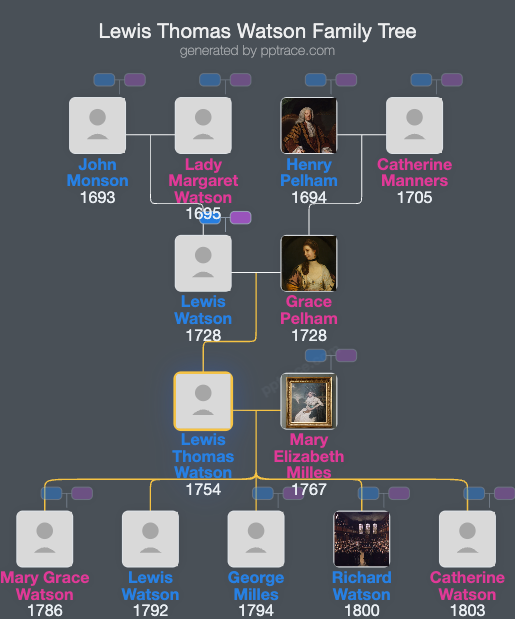
Family Tree
Tap  to expand more relatives
Introduction
Lewis Thomas Watson, 2nd Baron Sondes (18 April 1754 – 21 June 1806), was a British peer and politician associated with the Whig party.
**Early Life**
He was the son of Lewis Watson, 1st Baron Sondes, and Grace Pelham, who was a daughter of Henry Pelham. Watson received his education at Eton College from 1765 to 1771.
**Political Career**
In 1774, Lord Rockingham, a close associate and first cousin twice removed of Watson, offered him a parliamentary seat for Pontefract. Watson declined this offer due to the borough's patron, Lord Galway, requesting a payment of £3,500.
The following year, in 1775, a vacancy arose at Hedon following the death of Sir Charles Saunders. Lord Rockingham, eager to retain the seat from falling into government hands, recommended Watson to William Iveson, the election manager. Iveson had inherited Saunders' influence over the borough. The subsequent by-election in January 1776 was contested by Christopher Atkinson, leading to an unexpectedly expensive campaign. Watson's expenses totaled £3,600, with an additional £1,200 billed later that year, which he expressed dissatisfaction over to Lord Rockingham.
Watson aligned with Rockingham's opposition to the North ministry, although he did not speak in Parliament. In 1780, he attempted to stand for Kent but withdrew after realizing he lacked support. In the 1784 election, he contested Seaford against the Treasury-backed candidates, supported by the Pelham family's longstanding influence. He was defeated by one vote, and subsequently contested the election on the grounds that the bailiff had failed to give the mandated four days' notice. The election was declared void in 1785, though Watson did not pursue a subsequent campaign there.
In 1790, he was placed as a Whig candidate at Canterbury without his knowledge, but he ranked last in the poll. Watson was appointed deputy lieutenant for Northamptonshire in April 1793 and for Kent on 29 June of the same year.
**Peerage**
In 1795, Watson succeeded his father and took his seat in the House of Lords as the 2nd Baron Sondes. Around this period, he sold the manor of Garthorpe in Leicestershire to Wilbraham Tollemache, 6th Earl of Dysart, in 1803.
**Militia Service**
On 19 May 1798, Watson was commissioned as Colonel of the Kent Supplementary Militia, which was later converted into the 3rd Kent Militia. He received brevet rank as colonel in the Army on 13 October 1798, a rank held while the militia remained active.
Following the breakdown of the Peace of Amiens, Watson was appointed lieutenant-colonel commandant of the Lees Court Volunteer Infantry on 27 September 1803. In October 1803, he was appointed colonel of the 2nd East Kent or Lath of Scray and Wingham Regiment of Local Militia, a position he held until his death, when George Harris succeeded him.
**Family and Death**
On 30 November 1785, Watson married Mary Elizabeth Milles (1767–1818), the only daughter and heiress of Richard Milles, who served as Member of Parliament for Canterbury from 1761 to 1780. They had seven children:
- Hon. Mary Grace Watson (29 December 1786 – 24 November 1853), married Sir John Henry Palmer, 7th Baronet, on 3 May 1808.
- Grace Theodosia Watson (1 August 1790 – 9 September 1794).
- Lewis Watson, 3rd Baron Sondes (1792–1836).
- George Milles, 4th Baron Sondes (1794–1874).
- Hon. Rev. Henry Watson (10 August 1796 – 23 September 1849).
- Hon. Richard Watson (1800–1852).
- Hon. Catherine Watson (10 June 1802 – 24 November 1884), married William de Capell Brooke on 23 April 1829.
Lewis Thomas Watson, 2nd Baron Sondes, died on 21 June 1806. He was buried at Rockingham, Northamptonshire.