Lewis Watson, 3rd Baron Sondes
| Name | Lewis Watson, 3rd Baron Sondes |
| Title | English peer |
| Gender | Male |
| Birthday | 1792-05-24 |
| nationality | — |
| Source | https://www.wikidata.org/wiki/Q27468381 |
| pptrace | View Family Tree |
| LastUpdate | 2025-11-26T12:20:08.824Z |
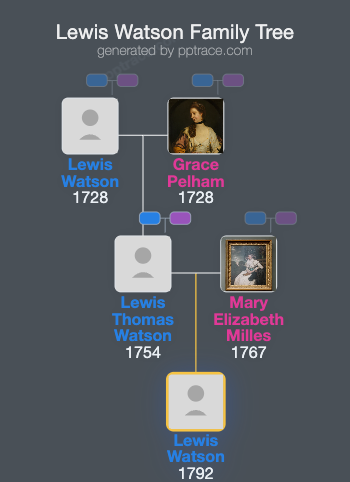
Family Tree
Tap  to expand more relatives
Introduction
Lewis Richard Watson, 3rd Baron Sondes, was born on 24 May 1792. He was the eldest son of Lewis Watson, 2nd Baron Sondes, and his wife Mary. He held the courtesy title Hon. Lewis Watson until he succeeded his father in 1806, upon which he became the 3rd Baron Sondes.
In 1806, he became the heir to the peerage following his father's death. On 1 February 1810, Watson matriculated at Christ Church, Oxford, continuing his education at the University of Oxford.
In 1814, Lewis Watson presented his former tutor, William Brice Fletcher, to the rectory of Kettering, a benefice of which Watson held the advowson. Fletcher entered into a bond with Watson stipulating that he would resign the rectory of Kettering when any of Watson’s younger brothers became capable of accepting a benefice. This bond is central to the legal case Fletcher v. Lord Sondes.
In 1820, Watson requested Fletcher’s resignation in order to present his younger brother, Henry Watson, to the rectory. Fletcher, expecting Watson to find another benefice for him, refused to resign. Watson then initiated legal proceedings against Fletcher for non-compliance with the bond. Fletcher appealed the verdict, leading to a case that ultimately was brought before the House of Lords.
In 1827, after judicial consultation, the House of Lords reversed the earlier verdict, declaring that the bond of special resignation signed by Fletcher was simoniacal. The decision clarified legal distinctions regarding bonds of resignation: bonds of general resignation had previously been held to be simoniacal, as seen in the case of Bishop of London v. Ffytche, but bonds of special resignation like Fletcher’s were thought to be legal and were in common use until Fletcher v. Lord Sondes.
Following the House of Lords decision, legislation was enacted to indemnify existing bondholders and to regulate bonds of special resignation, making them legal under certain conditions. Since the presentation of Fletcher was deemed void due to its simoniacal nature, the right to present to the benefice reverted to the Crown. Consequently, King William IV presented Henry Watson to the rectory of Kettering.
On 20 December 1830, Watson was commissioned as first major in the East Kent Regiment of Yeomanry Cavalry. He was among the representatives who paid homage at the coronation of William IV in 1831.
Lewis Richard Watson died unmarried on 14 March 1836. Upon his death, the title passed to his younger brother, George Watson. An obituary noted his aversion to sentiment and affectation, as well as his disdain for women, describing his preference for employing manservants rather than housemaids at Rockingham Castle.