Richard Watson
| Name | Richard Watson |
| Title | British politician (1800-1852) |
| Gender | Male |
| Birthday | 1800-01-06 |
| nationality | United Kingdom of Great Britain and Ireland |
| Source | https://www.wikidata.org/wiki/Q7329841 |
| pptrace | View Family Tree |
| LastUpdate | 2025-11-26T23:21:23.380Z |
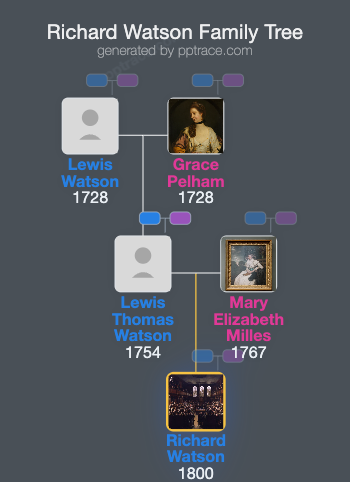
Family Tree
Tap  to expand more relatives
Introduction
The Honourable Richard Watson was born on 6 January 1800 and died on 24 July 1852. He was a British politician affiliated with the Whig party. Watson served as a Member of Parliament (MP) for Canterbury from 1830 to 1835 and briefly represented Peterborough in 1852.
He was the youngest son of Lewis Thomas Watson, the 2nd Baron Sondes, who lived from 1794 to 1874. His mother was Mary Elizabeth Milles of North Elmham, an heiress. Watson had an elder brother who changed his surname to Milles.
Richard Watson was commissioned into the 11th Hussars, a cavalry regiment of the British Army, and served in the Peninsula during the Napoleonic Wars.
His political career began with an attempt at the 1826 general election in Canterbury, where he was nominated by Reformers despite not being present and received 107 votes. He successfully contested Canterbury in the 1830 general election, gaining the top spot with 1,334 votes. Watson was returned unopposed in 1831 and was re-elected in 1832 in a contested election. One of his opponents in 1832 was John Nichols Thom, known as Sir William Courtenay or 'Tom of Truro,' who gained 375 votes. Watson was notably dismayed by the support given to this candidate and did not stand for election again at Canterbury in 1835.
On 21 December 1839, Watson married Lavinia Jane, the daughter of Lord George Quin and granddaughter of Thomas Taylour, 1st Marquess of Headfort, as well as George Spencer, 2nd Earl Spencer. They had five children, including three sons and two daughters. Their last child was born posthumously.
Their eldest son was George Lewis Watson, who married Laura Maria Culme-Seymour in 1867; the marriage produced no children. Their second son was Edward Spencer Watson, who died in January 1889 and married Mary Blanche Hall, with whom he had children. Their third son, Reverend Wentworth Watson (1848–1925), was a vicar in Monmouth, St. Thomas' Oxford, and Abingdon, and married Eveleen Frances Stopford in 1903. Their daughters included Mary Georgiana Watson, who married Sir Michael Culme-Seymour, 3rd Baronet, in 1866, and Lavinia Grace Watson (1852–1933), who married Baron Eugen von Roeder in 1875 and had children.
In 1849, Watson inherited the remaining Northamptonshire estates of his family from his brother Henry, who had no children. These estates centered on Rockingham Castle, where Watson had resided since 1836.
In the 1850 general election, Watson was elected as MP for Peterborough. However, he died shortly thereafter on 24 July 1852 at the Baths in Bad Homburg, near Frankfurt, at the age of 52. His body was returned to England and buried at Rockingham, Northamptonshire.
In 1850, Charles Dickens dedicated the novel "David Copperfield" to Richard Watson and his wife, with the inscription: "Affectionately Inscribed to The Hon. Mr and Mrs Richard Watson, of Rockingham, Northhampshire."