Frances Balfour
| Name | Frances Balfour |
| Title | British aristocrat and suffragist (1858-1931) |
| Gender | Female |
| Birthday | 1858-02-22 |
| nationality | United Kingdom |
| Source | https://www.wikidata.org/wiki/Q6470159 |
| pptrace | View Family Tree |
| LastUpdate | 2025-11-26T23:31:08.471Z |
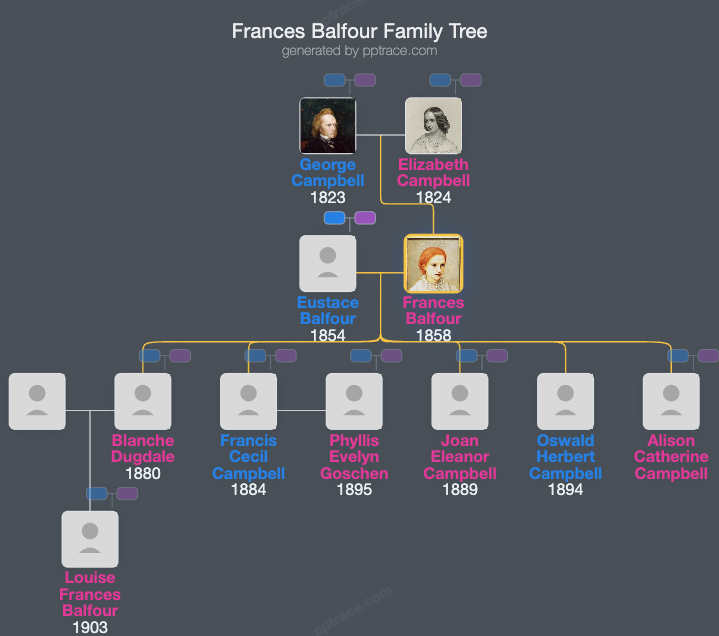
Family Tree
Tap  to expand more relatives
Introduction
Lady Frances Balfour, née Campbell, was born on 22 February 1858 in Kensington, London. She was the tenth child of British Liberal politician and Scottish peer George Campbell, 8th Duke of Argyll, and his wife, Lady Elizabeth Sutherland-Leveson-Gower, who was the eldest daughter of the 2nd Duke of Sutherland. Balfour's birthplace was Argyll Lodge in Kensington. She had a congenital hip joint disease that caused her to experience constant pain and walk with a limp throughout her life.
Her parents were known for their religious commitment and involvement in social reform campaigns, which she reportedly supported from childhood. As a young girl, she contributed to charitable efforts, including knitting garments for children of former slaves following the abolition of slavery within British territories in 1833.
In 1879, she married Eustace Balfour, a Scottish architect based in London. Eustace was related to prominent political figures: his uncle, Lord Salisbury, served three terms as Prime Minister of the United Kingdom, and his brother-in-law, Arthur Balfour, was Prime Minister from 1902 to 1905. Despite these connections, Lady Frances and her husband held differing political views; she supported Liberal politician William Gladstone, while her husband's family was aligned with Conservative politics. Their political differences contributed to a gradual decline in theirmarriage.
Lady Frances Balfour became active in the women's suffrage movement in 1889, becoming a key liaison between the constitutionalist factions and Parliament. In 1897, she joined the executive committee of the newly formed National Union of Women's Suffrage Societies (NUWSS), which was presided over by Mrs. Millicent Garrett Fawcett. She served on the committee until 1918, during which time she also presided over the London Society of Women's Suffrage from 1896 to 1919 and was President of the Lyceum Club from 1903 to 1915, an organization supporting professional women.
In 1917, Balfour joined the National Council of Women, serving as its president from 1921 to 1923. She was an advocate for women's rights and authored six books, including her autobiography "Ne Obliviscaris" (which translates from Latin as "Dinna Forget"). She also co-edited "Women and Progress" with Nora Vynne, a publication dedicated to achieving equal citizen rights for men and women. The magazine emphasized equal voting rights regardless of gender, applying to both young men and women, and ceased publication in June 1914 due to financial difficulties, remaining a valuable historical resource on early suffrage activities.
As a supporter of women’s professional advancement, she played a significant role in founding and leading the Lyceum Club in 1903, a women's organization that aimed to bring together writers, professionals, and the wives and daughters of prominent men. She served as chair of the club for fifteen years, with Enid Moberly Bell as vice-chair.
Lady Frances Balfour died in London on 25 February 1931 from bronchial pneumonia and heart failure. She was buried at Whittingehame, her family's estate in East Lothian, Scotland. Her honorary degrees include a Doctor of Letters (DLitt) from the University of Durham in 1919 and a Doctor of Laws (LLD) from the University of Edinburgh in 1921.
Her contributions to the women's suffrage movement are commemorated on the plinth of the statue of Millicent Fawcett in Parliament Square, London, unveiled in 2018, where her name and image are displayed alongside those of other supporters.