Eustace Balfour
| Name | Eustace Balfour |
| Title | Scottish architect and officer in the Volunteer Force |
| Gender | Male |
| Birthday | 1854-06-08 |
| nationality | — |
| Source | https://www.wikidata.org/wiki/Q17308766 |
| pptrace | View Family Tree |
| LastUpdate | 2025-11-26T12:48:28.155Z |
Family Tree
Tap  to expand more relatives
Introduction
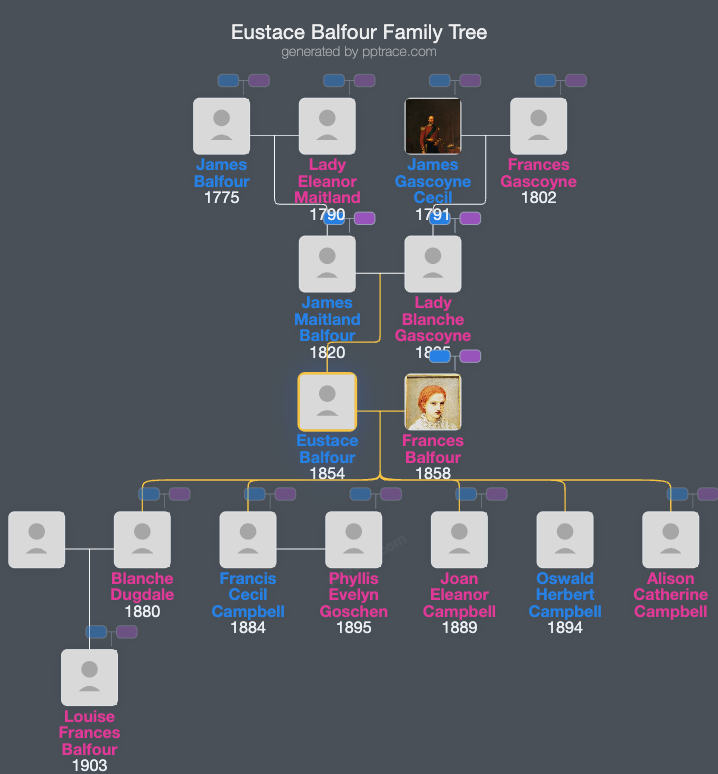
Colonel Eustace James Anthony Balfour (8 June 1854 – 14 February 1911) was a Scottish architect based in London. He was a member of the Balfour family, with notable familial connections to British political leadership. His brother Arthur Balfour served as Prime Minister of the United Kingdom, and his uncle Robert Gascoyne-Cecil, 3rd Marquess of Salisbury, also served as Prime Minister. His mother was Lady Blanche Mary Harriet Gascoyne-Cecil, daughter of the 2nd Marquess of Salisbury, and his father was James Maitland Balfour. The Balfour family had accumulated wealth through various ventures, including James Balfour’s involvement in supplying the Royal Navy in India.
Eustace Balfour was born at Whittingehame House in East Lothian. He was the youngest of five sons. His paternal grandfather, James Balfour, was a contractor and Tory Member of Parliament, while his maternal grandfather was a Conservative cabinet minister. He received education at Harrow School and Trinity College, Cambridge, graduating in 1873. Subsequently, he studied architecture under Basil Champneys before establishing his own practice in 1879. His office was located in Addison Road, North Kensington, which also served as his residence.
He married Lady Frances Campbell on 12 May 1879. Lady Frances was the fifth daughter of George Campbell, 8th Duke of Argyll, and the sister-in-law of Princess Louise, daughter of Queen Victoria. Their marriage took place shortly after they met at a London ball, and due to family considerations, it was arranged to be modest, with no formal wedding meal or honeymoon.
Balfour’s initial architectural work comprised small projects for family and friends, including the restoration of Inveraray Castle for his father-in-law, extension work at his brother Arthur’s hunting lodge Strathconan House in Ross-shire, and the design of St Mary Magdalene Church in Hatfield Hyde, which is now located in Welwyn Garden City. In 1885, he formed a professional partnership with Hugh Thackeray Turner, which lasted until Balfour's death. Their collaborations included the reconstruction of Ampton Hall in Suffolk after a fire, designed in a restrained Jacobean style, which was his only major country house commission.
In 1890, Balfour was appointed surveyor for the Grosvenor Estate in London, a role he obtained through his family’s influence, including a direct approach to the Duke of Westminster by his wife. The position provided significant design responsibilities, particularly in Mayfair and Belgravia, and allowed him to oversee many architectural projects. His design work favored the domestic revival style, often using red brick, and he was known for strict adherence to architectural guidelines, sometimes redesigning projects to meet his standards. His notable projects include the redevelopment of Balfour Place in Mayfair and the design of Aldford House on Park Lane for financier Alfred Beit. The firm also designed St Anselm’s Church in Davies Street, considered a notable example of arts and crafts influences, which was later dismantled and reconstructed in Belmont as "St Anslelm Belmont."
Balfour served as surveyor until 1910, when he was succeeded by Edmund Wimperis. His influence waned after the death of the 1st Duke of Westminster in 1899 due to the estate’s significant death duties. This financial strain limited estate redevelopment until 1906.
In addition to his architectural pursuits, Balfour was active in the Volunteer Force from 1882, commanding the London Scottish Regiment of Volunteers from 1894 to 1902, achieving the rank of Lieutenant-Colonel. He was involved in military discussions and contributed writings on defense matters. During the Second Boer War, he offered to raise a volunteer force, but did not participate in the campaign due to his duties related to the Grosvenor estate. He became a colonel on honorary terms after resigning from command in 1902, and served as a military aide-de-camp to King Edward VII in 1903.
He and his wife Frances had five children: Blanche Elizabeth Campbell Dugdale, a biographer and Zionist; Francis Cecil Campbell Balfour, who served as a colonial governor; Oswald Herbert Campbell Balfour, who was Military Secretary in Canada; Joan Eleanor Campbell Balfour; and Alison Catherine Campbell Balfour. Frances Balfour’s health was impaired by congenital hip dislocation, affecting their marriage and household life.
Eustace Balfour died in 1911, with his death attributed to complications related to alcoholism, which affected him in his later years.