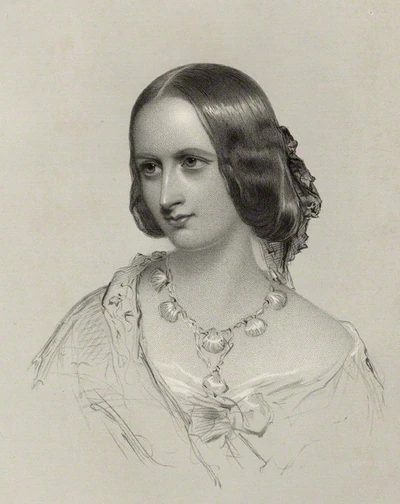
Elizabeth Campbell, Duchess Of Argyll
| Name | Elizabeth Campbell, Duchess Of Argyll |
| Title | British noblewoman and abolitionist (1824-1878) |
| Gender | Female |
| Birthday | 1824-05-30 |
| nationality | United Kingdom of Great Britain and Ireland |
| Source | https://www.wikidata.org/wiki/Q1184731 |
| pptrace | View Family Tree |
| LastUpdate | 2025-11-26T23:31:14.323Z |
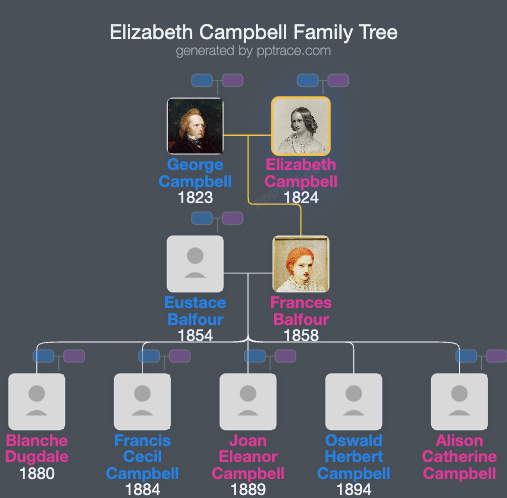
Family Tree
Tap  to expand more relatives
Introduction
Elizabeth Georgiana Campbell, Duchess of Argyll (née Leveson-Gower), was born on 30 May 1824 and died on 25 May 1878. She was a member of the British nobility and was involved in abolitionist activities.
Family and Early Life:
She was the eldest daughter of George Granville Leveson-Gower, 2nd Duke of Sutherland, and Lady Harriet Howard. Her paternal grandmother was Elizabeth Gordon, Countess of Sutherland, who owned extensive estates in the Scottish Highlands. The Leveson-Gower family held significant wealth and influence, derived from landholdings, rents, stocks, and investments in transportation firms. Her father succeeded as the 2nd Duke of Sutherland in 1833, expanding the family's estates.
Elizabeth was raised amidst these large estates, traveling extensively in Scotland and England. The family resided mainly at Stafford House in London, acquired in 1827, and possessed multiple country estates. Her mother was a prominent political hostess and served as Mistress of the Robes to Queen Victoria.
Marriage:
In 1842, Elizabeth met George Douglas Campbell, Marquess of Lorne, the eldest son of the 7th Duke of Argyll, during a visit to Taymouth Castle with Queen Victoria. The couple married on 31 July 1844 at Trentham Hall, the Leveson-Gower estate. The marriage connected two prominent Scottish landowning families and was financially significant for the Argyll estate, which was indebted.
Following her marriage, Elizabeth converted from Anglicanism to the Church of Scotland and became involved with the Scottish Episcopal Church. She and her husband shared interests in liberal politics.
Duchess of Argyll:
Her husband succeeded his father as the 8th Duke of Argyll on 25 April 1847, at which point Elizabeth became Duchess of Argyll. Their main residences included Inveraray Castle, Argyll Lodge in London, and Rosneath. They had twelve children, including John Campbell, who became the 9th Duke of Argyll.
The household was characterized by formality and routine. Elizabeth's health declined over the years, partly due to a stroke in 1868 that left her partially incapacitated. Her children, especially her third daughter, Lady Victoria, assisted in her care.
Abolitionist Activities:
The Duchess was active in the abolitionist movement. She was influenced by the publication of "Uncle Tom's Cabin" in 1852 and collaborated in drafting a letter signed by over 562,000 women in Britain, addressing the issue of slavery in the United States. She maintained a friendship and correspondence with Harriet Beecher Stowe, the author of the novel, who visited England frequently.
The Duchess also formed associations with American abolitionists such as Charles Sumner, and her social connections facilitated support for anti-slavery efforts.
Public Service and Honors:
In December 1868, she was appointed Mistress of the Robes to Queen Victoria in Gladstone’s first ministry, succeeding Elizabeth Wellesley, Duchess of Wellington. She held the position until 1870 when ill health compelled her resignation. In December 1877, she was awarded the Order of the Crown of India and was a member of the Royal Order of Victoria and Albert, Second Class.
Death and Burial:
Elizabeth Campbell died on 25 May 1878 in London while dining with William Ewart Gladstone. She was buried at Kilmun Parish Church.
Children:
Elizabeth and the 8th Duke of Argyll had twelve children:
- John Campbell, 9th Duke of Argyll (1845–1914)
- Lord Archibald Campbell (1846–1913)
- Lord Walter Campbell (1848–1889)
- Lady Edith Campbell (1849–1913)
- Lord George Granville Campbell (1850–1915)
- Lady Elizabeth Campbell (1852–1896)
- Lord Colin Campbell (1853–1895)
- Lady Victoria Campbell (1854–1910)
- Lady Evelyn Campbell (1855–1940)
- Lady Frances Campbell (1858–1931)
- Lady Mary Emma Campbell (1859–1947)
- Lady Constance Harriett Campbell (1864–1922)
Following her death, her widower remarried in 1881 to Amelia Maria, daughter of Bishop Thomas Legh Claughton of St Albans.