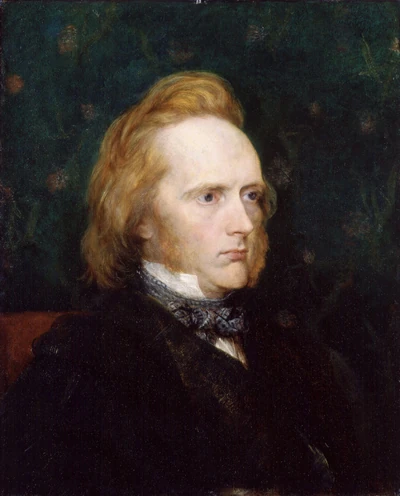
George Campbell, 8th Duke Of Argyll
| Name | George Campbell, 8th Duke Of Argyll |
| Title | Scottish peer, Liberal politician and writer on science, religion, and politics (1823-1900) |
| Gender | Male |
| Birthday | 1823-04-30 |
| nationality | United Kingdom of Great Britain and Ireland |
| Source | https://www.wikidata.org/wiki/Q335300 |
| pptrace | View Family Tree |
| LastUpdate | 2025-11-26T23:31:15.203Z |
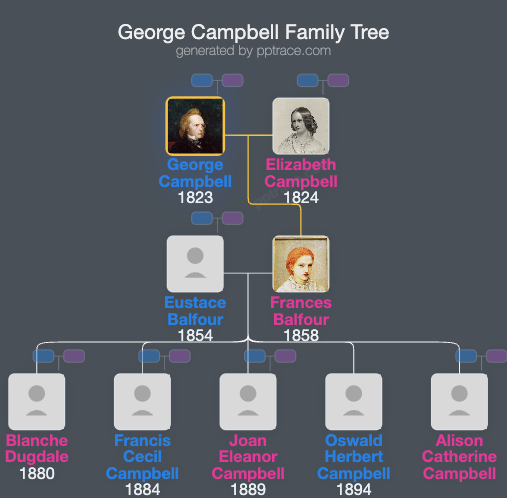
Family Tree
Tap  to expand more relatives
Introduction
George John Douglas Campbell, 8th and 1st Duke of Argyll (30 April 1823 – 24 April 1900), was a Scottish politician, scholar, and polymath. He was born at Ardencaple Castle in Dunbartonshire as the second but only surviving son of John Campbell, 7th Duke of Argyll, and Joan Glassel, the daughter of John Glassel. In 1847, he succeeded his father as Duke of Argyll, acquiring additional titles including hereditary Master of the Household of Scotland and Sheriff of Argyllshire. His landholdings encompassed approximately 175,000 acres in Argyll and Dumbarton.
Before succeeding to the dukedom, Argyll became known for pamphlets concerning the Disruption of the Church of Scotland and emerged as a figure on the Liberal side of British politics, aligning with Peelite Conservative factions. He was a prominent speaker in the House of Lords and maintained close associations with Prince Albert. His political career included serving as Lord Privy Seal from 1852 to 1855 in the cabinet of Lord Aberdeen, and as Postmaster General from 1855 to 1858 in Lord Palmerston’s first government. He held the position of Lord Privy Seal again from 1859 to 1866 under Lord Palmerston and Lord Russell administrations, notably advocating for the Northern cause during the American Civil War.
Argyll played a significant role in Scottish education reform, leading the 1866 Argyll Commission which identified deficiencies in the Scottish schooling system. The commission's report, completed in 1869, contributed to the passage of the Education (Scotland) Act of 1872, which made primary education compulsory for children aged five to thirteen.
During William Ewart Gladstone’s first government (1868–1874), Argyll served as Secretary of State for India. His decision not to support the Emir of Afghanistan against Russian advances contributed to the outbreak of the Second Afghan War. His wife, Lady Elizabeth Georgiana Leveson-Gower, served as Mistress of the Robes during this period. Additionally, Argyll was instrumental in establishing the Royal Indian Engineering College, which operated from 1872 to 1906 to train civil engineers for service in India.
In 1871, his son, Lord Lorne, married Princess Louise, daughter of Queen Victoria. Argyll returned to the government as Lord Privy Seal in 1880 under Gladstone, but resigned in 1881 over opposition to Gladstone’s Land Bill. He distanced himself from Gladstone in 1886 due to disagreements over Irish Home Rule, choosing an independent political course rather than joining the Liberal Unionists.
He served as Lord Lieutenant of Argyllshire from 1862 until his death in 1900. He was sworn into the Privy Council in 1853, appointed a Knight of the Thistle in 1856, and elevated to a Knight of the Garter in 1883. In 1892, he was created Duke of Argyll in the Peerage of the United Kingdom.
Argyll was also engaged in scientific pursuits, especially in ornithology, geology, anthropology, evolution, and economics. He was elected Fellow of the Royal Society in 1851, served as Chancellor of the University of St Andrews, and was Rector of the University of Glasgow from 1854. He was president of the British Association for the Advancement of Science in 1855 and President of the Geological Society from 1872 to 1874. In 1866, he was a founding member and president (1866–1895) of Britain's first aeronautical society, the Aeronautical Society of Great Britain. He was also a member of the American Antiquarian Society and the American Philosophical Society.
Argyll married three times. His first wife was Lady Elizabeth Leveson-Gower; the marriage produced five sons and seven daughters. The second marriage was to Amelia Maria, widow of Augustus Anson, and the third to Ina McNeill; no children resulted from these later marriages. He died at Inveraray Castle in April 1900 and was buried at Kilmun Parish Church. His eldest son, John Campbell, succeeded him as the 9th Duke of Argyll.
A road in Penang, Malaysia, named Argyll Road, bears his name. His published works include "The Reign of Law" (1867), "Primeval Man" (1869), "The Eastern Question" (1879), "The Unity of Nature" (1884), and "The Philosophy of Belief" (1896), among others.