David Lloyd George
| Name | David Lloyd George |
| Title | Prime Minister of the United Kingdom from 1916 to 1922 |
| Gender | Male |
| Birthday | 1863-01-17 |
| nationality | United Kingdom |
| Source | https://www.wikidata.org/wiki/Q134982 |
| pptrace | View Family Tree |
| LastUpdate | 2025-11-26T23:31:40.103Z |
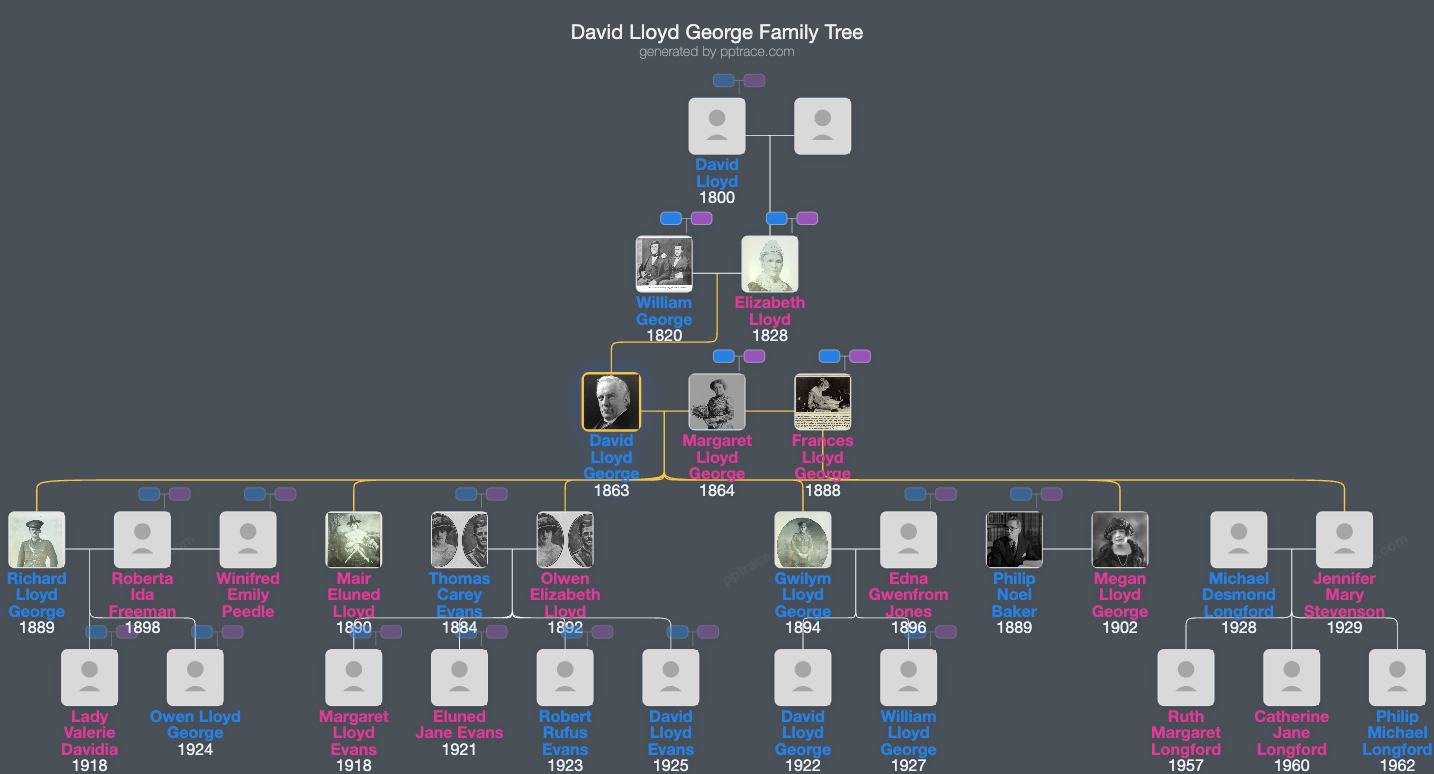
Family Tree
Tap  to expand more relatives
Introduction
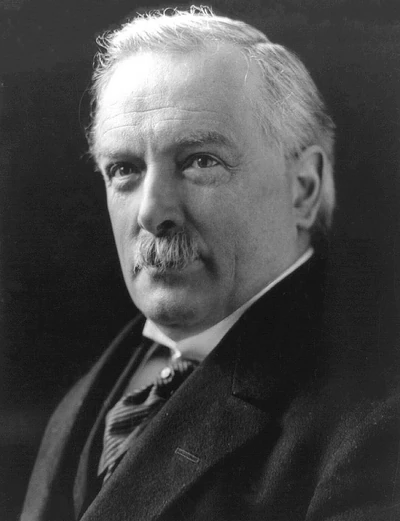
David Lloyd George, 1st Earl Lloyd-George of Dwyfor (17 January 1863 – 26 March 1945), was a prominent British politician who served as Prime Minister of the United Kingdom from 1916 to 1922. He was affiliated with the Liberal Party and was of Welsh descent. His tenure as Prime Minister coincided with the latter part of the First World War and the immediate post-war period.
Lloyd George was born in Chorlton-on-Medlock, Manchester, to William George and Elizabeth Lloyd George, both of Welsh origin. His father died of pneumonia in June 1864, when Lloyd George was just over one year old. Subsequently, his mother relocated with her children to Llanystumdwy in Caernarfonshire, Wales, where Lloyd George was raised in a cottage known as Highgate. He was educated at Llanystumdwy National School and was later taught by private tutors. His first language was Welsh, and his cultural outlook was deeply rooted in Welsh identity.
He adopted the surname Lloyd George from his uncle Richard Lloyd, a local shoemaker and lay minister, who was a significant influence during his upbringing. Although raised as a devout evangelical Protestant, Lloyd George privately lost his religious faith in his youth, transitioning towards deism or agnosticism, yet maintaining involvement in chapel services and preaching.
In 1884, Lloyd George qualified as a solicitor after completing his legal training and examination. He established his practice in Porthmadog and later in Criccieth, becoming the only solicitor to hold the office of Prime Minister as of 2025. His initial political activity included campaigning for the Liberal Party and the Welsh Liberal movement, advocating for Welsh disestablishment and land reform.
Lloyd George's early legal milestone was the Llanfrothen burial case, which affirmed the rights of Nonconformists to conduct denominational burials in parish cemeteries. This case garnered national attention and implicated his emerging reputation. In 1888, he married Margaret Owen, daughter of a local farming family, and they had five children.
He was first elected to Parliament representing Caernarfon Boroughs during a by-election on 10 April 1890, a seat he held until his death in 1945. Throughout his parliamentary career, Lloyd George was known for his oratory and for advocating radical reform policies, including Welsh devolution, disestablishment of the Church of England in Wales, equality for laborers and tenant farmers, and reforms of land tenure.
Lloyd George entered government service as a member of Henry Campbell-Bannerman's cabinet in 1905. In 1908, following Asquith's rise to Prime Minister, Lloyd George became Chancellor of the Exchequer. He proposed the 1909 People's Budget, which aimed to fund extensive welfare reforms through taxes on land and high incomes, but it was rejected by the House of Lords, leading to a constitutional crisis that was resolved through the Parliament Act 1911. The budget's measures included the National Insurance Act 1911, laying foundations for the modern welfare state.
During the involvement in the 1913 Marconi scandal, Lloyd George maintained his political position and continued to pursue policy initiatives. Amid the First World War, he was appointed Minister of Munitions in 1915 and later Secretary of State for War in 1916, although he faced limitations on his authority and disagreements with military commanders.
In December 1916, Lloyd George replaced Asquith as Prime Minister, establishing a small war cabinet and centralizing decision-making. He implemented measures to address food shortages, including the convoy system and rationing, and supported key military campaigns, including the Battle of Passchendaele. He ultimately authorized the unification of Allied command in March 1918, contributing to the Allied victory in November 1918.
Following the war, Lloyd George participated actively in the Paris Peace Conference of 1919. He was involved in negotiations regarding the independence of Ireland, resulting in the establishment of the Irish Free State in 1921. His domestic policies included education and housing reforms, but challenges such as rising trade union militancy, economic depression, and unemployment gained prominence during his premiership.
Crisis and scandal marked the end of his tenure as Prime Minister. In 1922, after disagreements within the coalition and issues related to honours and the Chanak Crisis, Lloyd George resigned. He remained as leader of a faction of the Liberal Party and led the party from 1926 to 1931, proposing various reforms with limited electoral success.
In later years, Lloyd George's influence waned, and by the 1930s, he was viewed with mistrust by many. During World War II, he refused to participate in Churchill's War Cabinet. He was elevated to the peerage in 1945 but died before taking his seat in the House of Lords.