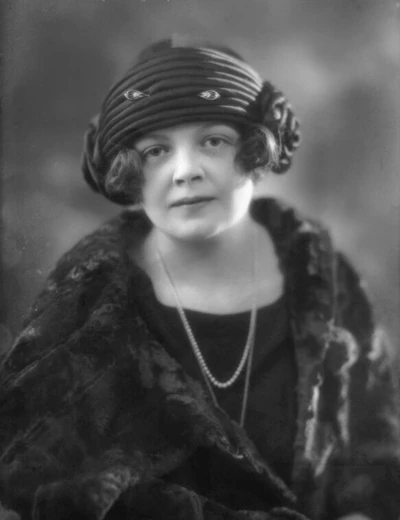
Megan Lloyd George
| Name | Megan Lloyd George |
| Title | British politician (1902-1966) |
| Gender | Female |
| Birthday | 1902-04-22 |
| nationality | United Kingdom |
| Source | https://www.wikidata.org/wiki/Q6808694 |
| pptrace | View Family Tree |
| LastUpdate | 2025-11-26T23:31:43.786Z |
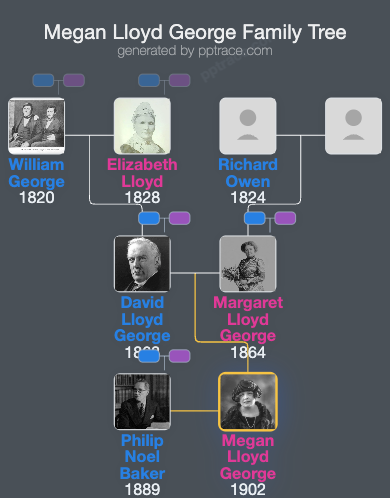
Family Tree
Tap  to expand more relatives
Introduction
Lady Megan Arvon Lloyd George was born on 22 April 1902 in Criccieth, Caernarfonshire, Wales. She was the youngest child of David Lloyd George, who served as Prime Minister of the United Kingdom, and his wife, Margaret. Her birth was registered with the forenames Megan Arvon and surname George; however, she adopted her father's full surname, "Lloyd George." In 1945, her father was elevated to the peerage as Earl Lloyd-George of Dwyfor, after which she acquired the style of Lady Megan (Lloyd George).
As a child, Lloyd George was characterized as imaginative and energetic, described by local press as "sprite-like" and a "daring sceptic." She reportedly disliked her father’s stories of biblical figures like Daniel in the lions' den. Around the age of five, she accompanied her father to their residence in Brighton, where she would bring early morning cups of tea to his guests, demonstrating an early engagement in public activities. At the age of eight, on 16 November 1910, she participated in the opening ceremony for the extension of the Claremont Central Mission in Pentonville.
Following her family’s political legacy, Lloyd George entered politics like her brother, Gwilym Lloyd George. She became the first female Member of Parliament (MP) in Wales when she successfully contested the seat of Anglesey for the Liberal Party in 1929. During her parliamentary career, she maintained her seat through multiple elections, including holding Anglesey as a Liberal in 1931, 1935, and until 1951. She was known for her opposition to Ramsay MacDonald’s National Government in 1931, along with her father, and she refused to support the government during that period. Throughout the 1940s and early 1950s, she campaigned actively for the establishment of a Welsh Parliament and the creation of a Secretary of State for Wales.
During World War II, Lloyd George was a member of Radical Action, a faction advocating for a more radical political approach and calling for withdrawal from the wartime electoral truce. She was prominent among Liberal radicals who believed the party was drifting from the liberal principles associated with her father. Despite her affiliation with the Liberal Party, she maintained friendly relations with prominent figures like Clement Attlee in the late 1940s. Rumors circulated that she considered joining the Labour Party.
In 1949, Lady Megan was elected Deputy Leader of the Liberal Party with the aim of fostering unity within the party. However, after losing her seat in 1951, she stood down from her position in 1952 and indicated she would not seek re-election in Anglesey. Disillusioned with the Liberal Party, she transitioned to the Labour Party in 1955.
As a Labour candidate, she contested and won the Carmarthen by-election in 1957, representing Labour until her death in 1966. She held the seat until her passing from breast cancer at Pwllheli in Wales, aged 64.
In her personal life, she was the romantic partner of Philip Noel-Baker from 1936 until her partner’s death in 1956. Posthumously, she was appointed as a Member of the Order of the Companions of Honour in the Dissolution Honours List five days after her death. In 2016, she was recognized as one of "the 50 greatest Welsh men and women of all time." In 2019, a Purple Plaque was installed on her former family home in Criccieth, commemorating her contributions.
References and additional information about her life and career are available through various sources, including the Welsh History Review, the Dictionary of Liberal Biography, her biography "A Radical Life: The Biography of Megan Lloyd George, 1902–66" by Mervyn Jones, and archival material held by the UK National Archives and the National Library of Wales.