Antoine Bibesco
| Name | Antoine Bibesco |
| Title | Romanian diplomat |
| Gender | Male |
| Birthday | 1878-07-19 |
| nationality | Romania |
| Source | https://www.wikidata.org/wiki/Q2853679 |
| pptrace | View Family Tree |
| LastUpdate | 2025-11-26T23:31:27.963Z |
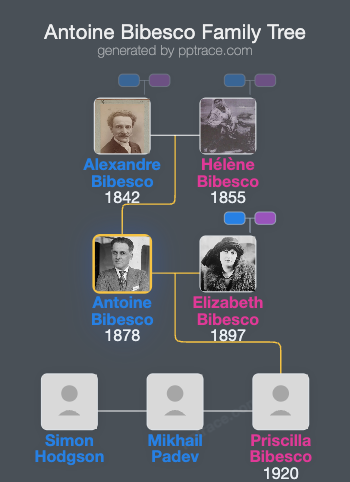
Family Tree
Tap  to expand more relatives
Introduction
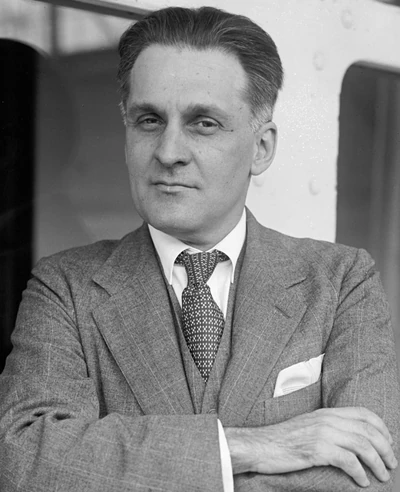
Prince Antoine Bibesco (Romanian: Prințul Anton Bibescu) was born on July 19, 1878, and died on September 2, 1951. He was a Romanian aristocrat, lawyer, diplomat, and writer.
Family and Early Life:
He was the son of Prince Alexandre Bibesco, who was the last surviving son of the Duke of Wallachia. His mother was Elena Epureanu, the daughter of Manolache Costache Epureanu, a former Prime Minister of Romania. Although he was raised at 69, Rue de Courcelles, in Paris, Bibesco continued to oversee the Bibesco estates located in Craiova until after World War II.
Cultural and Personal Connections:
As a young man, Bibesco benefited from the social environment of his mother, Princess Hélène Bibesco's celebrated Paris salon. The salon provided him the opportunity to meet notable figures including composer Charles Gounod, Claude Debussy, Camille Saint-Saëns, painters Pierre Bonnard, Édouard Vuillard, and Aristide Maillol, as well as writers Anatole France and Marcel Proust. His family commissioned artworks and music from prominent artists such as Edgar Degas and George Enescu, and Antoine maintained traditions of artistic patronage and friendship.
Relationship with Marcel Proust:
Bibesco developed a lifelong friendship with Marcel Proust, who shared a secret language with him, in which Proust was known as Lecram and the Bibesco family as Ocsebib. Bibesco aimed to have Proust's novel "Du Côté de Chez Swann" published through André Gide and the Nouvelle Revue Française—an effort that was ultimately unsuccessful. Near the end of Proust's life, Bibesco served as a confidant, and he later published "Letters of Marcel Proust to Antoine Bibesco."
Writing and Works:
Though not prolific, Bibesco authored several plays in French and achieved at least one success in the United States. His play "Ladies All" premiered on Broadway at the Morosco Theatre in 1930, running for 140 performances. He translated Noël Coward's "Weekend" and John Galsworthy's "Le Domaine" into French.
Diplomatic Career:
Bibesco's diplomatic career included early service as counsellor at the Romanian legations in Paris and Petrograd. By 1914, he was the First Secretary of the Romanian Legation in London. By 1918, he had established connections with former British Prime Minister H. H. Asquith. During this period, he was involved in a romantic relationship with writer Enid Bagnold, which ended as he developed feelings for Elizabeth Asquith, the twenty-one-year-old daughter of H. H. Asquith. He married Elizabeth at St Margaret's Church, Westminster, on April 29, 1919. The marriage was a prominent social event attended by notable figures including Queen Alexandra and George Bernard Shaw.
Children:
The couple had one child, Priscilla Bibesco, born in London in 1920. She passed away in Paris in 2004.
Continued Diplomatic Service:
Bibesco served as Minister of the Romanian Legation in Washington, D.C., from 1920 to 1926. The current Romanian Embassy in Washington was first utilized during his tenure. He later served in Madrid from 1927 to 1931.
Later Career and Life:
In 1936, amid political changes, Bibesco was tasked with reassuring the United Kingdom and France that Romania was not succumbing to fascist influences after the removal of Nicolae Titulescu as Foreign Minister. During World War II, Bibesco resided in Romania, where his wife died in 1945. After the war, following the confiscation of his estates by the Communist regime, he left Romania and never returned.
Death and Burial:
Prince Antoine Bibesco died in 1951 and was buried in Paris. His biographer Enid Bagnold noted in her Times obituary that he had "three tombs in his heart"—those of his mother, his brother Emmanuel, and his wife.