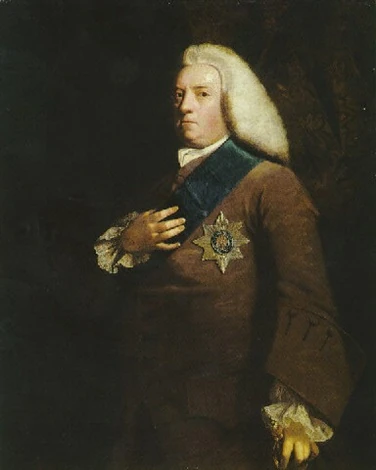
William Cavendish, 3rd Duke Of Devonshire
| Name | William Cavendish, 3rd Duke Of Devonshire |
| Title | British nobleman and Whig politician |
| Gender | Male |
| Birthday | 1698-09-26 |
| nationality | Great Britain |
| Source | https://www.wikidata.org/wiki/Q2400397 |
| pptrace | View Family Tree |
| LastUpdate | 2025-11-26T23:21:59.102Z |
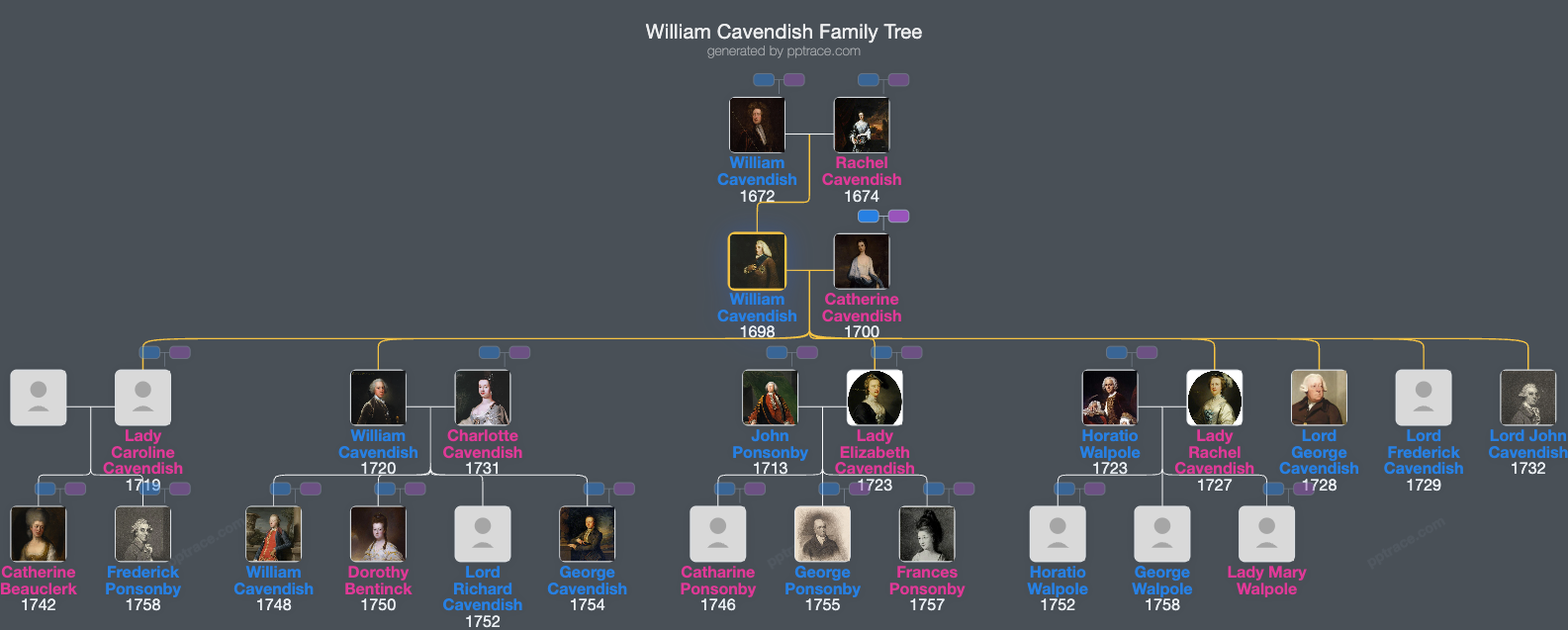
Family Tree
Tap  to expand more relatives
Introduction
William Cavendish, 3rd Duke of Devonshire (26 September 1698 – 5 December 1755), was a British politician associated with the Whig party. His tenure in the House of Commons spanned from 1721 until 1729, after which he succeeded to the House of Lords.
Early Life and Family Background:
He was born in 1698 to William Cavendish, 2nd Duke of Devonshire, and Rachel Russell, the Honorable daughter of William Russell, Lord Russell. He was known by the courtesy title Marquess of Hartington during his early life.
Political Career:
In 1721, Cavendish was elected unopposed as a Member of Parliament (MP) for Lostwithiel in a by-election. The following year, in the 1722 general election, he was re-elected unopposed as MP for Grampound. At the 1727 general election, he was returned unopposed as MP for Huntingdonshire. In 1729, upon the death of his father, he vacated the Commons seat and took his place in the House of Lords as the 3rd Duke of Devonshire.
In 1731, he was appointed a Privy Counsellor and served as Lord Privy Seal from 1731 to 1733. That year, he was invested as a Knight of the Garter. Later, he held the position of Lord Lieutenant of Ireland for seven years.
Property and Philanthropy:
The Duke sold the Old Devonshire House located at 48 Boswell Street in Bloomsbury and, in 1734, commissioned architect William Kent to design a new residence, Cavendish House, in Piccadilly. In 1739, he became a founding governor of the Foundling Hospital in Bloomsbury, a charitable institution established to address the issue of infant abandonment. The hospital subsequently became a notable center for arts and music.
Military Involvement:
During the Jacobite rising of 1745, the Duke organized a militia unit supporting the crown, known as the Derbyshire Blues. This militia assembled at the George Inn in Derby on 3 December 1745.
Marriage and Children:
On 27 March 1718, Cavendish married Catherine Hoskins, daughter of John Hoskins of Oxted and Catherine Hale. Their union produced seven children:
- Lady Caroline Cavendish (22 May 1719 – 20 January 1760), married William Ponsonby, 2nd Earl of Bessborough, with issue.
- William Cavendish, 4th Duke of Devonshire (1720 – 2 October 1764).
- Lord George Augustus Cavendish (died 2 May 1794), unmarried.
- Lady Elizabeth Cavendish (born before 1727 – died 1796), married John Ponsonby, with issue.
- Lady Rachel Cavendish (7 June 1727 – 8 May 1805), married Horatio Walpole, 1st Earl of Orford.
- Field Marshal Lord Frederick Cavendish (c. 1729 – 21 October 1803), unmarried.
- Lord John Cavendish (c. 1734–1796).
References and External Links:
Additional details and sources about William Cavendish, 3rd Duke of Devonshire, can be found through historical records and online resources.