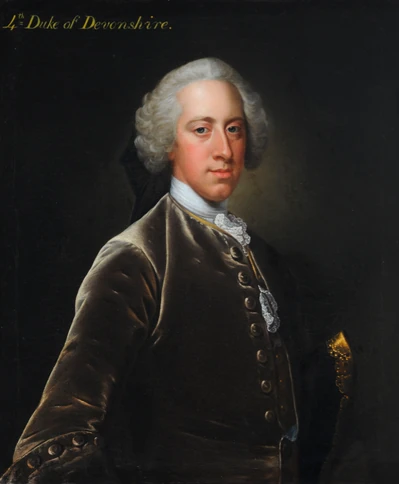
William Cavendish, 4th Duke Of Devonshire
| Name | William Cavendish, 4th Duke Of Devonshire |
| Title | Former Prime Minister of the United Kingdom |
| Gender | Male |
| Birthday | 1720-05-08 |
| nationality | Great Britain |
| Source | https://www.wikidata.org/wiki/Q238639 |
| pptrace | View Family Tree |
| LastUpdate | 2025-11-26T23:21:58.142Z |
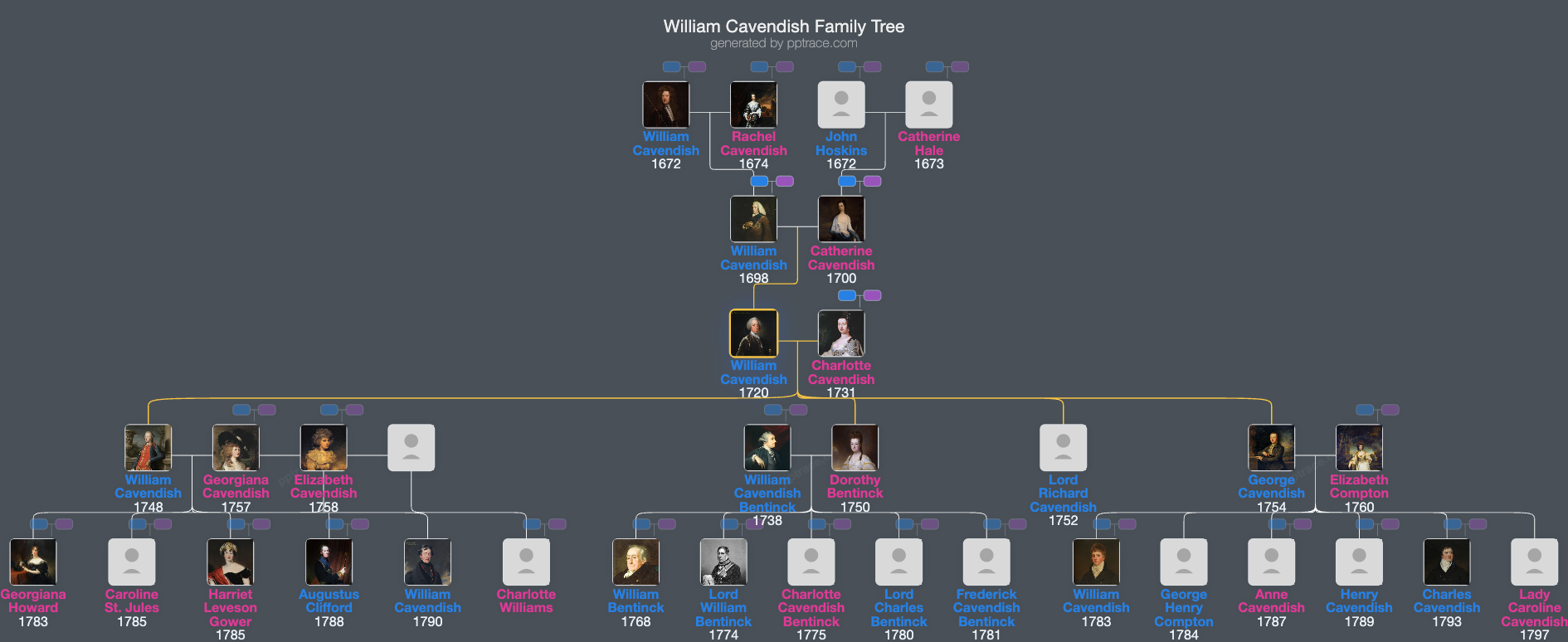
Family Tree
Tap  to expand more relatives
Introduction
William Cavendish, 4th Duke of Devonshire (8 May 1720 – 2 October 1764), was a British nobleman and political figure who briefly served as the nominal Prime Minister of Great Britain. He was born in London and was the eldest son of William Cavendish, 3rd Duke of Devonshire, and Catherine Hoskins. Baptized on 1 June 1720 at St Martin's-in-the-Fields, he was likely educated privately before undertaking a grand tour of France and Italy from 1739 to 1740, accompanied by a tutor.
Cavendish entered politics as a Member of Parliament for Derbyshire in 1741, holding the seat until 1747. He was a supporter of Sir Robert Walpole and later of the Pelham faction. Henry Pelham described him as a key supporter among the young Whigs. Horace Walpole characterized Cavendish as "a favourite by descent of the Old Whigs" and as "a bigot" to the Pelham faction. He declined an offer to serve as governor to the Prince of Wales but was appointed Master of the Horse by Henry Pelham, a position he held until 1755. In 1753, as Marquess of Hartington, he brokered a pension for the opposition journalist James Ralph.
Upon the death of his father in December 1755, Cavendish succeeded as the 4th Duke of Devonshire. He served as Lord Lieutenant of Ireland from 2 April 1755 until 3 January 1757. In October 1756, following the resignation of Duke of Newcastle amid difficulties in the Seven Years' War, George II appointed Devonshire to form an administration. He served as First Lord of the Treasury from November 1756 to May 1757, a role considered by many historians as that of Prime Minister, during a government effectively led by William Pitt.
Devonshire's government prioritized war efforts, securing increased funding, dispatching troops to America, and passing a Militia Act. His administration was short-lived, ending in May 1757, due to opposition from King George II and issues such as the mishandling of Admiral John Byng's trial and execution. It was succeeded by the Pitt–Newcastle ministry, which guided Britain to victory in most of the Seven Years' War.
From 1757 to 1762, Cavendish served as Lord Chamberlain under the Duke of Newcastle’s government. His relationship with Newcastle was close. After George II's death in 1760, his grandson George III became king, but the monarch was suspicious of Devonshire and Newcastle. In October 1762, George III reacted negatively to perceived plots by Devonshire and Newcastle, ordering that Devonshire’s name be struck from the Privy Council and refusing to see him when he sought an audience.
During his final years, Cavendish's health deteriorated, and he traveled to Spa in the Austrian Netherlands for treatment. He died in October 1764 at Spa at the age of 44 years and 147 days, making him the shortest-lived British Prime Minister. He was interred at Derby Cathedral.
William Cavendish married Lady Charlotte Elizabeth Boyle, 6th Baroness Clifford, on 28 March 1748, at Carlton House. Lady Charlotte was the daughter of Richard Boyle, 3rd Earl of Burlington, noted for his contributions to architecture and art collection. The marriage brought the family significant estates, including Chiswick House, Burlington House, Bolton Abbey, Londesborough Hall, and Lismore Castle. The Duke also commissioned Capability Brown to landscape the gardens at Chatsworth House and James Paine to design the stable block.
He had four children: William Cavendish, who became the 5th Duke of Devonshire; Lady Dorothy Cavendish, who married William Cavendish-Bentinck, 3rd Duke of Portland; Lord Richard Cavendish; and George Augustus Henry Cavendish, who was created 1st Earl of Burlington. His descendants included the 7th Duke of Devonshire, who inherited the family titles.
Throughout his life, Cavendish was known for his moderate political stance and personal integrity. Historians have noted his competence as a mediator and his influence within the Whig party, despite lacking a particularly outstanding intellect. His death marked a significant loss to the Whig leadership of the period.