Lord John Cavendish
| Name | Lord John Cavendish |
| Title | British politician |
| Gender | Male |
| Birthday | 1732-10-22 |
| nationality | Great Britain |
| Source | https://www.wikidata.org/wiki/Q6679438 |
| pptrace | View Family Tree |
| LastUpdate | 2025-11-26T23:22:05.622Z |
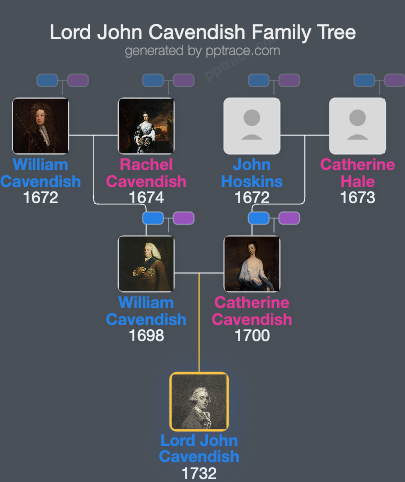
Family Tree
Tap  to expand more relatives
Introduction
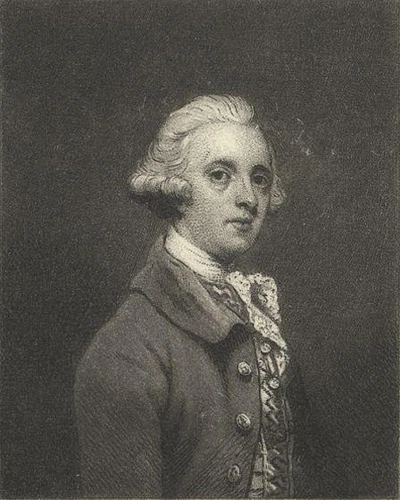
Lord John Cavendish (22 October 1732 – 18 December 1796) was a British nobleman and politician belonging to the Cavendish family. He was the youngest son of William Cavendish, 3rd Duke of Devonshire, and his wife Catherine Hoskins, daughter of John Hoskins. His elder brothers included William Cavendish, 4th Duke of Devonshire, who served as Prime Minister; Lord George Cavendish; and Field Marshal Lord Frederick Cavendish.
He received his education at Newcome's School in Hackney and at Peterhouse, Cambridge.
In his political career, Lord John Cavendish served as Chancellor of the Exchequer in 1782 and 1783. He was sworn into the Privy Council in 1782. He was a supporter of Charles Watson-Wentworth, 2nd Marquess of Rockingham, and later supported the Fox-North Coalition, which contributed to device the ministry of the Duke of Portland. He lost his parliamentary seat in the 1784 election following the fall of the coalition. He remained out of the House of Commons until 1794, when he returned representing Derbyshire, the family estate.
Regarding his personal life, Lord John Cavendish resided at Billing Hall in Northamptonshire. Around 1776, he commissioned John Carr to remodel the hall extensively in the Palladian architectural style. In 1790, the house passed to the Elwes family.
He died unmarried on 18 December 1796 at the age of 64.
Following his death, Edmund Burke wrote several eulogies describing Cavendish's character. Burke characterized him as possessing an honest and honorable mind, with considerable talents and virtues. He described Cavendish as benevolent, friendly, generous, disinterested, and unambitious. Burke noted that although Cavendish appeared reserved outwardly, he was inwardly quick and full of feeling. Burke emphasized Cavendish's opposition to dissimulation and his integrity. Burke also observed that Cavendish was well-versed in various forms of erudition, served the public with fidelity and diligence, and displayed resolution when required. Burke expressed a wish that Cavendish had more vanity, suggesting that his qualities were often obscured by his modesty.
Sir Nathaniel Wraxall characterized Cavendish's character as aligned with the ideal of an English nobleman of the old school, emphasizing his association with the legacy of the 1688 Revolution and his unblemished reputation. Wraxall noted Cavendish’s natural honesty and the respect he commanded among peers, regardless of differing political views.
References for Lord John Cavendish include Leigh Rayment's Peerage Pages and Rayment's Historical List of MPs.