William Cavendish, 5th Duke Of Devonshire
| Name | William Cavendish, 5th Duke Of Devonshire |
| Title | British aristocrat and politician (1748-1811) |
| Gender | Male |
| Birthday | 1748-12-14 |
| nationality | United Kingdom of Great Britain and Ireland |
| Source | https://www.wikidata.org/wiki/Q335425 |
| pptrace | View Family Tree |
| LastUpdate | 2025-11-26T23:22:00.108Z |
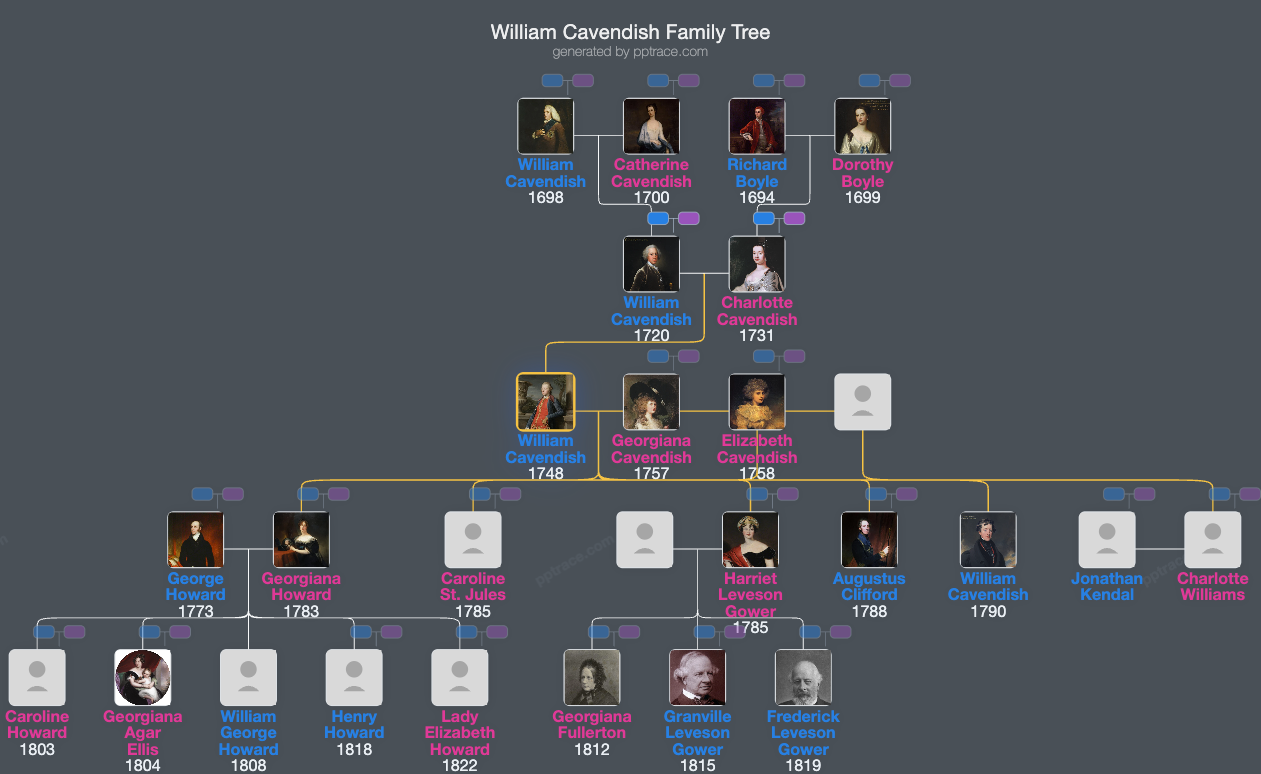
Family Tree
Tap  to expand more relatives
Introduction
William Cavendish, 5th Duke of Devonshire, was born on 14 December 1748 and died on 29 July 1811. He was a member of the British nobility and engaged in political roles during his lifetime. He was the eldest son of William Cavendish, 4th Duke of Devonshire, and Lady Charlotte Boyle, who held the title of Baroness Clifford by inheritance. Lady Charlotte Boyle was an heiress, contributing significant wealth and estates to the Cavendish family.
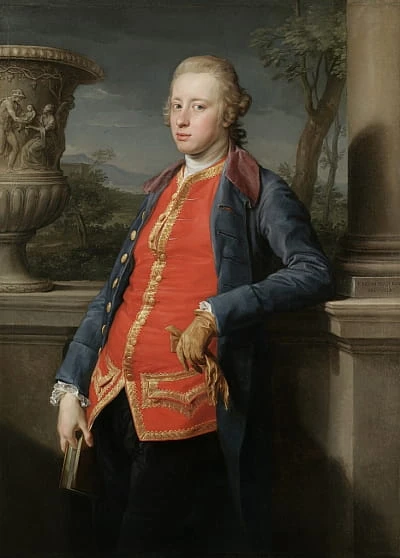
He received a private education and was involved in a tour of Italy at around twenty-one years of age, accompanied by William Fitzherbert. During this tour, they commissioned a pair of portraits painted by Pompeo Batoni.
William Cavendish held several official positions, including Lord High Treasurer of Ireland, Governor of Cork, and Lord Lieutenant of Derbyshire. Despite being invited to join the British Cabinet on three occasions, he declined each offer. In 1782, he was appointed a Knight of the Order of the Garter.
He married Lady Georgiana Spencer in 1774. Lady Georgiana was the daughter of John Spencer, 1st Earl Spencer. Together, they had one son, William Cavendish, who became the 6th Duke of Devonshire and was known as "The Bachelor Duke" due to dying unmarried in 1858. They also had two daughters: Lady Georgiana Cavendish, who became the Countess of Carlisle through her marriage to George Howard, 6th Earl of Carlisle; and Lady Harriet Cavendish, who became the Countess Granville via her marriage to Lord Granville Leveson-Gower. Both daughters left descendants, and the Clifford barony entered a state of abeyance between them.
The 5th Duke's daughter Georgiana gained prominence as a socialite and was associated with notable literary and political figures. Her portrait was painted by Thomas Gainsborough and Joshua Reynolds, with the Gainsborough portrait later becoming separated from the family and recovered after various vicissitudes.
His first wife died in 1806. He remarried Lady Elizabeth Foster, née Hervey, daughter of the 4th Earl of Bristol, in 1809. Lady Elizabeth had been his mistress and confidante for over twenty years prior to their marriage. They did not have legitimate children together but had two illegitimate children prior to marriage: a son, Augustus, who received the surname Clifford and became Sir Augustus Clifford, advancing to the rank of admiral in the Royal Navy and serving as Lord Gentleman Usher of the Black Rod in the House of Lords; and a daughter, Caroline, who took the surname St. Jules and married Hon. George Lamb, brother of the 2nd Viscount Melbourne, but had no issue.
The 5th Duke also fathered a daughter, Charlotte, with his mistress Charlotte Spencer. Charlotte was given the surname Williams and married a man named St. Jules.
In addition to his family life, the Duke was actively involved in local development. He utilized profits from his copper mines to develop the spa town of Buxton, transforming it into a replica of Bath. His developments included the construction of the Crescent Hotel and an octagonal set of stables, which later became the Devonshire Dome.
In popular culture, the 5th Duke of Devonshire was portrayed by Ralph Fiennes in the film "The Duchess," which depicts the life of his first wife, Georgiana.
He died in 1811, and his titles and estates were inherited by his son, the 6th Duke of Devonshire.