William III Of England
| Name | William III Of England |
| Title | King of England, Scotland, and Ireland from 1689 to 1702 |
| Gender | Male |
| Birthday | 1650-11-14 |
| nationality | Dutch Republic |
| Source | https://www.wikidata.org/wiki/Q129987 |
| pptrace | View Family Tree |
| LastUpdate | 2025-11-12T01:14:34.024Z |
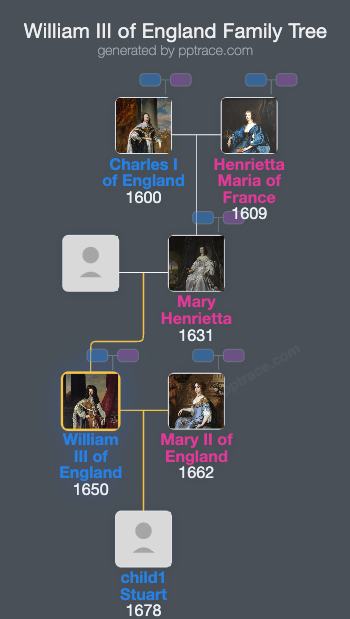
Family Tree
Tap  to expand more relatives
Introduction
William III and II (Dutch: Willem Hendrik; 4 November 1650 – 8 March 1702), also known as William of Orange, was born in The Hague in the Dutch Republic. He was the only child of William II, Prince of Orange, and Mary, Princess Royal, the eldest daughter of King Charles I of England, Scotland, and Ireland. William's father died of smallpox eight days prior to his birth, rendering him sovereign Prince of Orange from the outset. Following his father's death, a guardianship dispute arose among his mother, grandmother Amalia of Solms-Braunfels, and others concerning his upbringing. William received early education from Dutch and Scottish governesses and was instructed in the Reformed religion from age six by Calvinist preacher Cornelis Trigland.
In 1659, William commenced studies at the University of Leiden, although he was never formally enrolled. He spent several years in Delft at the Prinsenhof residence, cultivating political and military awareness. His mother, Mary, died in 1660 during a visit to King Charles II in England, after which the Dutch authorities adjusted his guardianship and education arrangements. William's upbringing was influenced by prominent figures such as Johan de Witt, who took personal charge of his political education starting in 1660.
William's early political career was marked by restrictions on his power due to tensions between republican factions and Orangist supporters. After the death of his father, the office of stadtholder was often vacant, especially during Oliver Cromwell's Interregnum. Relations between William's supporters and opponents fluctuated; in 1668, the States of Holland declared William of majority age, allowing him to manage his household and participate more actively in governance.
During the Franco-Dutch War (1672–1678), a period known as the "Disaster Year" (Rampjaar), France and its allies invaded the Dutch Republic. William was appointed stadtholder of Holland on 4 July 1672, and subsequent military campaigns saw him reconquer territories and lead significant battles in the Dutch efforts to repel French advances. In 1674, he was appointed hereditary stadtholder of Utrecht, Gelderland, and Overijssel. He led Dutch and allied forces against France in various engagements, notably at Seneffe in 1674 and during the siege of Grave. His military strategy often emphasized attrition and cutting strategic communication and supply lines.
William married his first cousin Mary, eldest daughter of King James II of England, on 4 November 1677. The marriage aimed to strengthen his political position and prospects of succeeding to English thrones, although the couple had no children. William's relationship with France remained hostile, especially after 1685 when Louis XIV revoked the Edict of Nantes. He formed alliances like the League of Augsburg in opposition to French expansionism.
In 1688, William played a central role in the Glorious Revolution, invading England at the invitation of English Protestants who opposed James II's Catholic policies. Landing at Brixham on 5 November 1688, William's arrival destabilized James's support, leading to James's flight to France. William was proclaimed king jointly with Mary II, who was crowned on 11 April 1689. Their joint reign is known historically as that of William and Mary.
William's accession established constitutional limits on royal authority through the Bill of Rights (1689), which he supported despite personal reservations. His reign in England saw the consolidation of parliamentary power and the passage of key legislation such as the Toleration Act and the Act of Settlement (1701). William also secured the support of Parliament for his foreign policies, including participation in the Nine Years' War against France.
William's rule included efforts to weaken Jacobite support; he led military campaigns in Ireland, notably defeating James II at the Battle of the Boyne in 1690, and suppressed Jacobite risings in Scotland, including the suppression following the Battle of Killiecrankie and the subsequent Glencoe massacre. He remained actively involved in European diplomacy and military affairs, striving to contain France's influence in Europe, notably during the War of the Spanish Succession.
William died on 8 March 1702, at Kensington Palace, from pneumonia after falling from his horse. His death marked the end of his reign as the only member of the House of Orange to rule over England. He was succeeded by Queen Anne. His legacy includes military reforms that strengthened the Dutch States Army, significant constitutional developments in Britain, and efforts to maintain the European balance of power against France.